

A private label jewelry supplier offers a different service from a standard wholesale supplier. The product may be based on a shared or catalog design, but it is sold under your own brand. That makes the buyer’s job more than picking styles and quantities. What matters is whether the supplier can consistently deliver brand-marked products with the packaging, labeling, and sales information your channel requires.
This guide focuses on evaluating a private label supplier from a branding and merchandising perspective. It covers what “private label” really involves, what to verify before committing, and where brand consistency most often breaks down. It does not assess workshop production capability or general supplier selection; those are separate questions.
What Private Label Actually Means
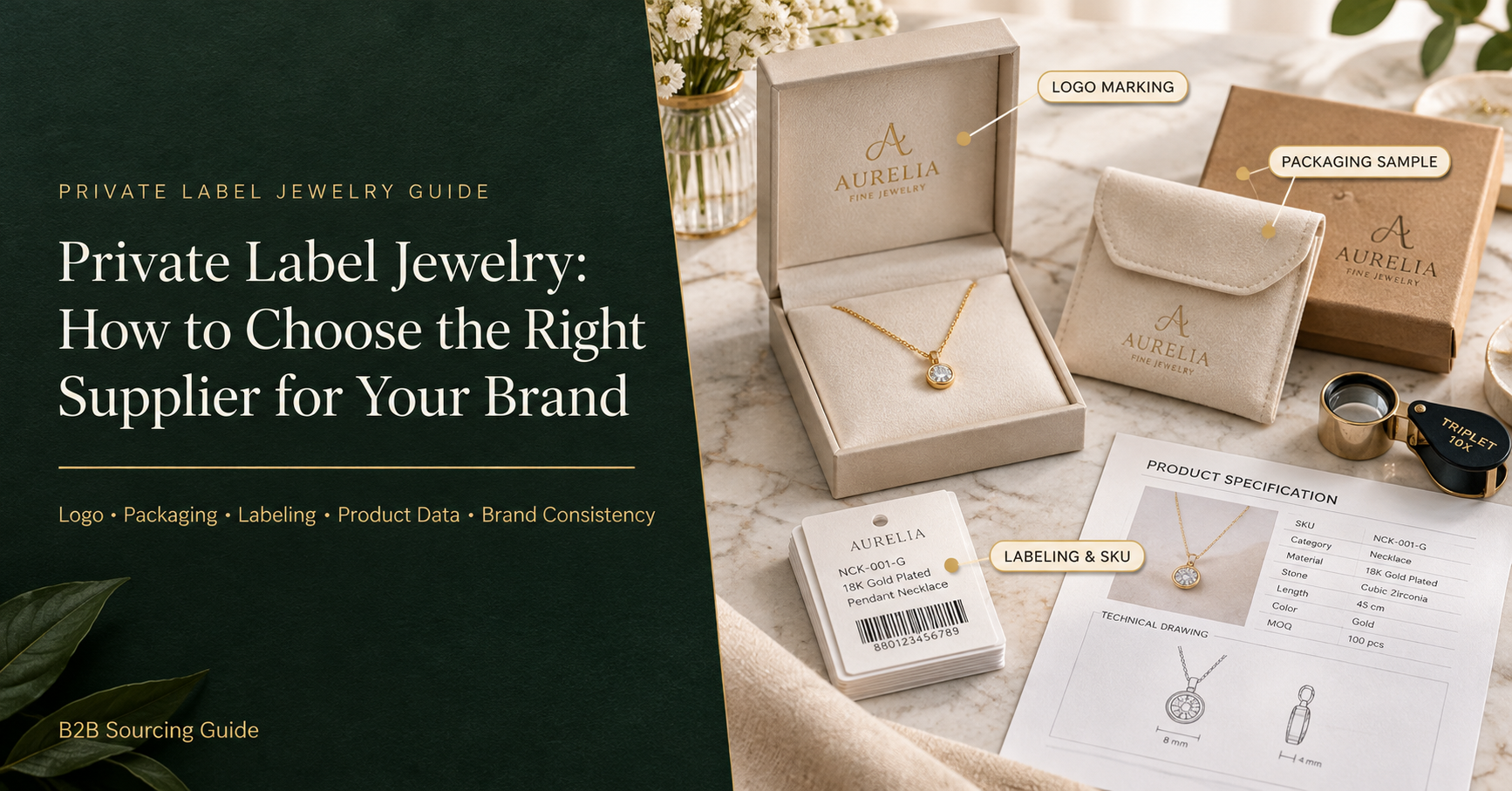
Private label is often described simply as “putting your logo on a product.” In practice, it is a coordination task across several product attributes.
A genuine private label arrangement usually involves:
- producing or preparing a product for sale under your brand
- applying your brand mark where agreed on the product
- providing packaging consistent with your brand identity
- supplying labels and product information suitable for your market and sales channel
- supplying images and product data you can use in your own listings
These elements must work together. A product with a correct logo and mismatched packaging creates a weaker brand impression than a product with consistent presentation throughout.
The useful question for buyers is: Can this supplier deliver a brand-consistent product and the supporting assets I need to sell it?
Where Private Label Differs from Standard Wholesale
Buyers who only need to resell existing products do not face the same requirements. Private label introduces brand and information duties.
This table matters because many sourcing failures in private label come from assuming standard wholesale rules still apply. Branding adds requirements that must be defined and confirmed.
Who Needs a Private Label Supplier
Private label support is most relevant to buyers who are building or maintaining a brand rather than reselling general products.
Emerging Jewelry Brands
New brands often start with private label because it allows a distinct identity without developing every product from scratch. Their priority is consistent branding and usable launch assets.
Boutique and Lifestyle Retailers
Retailers extending a store identity into jewelry often need packaging and labeling that match their existing brand. Their priority is visual coherence with the rest of their assortment.
E-commerce and Marketplace Sellers
Online sellers need clean product imagery, consistent specifications, and labeling that supports listings and reduces returns. Their priority is scalable product data and consistent appearance.
Established Brands Expanding a Range
Brands adding categories may use private label to extend product lines while protecting their design direction. Their priority is consistency with established brand standards.
Each buyer type needs different emphasis, but all depend on the same core: brand consistency across product, packaging, and information.
1. Confirm What Brand Elements Can Be Marked
The first practical question is how, where, and whether your brand mark can be applied.
Clarify:
- which surfaces can carry a logo
- the desired method of marking, and its visual result
- minimum size and legibility limits
- whether the mark placement is consistent across the product range
- how marking is checked before packing
Different products and materials may allow different marking results. A supplier should be able to explain the realistic outcome for each product rather than applying one method to everything.
A common pitfall is approving a logo without confirming how it appears on the actual product and material. A mark that looks clear on a digital mockup may look different when produced.
2. Lock Down Packaging Before Ordering
Packaging is the most visible brand touchpoint, and one of the most common sources of private label mismatch.
Before ordering, confirm:
- box or pouch style and dimensions
- material and finish of the packaging
- color accuracy against your brand reference
- how the product sits inside the package
- sticker, sleeve, or insert details
- how packaging is matched to each SKU
- how packaging is checked against the approved sample
A practical recommendation is to approve a packaging sample, not just a description. Packaging colors, finishes, and fit are difficult to judge from a document.
3. Verify Labeling and Product Information
Labels carry both branding and compliance relevance. Even where legal requirements vary by market, the supplier must be able to produce labels that match your approved content.
Confirm:
- the exact label content and placement
- how labels are applied and checked
- who is responsible for label content accuracy
- whether label information stays consistent across repeat orders
- how label changes are handled when your brand updates content
Label accuracy is a collaborative responsibility. The buyer defines the required content and market obligations; the supplier must execute consistently. Any statement about material, origin, or care should be verified against the applicable regulations for the target market before it is printed.
4. Check Whether Product Data and Images Are Usable
For online sellers, private label success depends heavily on usable product assets. This is an area where many suppliers underdeliver.
Ask what the supplier can provide, such as:
- product photos in the angle and style your site needs
- consistent image backgrounds across the range
- dimension and weight information
- material and finish descriptions
- packaging images
- updated images when a specification changes
If a supplier cannot provide consistent product data, the buyer inherits that work later, and inconsistency across a brand range becomes visible to customers.
It is worth confirming, in writing, which assets are included and what happens when products are updated. A brand range with mismatched photos or specifications looks less credible, regardless of product quality.
5. Plan SKU Structure and Brand Consistency
Private label ranges often grow over time. A supplier that can support a coherent, growing range provides more value than one that only handles isolated products.
Clarify:
- how products are organized by SKU across a range
- whether naming and reference systems stay consistent
- how a new item is added to an existing range
- whether earlier products remain available as the range expands
- how branding standards are maintained across new products
Consistency across a range is a brand issue, not a logistics detail. A range where packaging, labeling, and product appearance are inconsistent creates confusion for customers and makes marketing harder.
6. Watch for Private Label Risk Signals
Certain patterns suggest that branding support may be weaker than it appears.
Watch for:
- logo samples that cannot be shown on the actual product
- packaging approved only through mockups or descriptions
- label content handled with unclear responsibility
- product images that do not match your listing needs
- inconsistent naming across a product range
- reluctance to confirm packaging and labeling in writing
- changing brand-related specifications between conversations
None of these issues is automatically fatal, but each should prompt direct confirmation before an order is placed.
A Private Label Evaluation Checklist
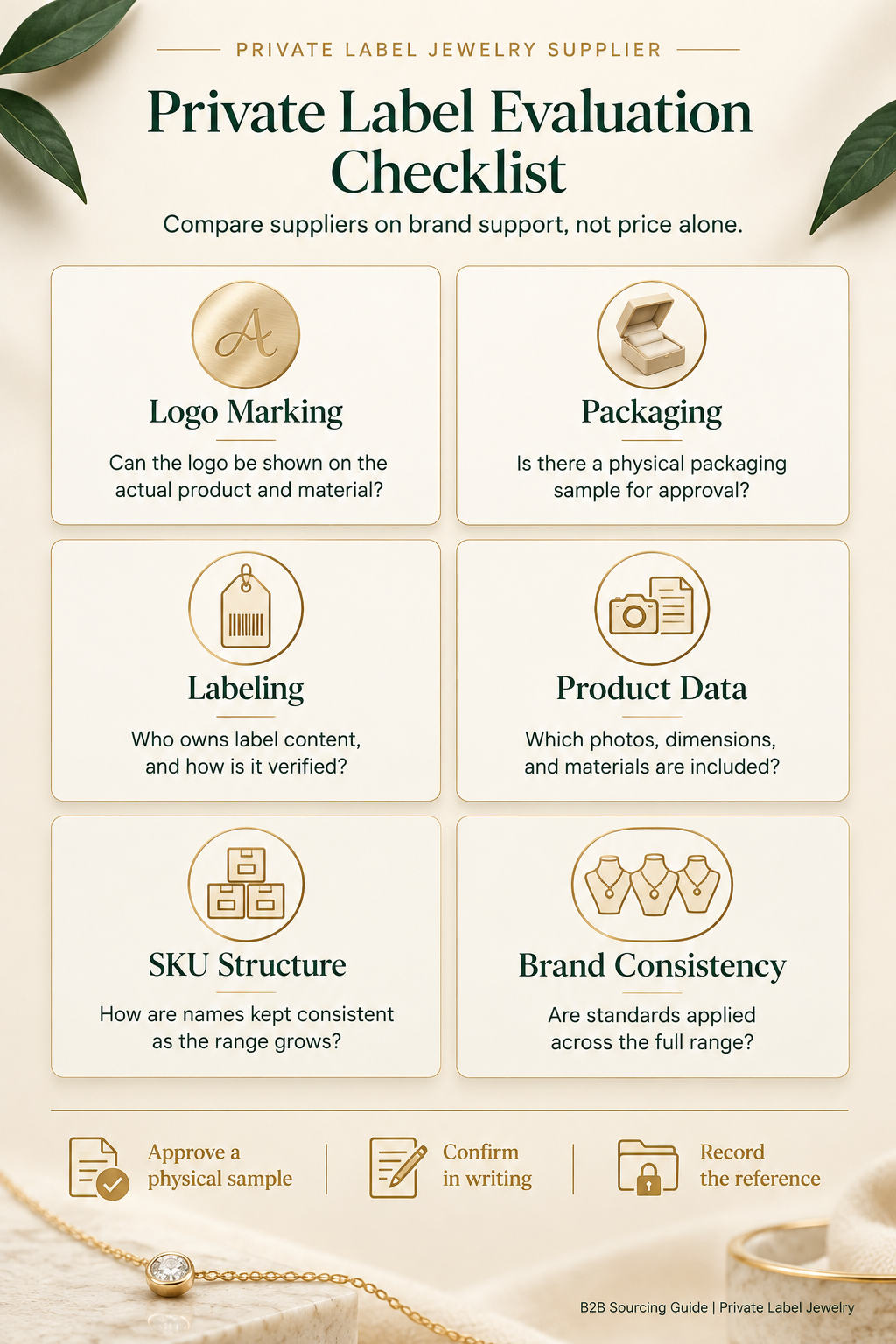
Use this checklist to compare suppliers on brand and merchandising support, not on price alone.
A supplier that handles all six areas is far more useful for a private label brand than one that only confirms logo placement.
Questions to Ask a Private Label Supplier
These questions help reveal whether the supplier understands brand-level requirements:
- Can you show the logo applied on the actual product and material?
- Can I approve a physical packaging sample before ordering?
- Who is responsible for label content, and how is it verified?
- What product images and data will I receive, and in what format?
- How do you keep naming and branding consistent as my range grows?
- How are brand-related specifications confirmed and recorded?
- What happens if a packaging or labeling detail changes after ordering?
Specific, practical answers indicate a supplier prepared to support a brand rather than only fulfilling a product order.
Conclusion
Choosing a private label jewelry supplier is a brand-support decision, not only a purchasing decision. The product matters, but so do the logo, packaging, labels, product data, and consistency across the whole range.
Focus on the elements that carry your brand: how your mark is applied, how packaging and labels are approved, what selling assets you receive, and how consistency is maintained as the range expands. Confirm each in writing and, where possible, approve a physical sample rather than a description.
If you are preparing a private label order, build a brand-specific checklist covering logo, packaging, labeling, product data, and SKU consistency. Approving these before ordering protects both your brand identity and the repeat relationship that makes growth possible.