

How to Evaluate a Jewelry Factory’s Production Capability
A jewelry factory may describe itself as a manufacturer, but that label alone does not show whether its workshop can handle your product, order volume, or production requirements. When evaluating a jewelry factory, buyers need evidence of capability—not just a catalog, a factory photo, or a general claim about production capacity.
This guide focuses on how to assess a factory’s production setup. It explains what to look for in the workshop, how to relate equipment and processes to your product, and how to check whether the factory’s stated capacity is credible. It is not a general guide to choosing a supplier; it is a practical framework for evaluating manufacturing capability.
What Does “Factory Capability” Mean?
A factory’s capability is not simply its building size or the number of machines shown in a presentation. It is the ability to carry out the processes required for a particular product and produce results that meet agreed specifications.
For a jewelry order, relevant capabilities may include:
- preparing or handling product components
- forming or casting metal parts, where applicable
- soldering and assembly
- stone setting, if the design includes stones
- polishing and surface finishing
- plating or other surface treatment, if offered
- inspection, packing, and production records
Not every jewelry factory performs every process in-house. Some operations may be handled by specialist partners. That is not automatically a problem, but buyers should understand which processes are performed on-site, which are outsourced, and who is responsible for checking the finished work.
The useful question is not, “Is this a large factory?” It is: Can this production setup reliably complete the processes my product actually requires?
Start with the Product, Not the Factory Tour
Before reviewing machinery or workshop photos, define the product you want to assess. Factory capability is product-specific: a workshop suited to simple chain assembly may not be equipped for a design with detailed stone setting or complex surface finishing.
Prepare a short product brief that includes:
- product type, such as a ring, necklace, earring, or bracelet
- base material and any specified surface finish
- approximate dimensions and weight, if known
- stone or decorative components
- construction details that affect assembly
- target quantity and expected repeat-order pattern
- any specific inspection or documentation requirements
This brief gives the factory a concrete basis for discussing capability. Without it, answers such as “We can make all kinds of jewelry” are difficult to evaluate.
1. Map the Required Processes to the Workshop
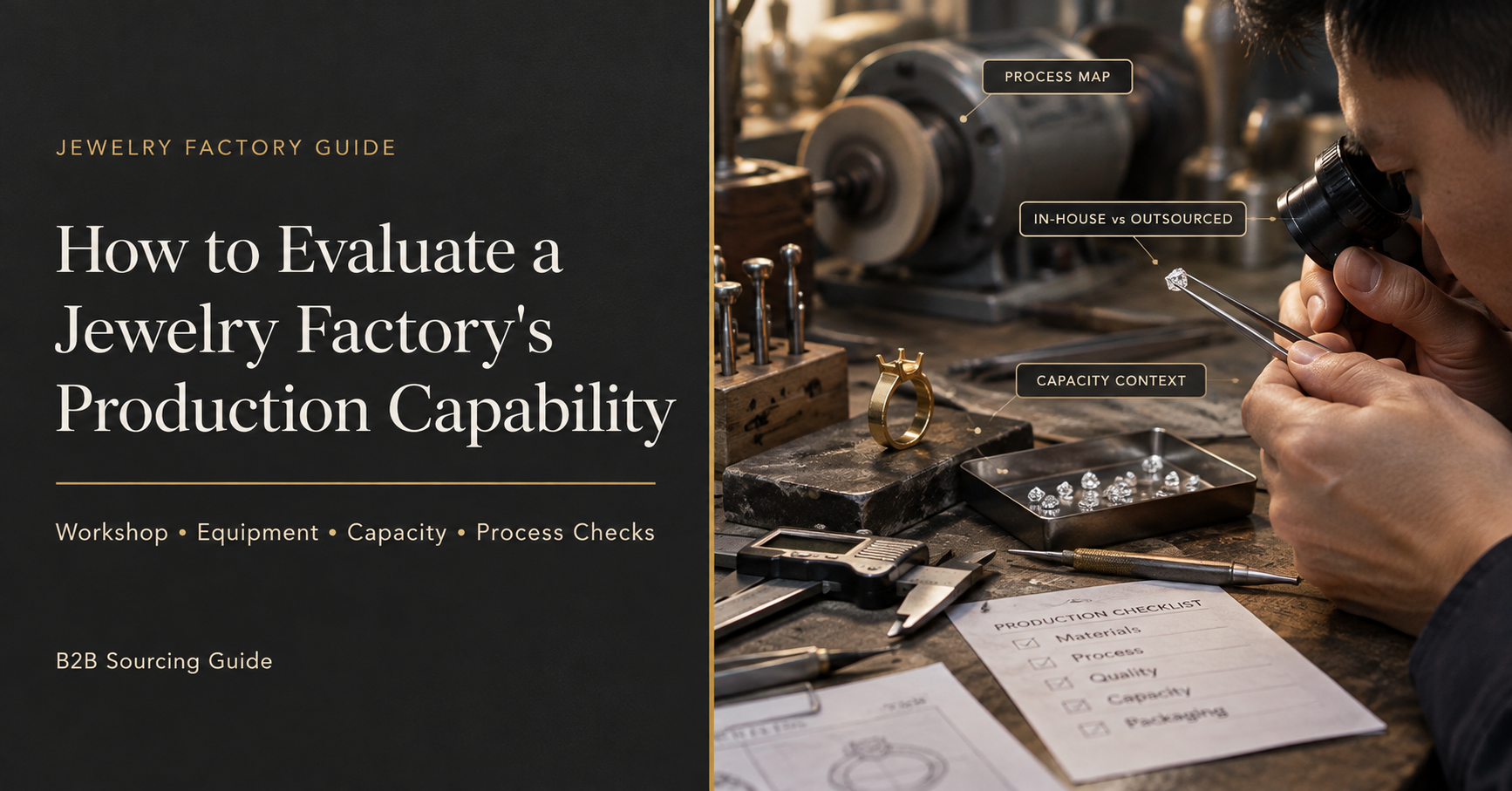
Ask the factory to explain how your product would move through its production setup. The goal is to understand the process map, not to request a broad presentation of every machine in the building.
For each important step, ask:
- What operation is performed?
- Is it done in-house or by an external partner?
- Which team or production area is responsible?
- How is the output checked before it moves to the next step?
- What product detail or specification could affect this operation?
For example, if your design includes a stone, ask how the stone-setting step is handled and how the finished setting is checked. If the product requires a particular surface appearance, ask who performs the finishing and what reference is used to judge the result.
A clear process map is more useful than a long equipment list because it connects the factory’s resources to your product’s actual requirements.
2. Check Whether the Equipment Fits the Work
Equipment should be evaluated by function, condition, and relevance to the order. The presence of a machine does not prove that the factory uses it effectively or that it is suitable for your product.
During a factory review—on-site or by live video—look for:
- whether the equipment shown is located in an active production area
- whether operators can explain what it is used for
- whether the machine is appropriate for the process under discussion
- whether tools and workstations appear organized for the task
- whether the factory can show a relevant workpiece or process example
Avoid drawing conclusions from a single photo. A staged image may show equipment without proving that the factory operates it, maintains it, or uses it for the relevant product category.
Ask for a demonstration tied to your product or a comparable item. A useful demonstration shows the relationship between the process, the product feature, and the inspection point.
3. Verify Process Experience with Comparable Products
A factory may have general jewelry experience but limited experience with a particular product structure or finish. Request examples that are comparable in construction and process, not merely similar in appearance.
When reviewing examples, check:
- whether the material is comparable
- whether the design uses similar assembly or setting methods
- whether the surface finish is relevant
- whether the size and structural details are comparable
- whether the example is a sample, a production item, or a finished order
A comparable example helps assess technical fit, but it does not guarantee that a new product will perform identically. The new design still needs its own specifications and approval process.
4. Understand How the Factory Measures Capacity
Production capacity is often presented as a single number, such as units per day or per month. That number may be misleading if it is not tied to product complexity, available labor, current workload, and the scope of processes included.
Ask the factory to clarify:
- which product or operation the capacity figure refers to
- whether the figure describes one process or the complete finished product
- what assumptions were used, such as shift length or working days
- whether the number represents theoretical maximum output or typical output
- how capacity changes for different designs or finishes
- whether the factory can provide a production plan for your order
A credible capacity discussion includes context. For instance, a simple item and a labor-intensive design should not be assumed to have the same output rate.
It can also help to request a capacity estimate for a defined order scenario: a specific product, quantity, specification, and target schedule. This turns a general claim into something the buyer can evaluate.
5. Look for Quality Checks at Relevant Production Stages
This article is not a general quality-control manual. The purpose here is to determine whether the factory has inspection points connected to the processes that affect your product.
Ask the factory to identify:
- what is checked after the key production steps
- who performs each check
- what reference is used, such as a drawing, approved sample, or specification
- how defects or deviations are recorded
- how nonconforming pieces are separated from acceptable items
Inspection should be connected to the product. A visual check alone may not answer every question. Depending on the item, buyers may also need agreed measurements, functional checks, or documentation.
Before production, make sure that the parties agree on the reference for acceptance. A written specification or approved sample is more useful than an informal description such as “same as the photo.”
6. Use a Focused Factory Review
A factory review should verify a defined set of claims rather than collect generic photos. If you cannot visit in person, ask for a live video walkthrough or a set of current, contextualized records. These are evidence to evaluate, not substitutes for independent verification.
A factory that gives specific, consistent answers is easier to assess than one that relies on broad claims. If the answer is “we do everything in-house,” ask which exact steps that includes and how they are documented.
7. Separate Factory Evidence from Marketing Claims
Marketing materials can help introduce a factory, but they should not be treated as proof on their own. Review claims in context and ask what evidence would confirm them.
The aim is not to assume a claim is false. It is to make the claim specific enough to support a purchasing decision.
Factory vs. Supplier: Keep the Evaluation Question Separate
A supplier evaluation asks whether a business partner can support your purchasing needs through communication, order terms, delivery coordination, and ongoing supply.
A factory evaluation asks whether the production setup can make the required product. These questions overlap, but they are not the same.
A business may be both a supplier and a factory, but buyers should still assess each role separately.
Common Warning Signs During a Factory Evaluation
One concern does not necessarily disqualify a factory. However, inconsistent or evasive answers should prompt further verification.
Pay attention if the factory:
- cannot explain how your product moves through its processes
- shows equipment but cannot connect it to your product
- provides capacity figures without assumptions or product context
- cannot distinguish in-house work from outsourced operations
- presents examples that are not comparable to your design
- describes quality checks only in general terms
- changes key explanations between conversations
A practical next step is to request clarification in writing and compare the answer with the factory’s other materials. If a critical capability remains unclear, do not rely on a verbal assurance alone.
A Practical Checklist Before You Shortlist a Jewelry Factory
Use this checklist to keep the review focused:
- Have I defined the product’s key materials, structure, and finish?
- Has the factory mapped the relevant processes?
- Do I know which operations are completed in-house?
- Have I seen evidence of comparable work?
- Is the equipment relevant to the processes required?
- Is stated capacity tied to my product and order scenario?
- Are the production-stage checks clear?
- Do I know how external processes are managed?
- Are the factory’s explanations consistent across documents and discussions?
If several answers remain unclear, the next step is not to guess. Ask for product-specific evidence or narrow the project scope until the factory can demonstrate fit.
Conclusion
Evaluating a jewelry factory means verifying whether its production setup matches the product—not simply judging its size, photos, or marketing claims. Start with the required processes, map them to the workshop, review relevant equipment and comparable work, and ask for a capacity estimate tied to a defined order scenario.
Keep the factory assessment separate from the broader supplier decision. That distinction helps buyers ask better questions and avoid confusing production capability with commercial suitability.
If you are reviewing a factory for a specific jewelry item, prepare a product brief and ask the factory to explain the relevant process map, in-house operations, capacity assumptions, and inspection points. Those details provide a more useful basis for evaluation than general claims alone.