

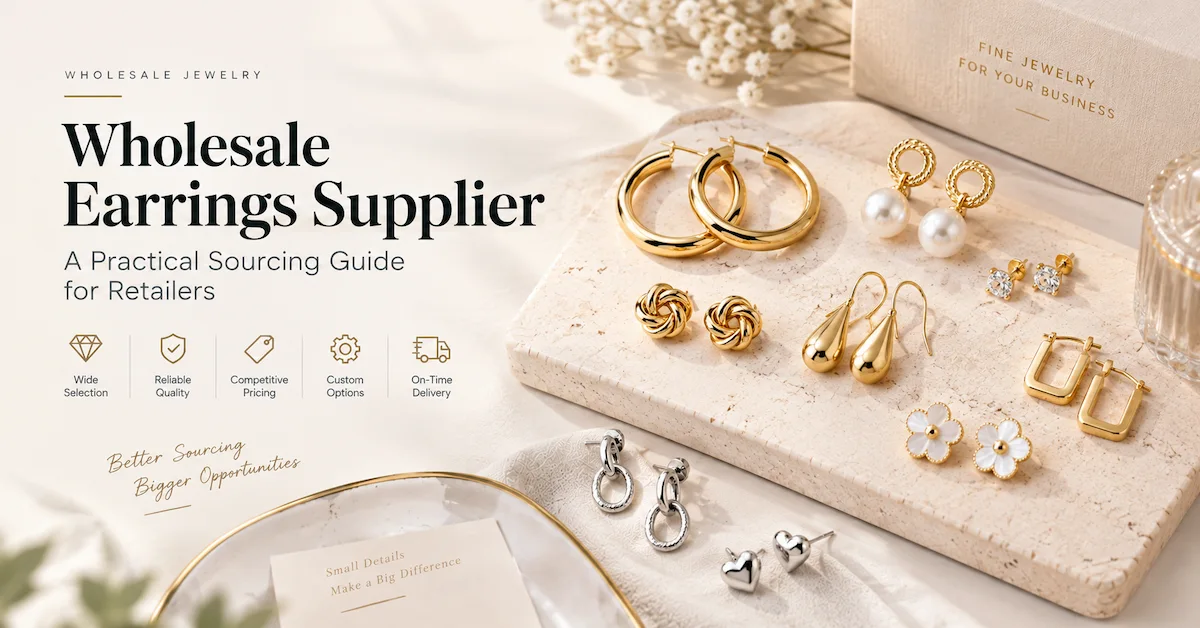
Finding a wholesale earrings supplier is easy. Finding one that can consistently deliver attractive designs, reliable finishing, comfortable construction, accurate pair matching, and stable replenishment is much harder.
For retailers, earrings are a special jewelry category because customers evaluate more than appearance. They notice weight, balance, clasp security, ear comfort, plating quality, symmetry, and even how the earrings are packaged.
That means choosing an earring supplier should be based on more than catalog size or unit price. The better approach is to evaluate the supplier through the specific requirements of earring production and retail performance.
What Makes Earring Sourcing Different?
Earrings are small products, but they contain several details that can create quality problems.
A necklace may still look acceptable if a chain link has a minor variation. With earrings, the two pieces are expected to form a visually consistent pair. A small difference in length, color, stone position, or surface finish can be immediately noticeable.
For retailers, the key sourcing variables include:
- Pair symmetry and dimensional consistency
- Earring weight and wearing comfort
- Ear post or hook construction
- Backing and clasp security
- Plating thickness and surface finish
- Stone or enamel placement
- Material compatibility with the intended market
- Packaging and pair protection
- SKU consistency during repeat orders
This is why an experienced wholesale earrings supplier should understand the commercial requirements of earrings rather than simply offering a large jewelry catalog.
Build Your Earring Collection by Product Role
Instead of selecting earrings one by one, retailers can build a more balanced assortment by assigning different roles to different styles.
| Earring Type | Retail Role | Typical Customer Need |
|---|---|---|
| Stud earrings | Entry-price products | Everyday wear |
| Hoop earrings | Core volume styles | Versatile fashion |
| Drop earrings | Statement products | Events and occasions |
| Dangle earrings | Trend-driven styles | Fashion customers |
| Huggie earrings | Repeat-purchase products | Comfortable daily wear |
| Pearl earrings | Classic styles | Gift and occasion buying |
| Geometric earrings | Fashion-forward SKUs | Trend-conscious shoppers |
| Personalized earrings | Differentiation | Gift and custom markets |
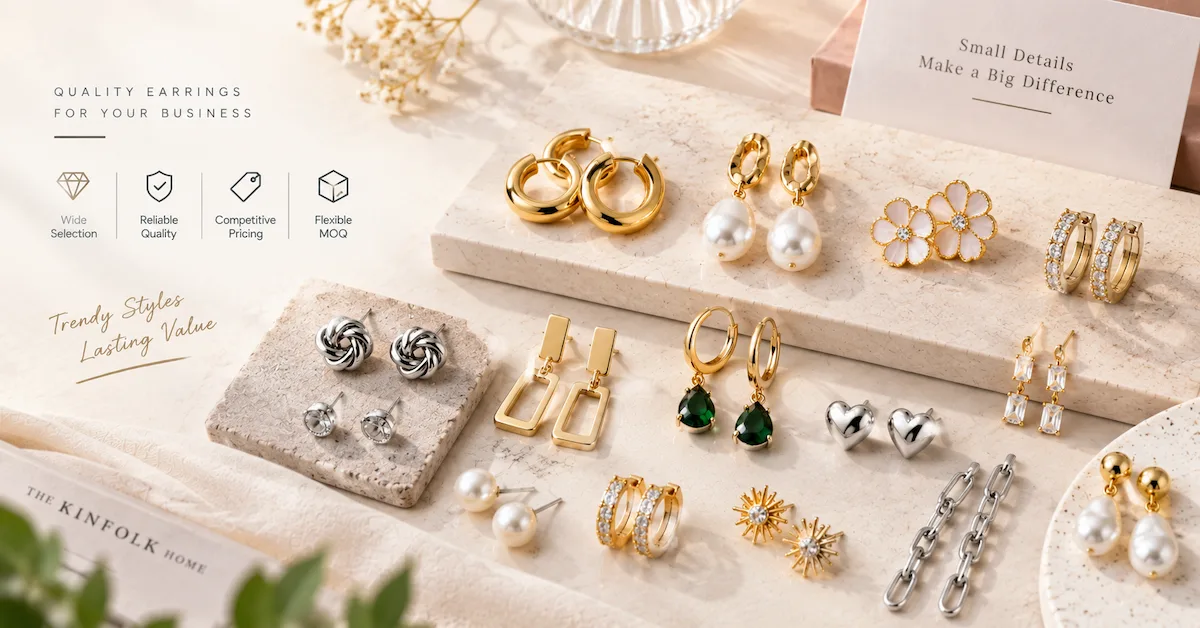
A strong supplier should give retailers enough product depth to build these different roles without forcing them to source every style from a different factory.
This can make assortment management easier, especially when a retailer needs multiple materials, finishes, colors, and price points.
The Most Important Earring Quality Checks
Product photos can tell you whether an earring looks attractive. They cannot tell you whether it will perform well after repeated handling and wearing.
Before placing a larger order, pay attention to several product-specific details.
1. Pair Consistency
The left and right earrings should match in:
- Size
- Shape
- Weight
- Color
- Plating tone
- Stone position
- Surface finish
For earrings with irregular or handmade characteristics, some variation may be acceptable. However, the supplier should still have a clear tolerance standard.
2. Ear Post and Closure Quality
The ear post, hook, lever-back, screw-back, or other closure is a functional component, not just a design detail.
Check whether the post is properly aligned and securely attached. For hinged or locking designs, test whether the mechanism opens and closes smoothly without becoming loose.
A beautiful earring with an unreliable closure can quickly become a customer-service problem.
3. Weight and Balance
Large earrings are especially sensitive to weight distribution.
A supplier should consider where the weight is concentrated and how the earring hangs when worn. Poor balance can make a product uncomfortable even when the total weight does not appear excessive.
For commercial collections, it is useful to request actual product weight rather than relying on general descriptions.
4. Surface and Plating
Gold-plated, PVD, silver-colored, enamel, and polished finishes can create very different visual and durability characteristics.
The important point is consistency.
A supplier should be able to maintain the same appearance across repeated production runs and communicate the material and finishing process clearly.
For example, Lonceen currently lists stainless steel earrings with options such as 18K gold plating and OEM/ODM support, while its broader wholesale platform states that many products use PVD coating technology.
Which Materials Should Retailers Consider?
Material selection should follow product positioning rather than simply choosing the cheapest option.
| Material | Suitable Positioning | Main Advantage |
|---|---|---|
| Stainless steel | Fashion and everyday jewelry | Durability and cost efficiency |
| 316L stainless steel | Higher-spec everyday styles | Corrosion resistance and premium positioning |
| 925 sterling silver | Fine and premium collections | Higher perceived value |
| Copper / alloy | Fashion-focused collections | Design flexibility |
| Gold-plated materials | Fashion and gift products | Premium visual appearance |
| Pearl combinations | Classic and occasion collections | Timeless appeal |
For retailers, the important question is not simply “Which material is best?”
A better question is:
Which material provides the right balance between retail price, appearance, durability, customer expectations, and target market?
That decision can significantly influence return rates and repeat purchasing.
Match the Supplier to Your Earring Business Model
Different buyers need different supplier capabilities.
For Independent Retailers
The priority is usually flexible purchasing, broad style selection, manageable inventory risk, and fast testing of new designs.
A supplier offering lower or flexible MOQ can make it easier to test several earring styles before committing to larger quantities.
For Established Jewelry Stores
Consistency becomes more important.
Retailers with established best sellers need suppliers that can reproduce the same SKU accurately and maintain stable quality across repeat orders.
For Online Jewelry Stores
Product variety and visual differentiation are especially important.
Online sellers often need new styles for social media, seasonal campaigns, and short product cycles. A supplier with frequent new-product development can therefore be valuable.
For Jewelry Brands
Brands usually require deeper customization.
Logo details, custom shapes, branded packaging, specific materials, plating colors, and private-label requirements may become more important than simply purchasing ready-made products.
What Should You Ask a Wholesale Earrings Supplier?
Before comparing quotations, create a standardized supplier checklist.
| Question | Why It Matters |
|---|---|
| What materials are available? | Determines product positioning |
| What is the MOQ per SKU? | Controls inventory risk |
| Can samples be ordered first? | Allows quality verification |
| How are pairs inspected? | Reduces mismatch problems |
| What plating process is used? | Helps evaluate finish durability |
| Can designs be customized? | Supports brand differentiation |
| Can packaging be customized? | Helps create a branded experience |
| What is the repeat-order process? | Important for best-selling SKUs |
| What is the normal production lead time? | Supports inventory planning |
| How are quality issues handled? | Reduces post-sale risk |
A supplier that answers these questions clearly is usually easier to work with than one that focuses only on price.
Sample Testing Should Come Before Bulk Ordering
For earrings, samples are particularly useful because several problems cannot be identified from photographs.
A practical sample inspection can include five stages:
Stage 1 — Visual inspection
Check color, symmetry, surface finish, stone placement, and overall appearance.
Stage 2 — Construction inspection
Examine posts, hooks, clasps, hinges, soldered points, and connection areas.
Stage 3 — Wear test
Check weight, balance, closure comfort, and whether the product feels secure during normal movement.
Stage 4 — Pair comparison
Compare both earrings side by side under the same lighting.
Stage 5 — Packaging test
Check whether the packaging prevents scratching, tangling, deformation, or loss of small components during transportation.
This process gives retailers much more useful information than simply comparing product photos.
MOQ and Pricing: Look Beyond the Unit Cost
The cheapest quotation is not always the cheapest sourcing option.
Suppose Supplier A offers a lower unit price but requires a large MOQ, while Supplier B offers a slightly higher unit price with flexible quantities.
For a new earring collection, Supplier B may produce a lower total inventory risk.
A simple commercial calculation should consider:
Total sourcing cost = Product cost + Shipping + Packaging + Sampling + Inventory risk + Quality-related losses
For earrings, quality-related losses can include mismatched pairs, damaged stones, loose components, plating inconsistencies, and customer returns.
Therefore, retailers should compare the total cost of ownership, not only the quoted unit price.
Replenishment Is a Different Requirement From First-Order Supply
A supplier may be capable of producing an attractive first order but still fail to support long-term retail growth.
For best-selling earrings, ask:
- Can the same SKU be reordered?
- Will the material specification remain unchanged?
- Can the supplier reproduce the same plating color?
- Is the original mold or tooling retained?
- Can packaging remain consistent?
- How quickly can repeat orders enter production?
- Can popular styles be reserved or restocked efficiently?
These questions become increasingly important as a retailer moves from product testing to stable sales.
The goal is to create a supplier relationship that supports the entire product lifecycle, from first sample to repeat replenishment.
When OEM/ODM Makes Sense
Ready-to-ship wholesale earrings are useful when you want to test demand quickly.
OEM/ODM becomes more valuable when you need something that competitors cannot easily copy.
Common customization options include:
- Custom shapes
- Logo engraving
- Custom charms
- Brand colors
- Custom stones or enamel
- Plating variations
- Private-label packaging
- Custom earring cards
- Original product development
A capable factory should have a defined process from design communication through sampling, engineering, production, assembly, and delivery.
Lonceen's factory describes an OEM process covering communication, sample design, engineering proofing, sample confirmation, production, assembly and delivery. It also states that its production network includes 16 factories and a monthly output exceeding 5 million pieces.
For brands planning original earring collections, this type of manufacturing infrastructure can reduce the number of separate suppliers involved in product development.
Why Lonceen Can Be Considered for Wholesale Earrings
Lonceen operates both a wholesale jewelry platform and a manufacturing operation.
Its wholesale platform offers a large catalog, factory-direct supply, no-MOQ purchasing, and multiple jewelry categories. It also states that its products include materials such as 304 stainless steel, 925 silver, 316L stainless steel, and alloy metals, with a two-step quality inspection process.
Its factory operation specifically includes earrings alongside rings, necklaces, bracelets, and pendants, and supports OEM/ODM production.
For buyers who want to inspect actual earring products, Lonceen also maintains a dedicated earring product range covering stainless steel, sterling silver, hoops, studs, drops, pearl styles, and other fashion designs.
You can explore the current Lonceen wholesale jewelry collection or review its earring product range before requesting samples or discussing a larger sourcing program.
Wholesale Earrings Supplier Checklist
Before choosing a supplier, make sure you can answer “yes” to most of these questions:
- Does the supplier offer the earring styles your customers actually need?
- Can it maintain consistent pair quality?
- Are material specifications clearly stated?
- Can you test samples before placing bulk orders?
- Are MOQ and pricing suitable for your business size?
- Can popular SKUs be replenished?
- Does the supplier support customization when required?
- Can packaging be adapted to your brand?
- Is there a clear quality-control process?
- Can the supplier support your business as order volume grows?
If several answers are unclear, the supplier may create more operational work than the initial price suggests.
Final Thoughts
The right wholesale earrings supplier should be evaluated as a product and supply partner, not simply as a source of low-cost jewelry.
For earrings, the most important factors are often hidden inside the product: pair consistency, closure construction, weight, balance, material, finishing, packaging, and repeat-order stability.
Retailers that evaluate these details before placing bulk orders can build a more reliable earring assortment while reducing quality problems and unnecessary inventory risk.
For businesses that need ready-to-sell products, flexible wholesale purchasing, or customized earring development, a supplier with both product depth and manufacturing capability can provide a stronger long-term sourcing foundation.
FAQ
1. What should I look for in a wholesale earrings supplier?
Look for consistent quality, suitable materials, flexible MOQ, reliable samples, stable pricing, repeat-order capability, and clear quality-control procedures.
2. What types of earrings are popular for wholesale?
Studs, hoops, huggies, drop earrings, pearl earrings, geometric designs, and trend-focused statement styles are common categories for retail collections.
3. What is a good MOQ for wholesale earrings?
There is no universal MOQ. New retailers generally benefit from flexible quantities that allow them to test multiple SKUs before committing to larger inventory.
4. Should I choose stainless steel or sterling silver earrings?
Stainless steel is often suitable for durable fashion collections and competitive price points, while 925 sterling silver can support a more premium product position.
5. Can wholesale earrings be customized?
Yes. Depending on the supplier, customization may include shapes, logos, materials, plating, stones, enamel, packaging, and private-label components.
6. How can I check earring quality before ordering?
Order samples and inspect pair symmetry, weight, closure mechanisms, surface finish, material, stone setting, comfort, and packaging.
7. Why is pair consistency important for earrings?
Customers can immediately notice differences between the left and right earrings. Consistent size, color, weight, shape, and finishing are therefore important quality indicators.
8. How do I compare wholesale earring suppliers?
Compare product quality, MOQ, material options, sample policy, production capability, customization, replenishment, shipping, and after-sales support instead of comparing unit price alone.
9. Can a wholesale earrings supplier also handle OEM/ODM?
Many manufacturers can. If customization is important, confirm their design, prototyping, sampling, production, and packaging capabilities before placing an order.
10. Where can I find wholesale earrings for retail?
Retailers can compare dedicated jewelry wholesalers, manufacturers, and factory-direct platforms. The best option depends on product requirements, MOQ, customization needs, and expected order volume.