

A gold jewelry manufacturer works with a metal whose value is both material and symbolic. Gold carries a live market price, a purity standard that must be declared accurately, and a color that depends on alloy composition rather than on the gold alone. It is also the category where the single most consequential sourcing error is made: confusing solid gold with gold-plated or gold-filled items, and describing them loosely.
This guide focuses on the metal itself: how karat and fineness should be confirmed, why alloy composition determines color and working properties, how to distinguish solid gold from plated and gold-filled, how gold-price-based pricing works, and what to check in soldering, finishing, and repairability. It does not cover supplier screening, fulfillment, or brand packaging; those belong to other sourcing discussions.
What Makes Gold Different
Gold behaves unlike silver, steel, or tungsten in ways that shape every sourcing decision.
- it carries a live market price that changes daily
- purity is expressed in karats, and each karat has a different gold content
- its color comes from alloying metals, not from the gold itself
- it is soft in pure form, so it is almost always alloyed for jewelry
- it can be melted down and re-refined, which gives it residual value
- the gap between solid gold and gold-plated is enormous, yet the two are easily confused in copy
These traits mean gold sourcing is above all a question of accurate declaration. A piece may look identical to another while containing a fraction of the gold. Getting the classification right is the foundation of everything else.
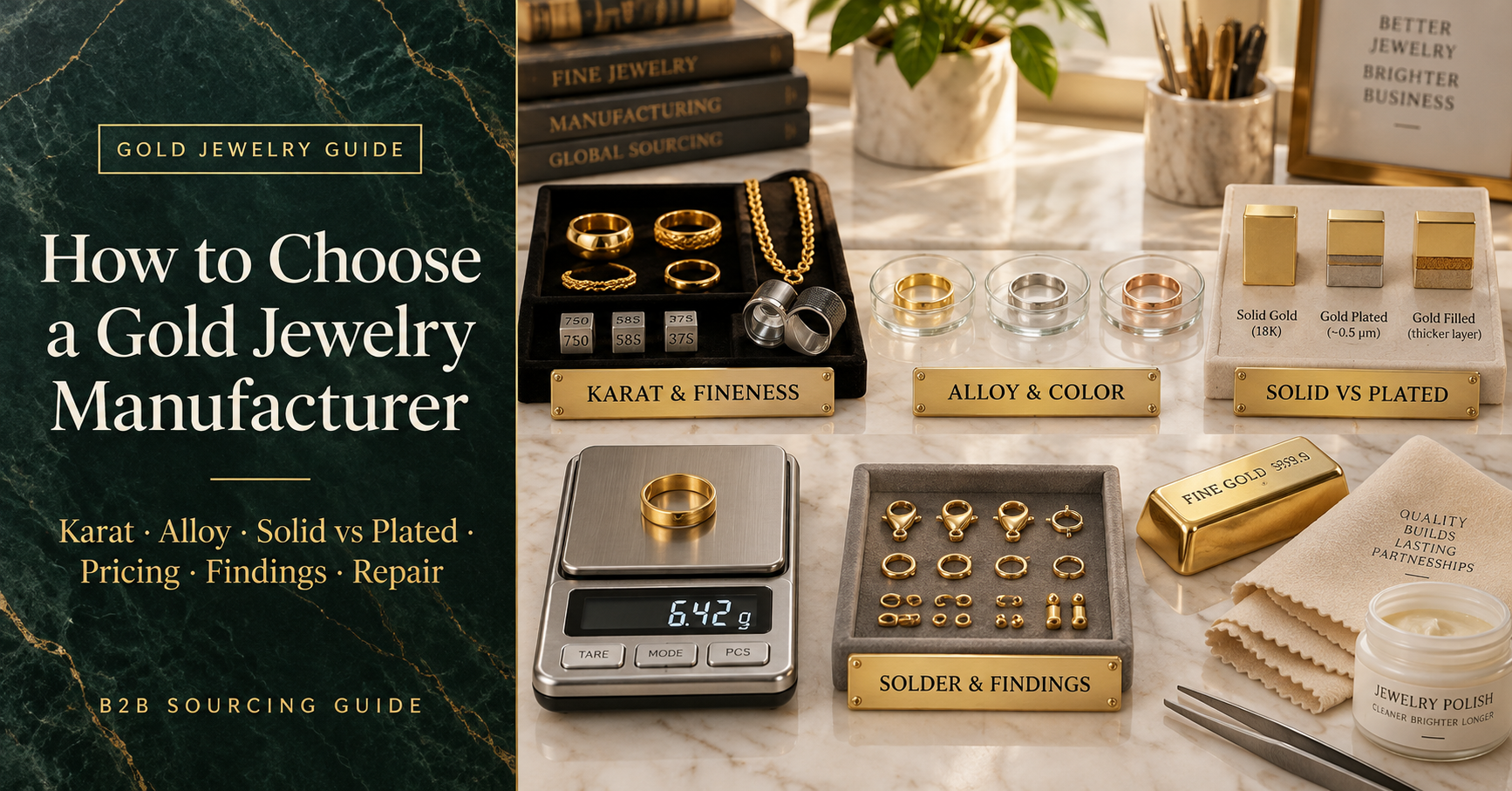
1. Confirm Karat and Fineness, With Marking
Purity is the core of every gold claim, and it must be precise.
Establish:
- which karat the item is—24K, 18K, 14K, 10K, or another standard
- the corresponding fineness (for example, 18K is 750 parts per thousand)
- how the karat is marked or stamped on the item
- what marking is legally required in your destination market
- whether the stated karat matches what is actually produced
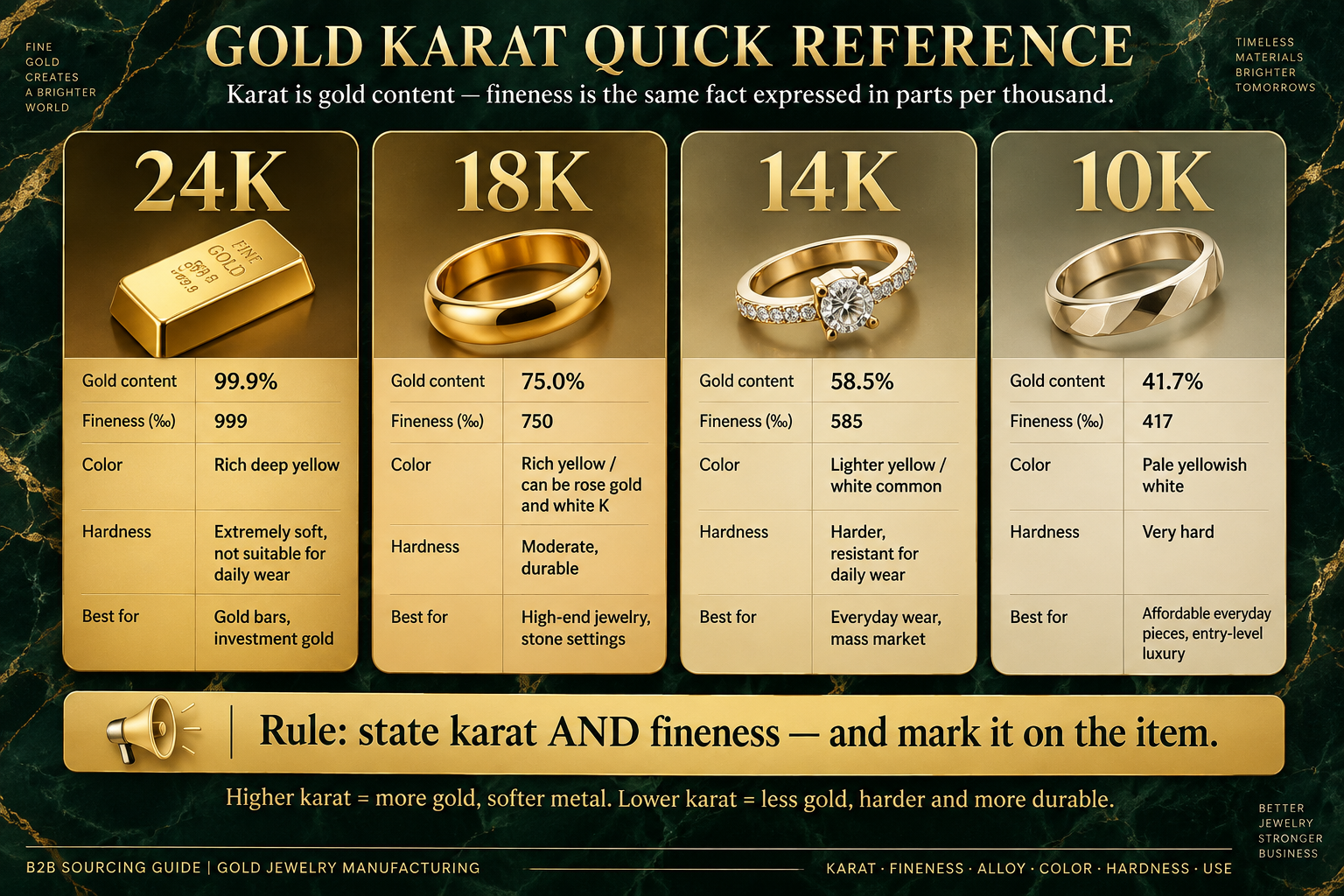
Karat marking rules and tolerance allowances differ by market, and some destinations require specific stamps or assay. A manufacturer that can state karat and fineness clearly, and mark consistently, is far easier to hold to account than one that says only "real gold."
2. Understand Alloy Composition and Color
Gold's color is a product of its alloy, and the alloy also affects hardness, workability, and skin contact.
Clarify:
- what metals are alloyed with the gold to achieve the color
- how yellow, white, and rose gold are produced in their range
- whether white gold is rhodium-plated, and how that plating wears
- what the alloy means for hardness and durability
- whether nickel or other sensitizing metals are present
White gold, for example, is usually alloyed with white metals and then rhodium-plated for brightness; the plating wears and needs re-plating. Rose gold depends on copper content. Yellow gold depends on silver and copper ratios. The color name alone tells you nothing about composition, so the alloy should be specified.
3. Separate Solid Gold from Plated and Gold-Filled
This is the most important distinction in the entire category, and the one most often blurred in product copy.
Confirm clearly:
- whether the item is solid gold throughout, gold-plated, or gold-filled
- what the base metal is, if the item is plated or filled
- how thick the gold layer is, and by what process it is applied
- how the item is described in listings and on the item itself
- whether any "gold" wording could mislead a buyer about gold content
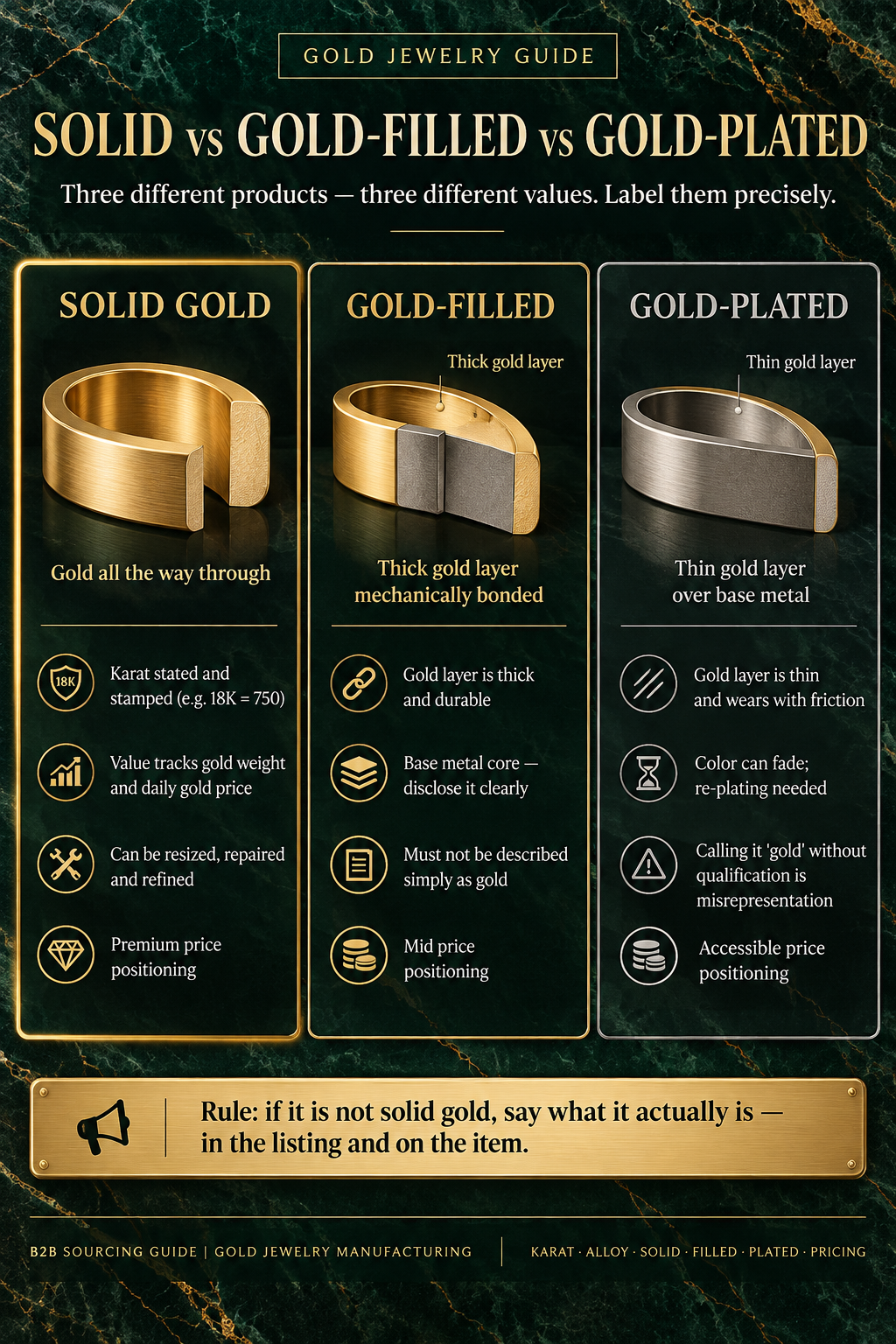
Solid gold, gold-plated, and gold-filled are three different products with different values, durability, and legal descriptions. In many markets, calling a plated item "gold" without qualification is a regulated misrepresentation. Any gold-related claim must be checked against the labeling rules of each destination market before publication.
4. Understand Gold-Price-Based Pricing
Gold pricing works differently from other materials because the raw metal has a daily market value.
Ask:
- whether pricing is based on gold weight plus labor, or a flat piece price
- what gold price the quote is based on, and when it was set
- how the manufacturer handles gold price movement between quote and delivery
- what the expected weight of the item is
- how price changes would be communicated on repeat orders
Two quotes can look similar while resting on very different weight assumptions, karat, or gold-price bases. A manufacturer that explains its pricing structure is easier to compare and far less likely to surprise you when the gold price moves.
5. Check Solder and Component Quality
On gold jewelry, solder and small components are frequent weak points, and they also affect the declared karat.
Confirm:
- what solder is used, and whether it matches the karat of the piece
- how joints are finished and checked
- what findings and clasps are used, and at what karat
- whether components are the same standard as the main body
- how finished pieces are checked for security and strength
Lower-karat solder or findings on a higher-karat body can affect both durability and the accuracy of the karat claim. This is a detail worth specifying explicitly.
6. Confirm Weight and Its Relationship to Price
Because gold is priced partly by weight, weight consistency is both a quality and a financial issue.
Establish:
- the expected weight range for the item
- whether weight is consistent between pieces and between orders
- how hollow or lightweight construction is handled, if used
- whether the weight supports the stated karat and price
- how the manufacturer controls weight in production
An item that is lighter than expected may still be the stated karat, but the customer is paying for less gold. Weight consistency protects both your margin and your credibility.
7. Value the Recyclability and Repairability of Gold
Gold has a property no other jewelry material shares to the same degree: it can be melted down and re-refined, and it can be repaired, resized, and re-plated almost indefinitely.
Consider:
- whether the manufacturer offers resizing, repair, and re-plating services
- how re-polishing and restoration are handled
- whether scrap or returns can be refined and credited
- how you would present gold's lasting value to customers
- what the cost and turnaround of restoration would be
This recyclability is a genuine differentiator against plated or alternative materials, and it supports a higher price positioning. It is worth building into your service model and your messaging.
8. Watch for Gold-Specific Risk Signals
Some concerns are particular to gold.
Watch for:
- karat claims without marking or documentation
- vague alloy descriptions that do not explain color or composition
- plated or gold-filled items described loosely as "gold"
- white gold sold without disclosing rhodium plating
- pricing that ignores gold weight or market price
- findings or solder at a lower karat than the body
- weight noticeably below what the price implies
Each of these signals deserves direct clarification before an order is placed.
A Gold Jewelry Manufacturer Evaluation Checklist
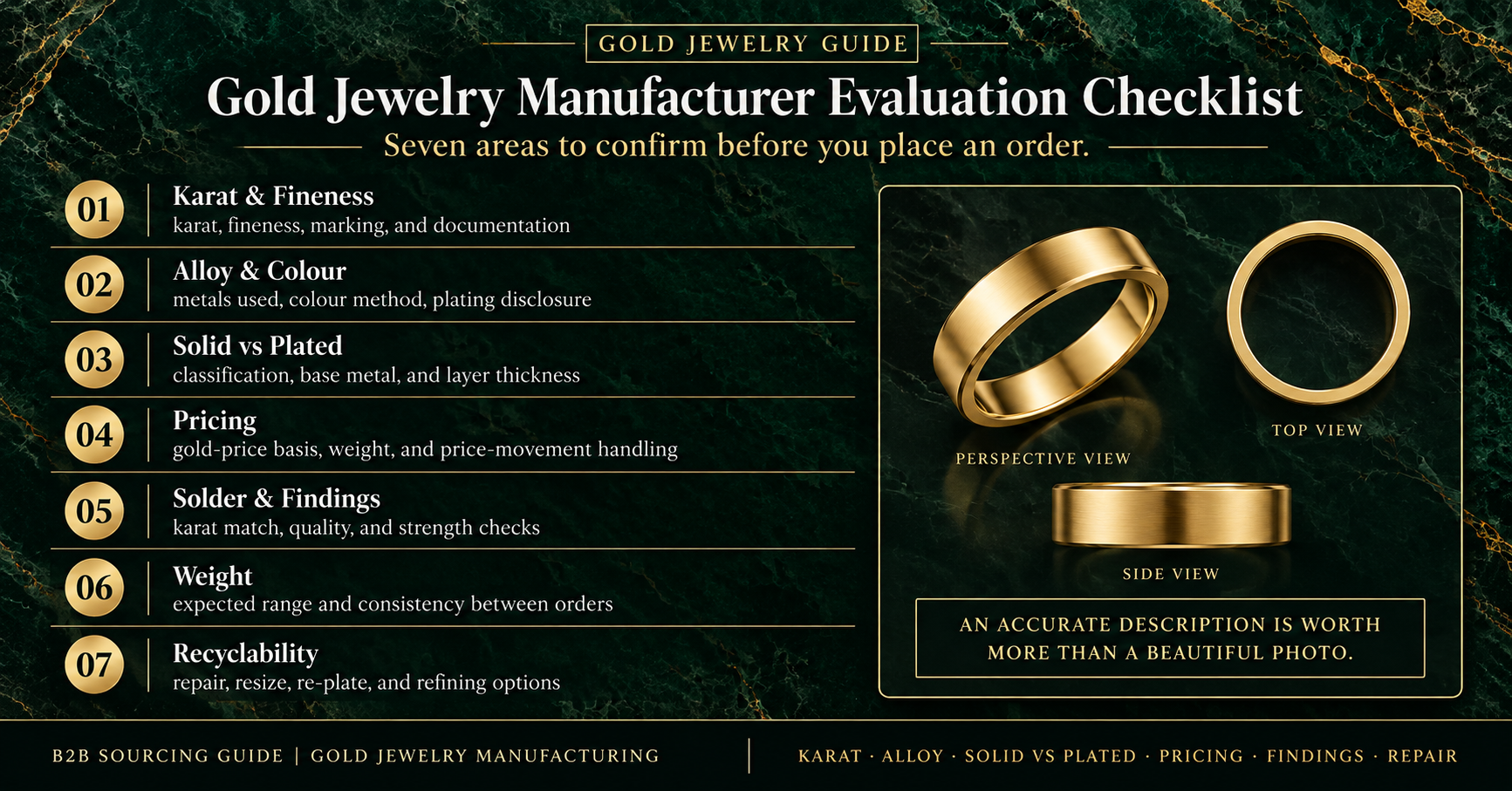
Use this to compare manufacturers on declared purity, honest classification, and pricing transparency.
A manufacturer that addresses all seven gives you a far more dependable basis for a gold range than one that only shows a polished sample.
Questions Worth Asking a Gold Jewelry Manufacturer
- What karat is this, and how is it marked and documented?
- What alloy produces this color, and is white gold rhodium-plated?
- Is this solid gold, gold-plated, or gold-filled, and what is the base metal?
- How is your pricing structured relative to gold weight and current gold price?
- What karat are the solder and findings, and how are joints checked?
- What weight should I expect, and how consistent is it between orders?
- Do you offer resizing, repair, re-plating, or refining?
Specific, documented answers indicate a manufacturer that treats gold as a precious metal with real declaration requirements, not just a shiny material.
Conclusion
Choosing a gold jewelry manufacturer is a decision about accurate declaration. Gold's value lies in its purity, its alloy, and its recyclability—and the biggest risk is not the color, but the gap between what a piece actually is and how it is described.
Focus on karat and marking, alloy composition, the solid-versus-plated distinction, gold-price-based pricing, solder and findings, weight consistency, and the repairability that gives gold lasting value. Confirming these before ordering protects both your margin and the legality of your listings.
If you are building a gold range, settle your purity standard and classification language first, then make sure every listing states clearly what the item is. In this category, an accurate description is worth more than a beautiful photo.