

A jewelry dropshipping supplier sells you a different kind of service from a wholesaler. You do not buy stock and hold it. The supplier keeps the inventory and ships each order directly to your customer on your behalf. That removes inventory risk, but it also moves the most customer-visible part of your business—delivery, packaging, and returns—into someone else’s hands.
This guide focuses on fulfillment. It explains what dropshipping actually requires from a supplier, which points most often break down, and what to confirm before you depend on a supplier for daily orders. It does not cover buying stock for resale, production, or brand development; those belong to other sourcing discussions.
What Dropshipping Really Requires
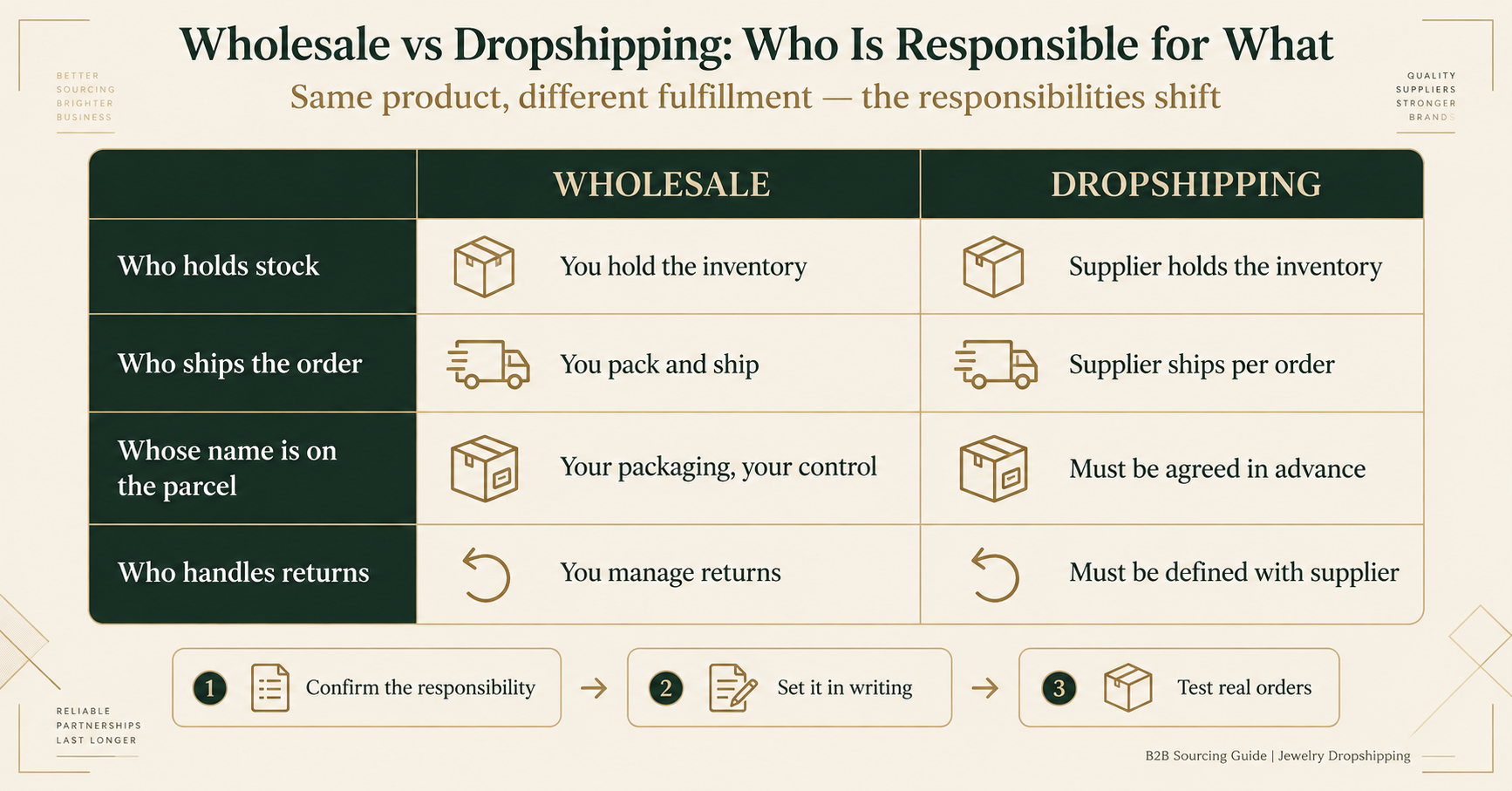
Dropshipping shifts the operational burden. You handle marketing, storefront, and customer communication; the supplier handles inventory and shipping.
That arrangement depends on several things working consistently:
- stock information that stays accurate
- reliable per-order fulfillment
- predictable delivery times
- packaging that represents your brand, not the supplier’s
- a clear process for returns and problems
- data that integrates with your store
A supplier that can hold stock is not automatically a good dropshipping supplier. The skills required are operational, not just product-related.
1. Test Fulfillment Reliability Before Scaling
With dropshipping, reliability is the product. A missed or late shipment is not an internal inconvenience—it is a customer complaint, a refund, and a damaged review.
Ask:
- how orders are received and confirmed
- what the typical handling time is before dispatch
- how the supplier handles peak periods
- what happens when an item is out of stock after an order is placed
- how you are notified of delays or problems
Do not rely on a promise of “fast shipping.” Ask how orders actually flow and what happens when something goes wrong. A supplier that can describe a clear process is more dependable than one that only assures you everything is fine.
2. Establish Realistic Delivery Expectations
Delivery time is the single most visible part of dropshipping, because it is experienced directly by your customer.
Clarify:
- which shipping methods are used and their expected timeframes
- whether tracking is provided and how it is shared
- how delivery times differ by destination
- what the supplier does when a parcel is delayed or lost
- how you will be informed of any change in shipping performance
Understating delivery time is a common source of disputes. It is better to set expectations you can meet than to promise speed the supplier cannot reliably deliver.
3. Confirm Packaging and Brand Representation
In dropshipping, the parcel arrives with your customer, and the packaging speaks for your brand—even though you never touched it.
Confirm:
- whether packaging can represent your brand rather than the supplier’s
- whether inserts, cards, or labels can be included
- how the product is protected in transit
- whether any supplier branding appears on or inside the package
- how packaging is checked before dispatch
A parcel that clearly comes from an unfamiliar supplier weakens the brand experience you are trying to build. This is one of the most overlooked aspects of dropshipping.
4. Verify Stock Synchronization
Because you sell before you ship, inaccurate stock information is a direct cause of cancellations and refunds.
Ask:
- how stock levels are shared with you
- how often stock data is updated
- how quickly an out-of-stock item is reflected
- whether you can see availability before listing a product
- how substitutions or cancellations are handled when stock changes
A supplier with accurate, timely stock data protects your storefront. A supplier with unreliable stock data pushes avoidable problems onto your customers.
5. Agree How Returns and Problems Are Handled
Returns are where dropshipping arrangements are most often vague, and where costs quietly accumulate.
Clarify:
- who is responsible for a return when a product is defective
- how a return is processed and to which address
- who bears the shipping cost in different scenarios
- how refunds or replacements are handled
- how often returns occur and how they are documented
Return policy terms differ by market and by product category, so any statement about returns and consumer rights should be checked against the applicable rules for your destination market before you publish it.
6. Confirm Data and Integration Support
Dropshipping runs on data. Without usable product data and a workable integration, the operational load grows quickly.
Ask:
- what product data the supplier provides—images, descriptions, dimensions
- whether data can be imported into your store efficiently
- how product updates are communicated
- whether there is support for order and tracking synchronization
- how changes to the catalog are handled
A supplier that supplies clean, consistent data reduces the hidden labor of running a dropshipping store. A supplier that provides only a catalog image transfers that work back to you.
7. Understand the Full Cost Structure
Dropshipping unit prices can look attractive while other costs erode the margin.
Clarify:
- what the quoted price includes
- whether shipping cost is included or added per order
- how handling or packaging fees are charged
- whether there are minimums or account requirements
- how returns and replacements affect your cost
- whether prices change frequently, and how you are notified
The relevant comparison is not unit price alone, but the total cost of fulfilling one order to a satisfied customer.
8. Watch for Dropshipping-Specific Risk Signals
Some concerns are specific to fulfillment-based buying.
Watch for:
- vague answers about handling and dispatch times
- stock information that is frequently out of date
- supplier branding appearing in customer parcels
- unclear responsibility for returns and defects
- no tracking, or tracking shared inconsistently
- product data that does not match the shipped item
- pricing that shifts without clear notice
Each of these signals should be clarified directly before you rely on a supplier for daily orders.
A Dropshipping Supplier Evaluation Checklist
Use this to compare suppliers on fulfillment performance, not on catalog appeal.
A supplier that addresses all seven areas is far more dependable for dropshipping than one that only offers a wide catalog.
Questions Worth Asking a Jewelry Dropshipping Supplier
- What is your typical handling time before an order ships?
- How do you inform me when an item is out of stock?
- Can packaging represent my brand instead of yours?
- How is stock information updated, and how often?
- Who is responsible for a defective item, and how is it returned?
- What product data and integration support do you provide?
- What is included in the price, and what is charged separately?
Specific, process-focused answers indicate a supplier built for fulfillment rather than one that only quotes prices.
Conclusion
Choosing a jewelry dropshipping supplier is a fulfillment decision. Because you never hold the product, your customer experience rests on reliability, delivery time, packaging, stock accuracy, returns handling, data quality, and cost clarity.
Focus on how orders actually flow, how long delivery takes, how the parcel represents your brand, how stock stays accurate, how problems are resolved, and what fulfillment truly costs. Confirming these before scaling turns a convenient arrangement into a dependable one.
If you are preparing to dropship jewelry, test a small number of real orders first and judge the supplier by what your customer actually experiences. That evidence is more reliable than any catalog or price list.