

Introduction
Body piercing jewelry has become an increasingly diverse category within the global fashion and accessories market. Consumers are exploring different piercing positions, decorative designs, and ways to personalize their appearance.
From nostril rings and septum clickers to flat-back labret studs and cartilage jewelry, each product serves a different purpose and requires specific construction details.
For jewelry wholesalers, piercing studios, body jewelry brands, and online retailers, this creates opportunities to develop more specialized product collections.
However, sourcing titanium piercing jewelry wholesale is different from purchasing ordinary fashion earrings. Buyers need to understand product structures, gauge measurements, wearable lengths, inner diameters, and closure systems before selecting products for their assortment.
A nose ring, labret stud, and cartilage hoop may look similar in a product photograph, but their structures and intended applications are different.
In 2026, piercing trends are also becoming more varied. Double tragus, paired nostrils, hidden helix, and other creative placements are attracting attention, creating new opportunities for retailers to introduce more specialized jewelry designs.
In this guide, we explore the main categories of titanium piercing jewelry, explain the technical specifications buyers should understand, and discuss how to build a more organized wholesale product assortment.
1. Why Is Titanium Piercing Jewelry an Important Wholesale Category?
Body piercing jewelry is not a single product category with one standard design.
Different piercing positions require different jewelry structures, dimensions, and decorative elements.
This creates opportunities for businesses to develop specialized collections rather than relying on a small selection of general-purpose accessories.
Growing Variety in Piercing Placements
Piercing styles have continued to evolve beyond traditional earlobe and nose piercings.
According to professional piercers interviewed by Allure in its 2026 piercing trend report, several placements are attracting attention:
-
Double tragus piercings.
-
Paired nostril piercings.
-
Snakebite helix.
-
Hidden helix.
-
Faux rook and faux snug.
-
Floating navel piercings.
These developments highlight the growing variety of piercing positions and jewelry designs.
For retailers, this means that different piercing locations may require different product shapes, post lengths, and decorative components.
However, a trending placement does not mean every customer can wear the same jewelry. Anatomy and fit remain important considerations.
Source: Allure – These Are the Top Piercing Trends of 2026.
Different Product Structures Create More Retail Opportunities
A specialized piercing collection can include:
-
Titanium nose rings.
-
Titanium septum clickers.
-
Flat-back labret studs.
-
Titanium cartilage earrings.
-
Circular barbells.
-
Curved barbells.
-
Decorative piercing ends.
Each product category can serve different retail needs.
For example, a piercing studio may need several post lengths and gauges for the same basic labret design, while an online fashion jewelry store may focus more on decorative ends and different colors.
Titanium as a Specialized Piercing Material
Titanium is widely used in professional body jewelry because of its lightweight properties and availability in recognized material grades.
The Association of Professional Piercers (APP) identifies specific titanium standards for jewelry intended for initial piercings, including ASTM F136, ASTM F1295, and ASTM F67.
However, buyers should distinguish between ordinary titanium descriptions and verified material grades.
A product labeled titanium is not automatically certified to an implant-grade specification.
For wholesale buyers, material documentation should be part of the product evaluation process.
2. Different Types of Titanium Piercing Jewelry by Placement
Understanding product categories is the first step toward building a suitable wholesale collection.
The following products are among the most recognizable types of body piercing jewelry.
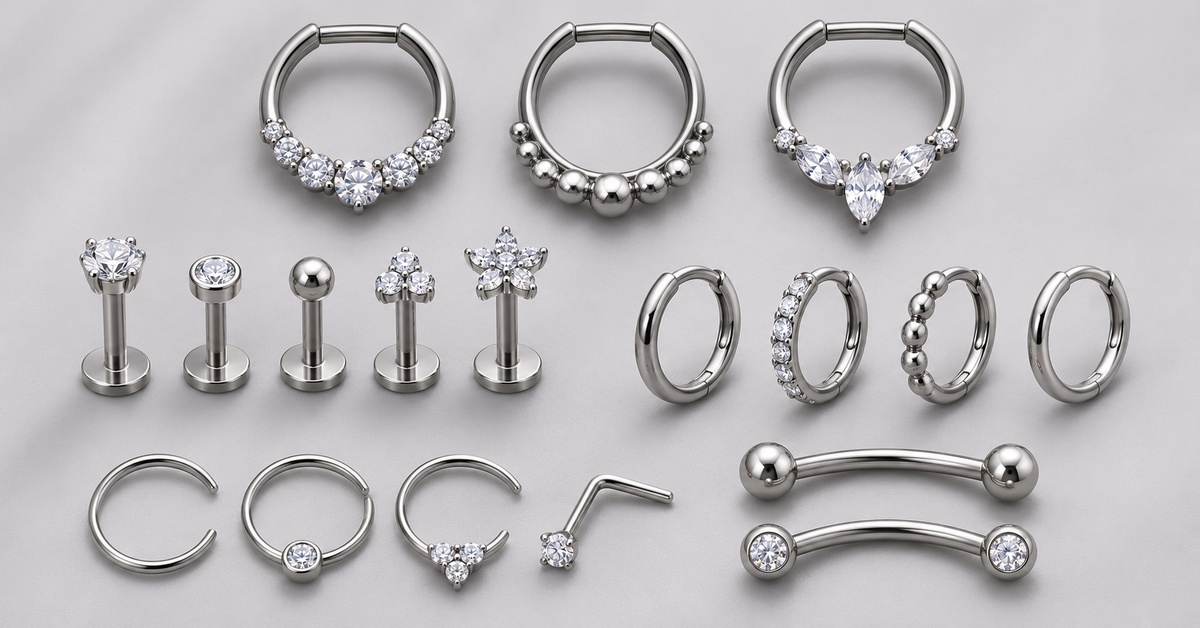
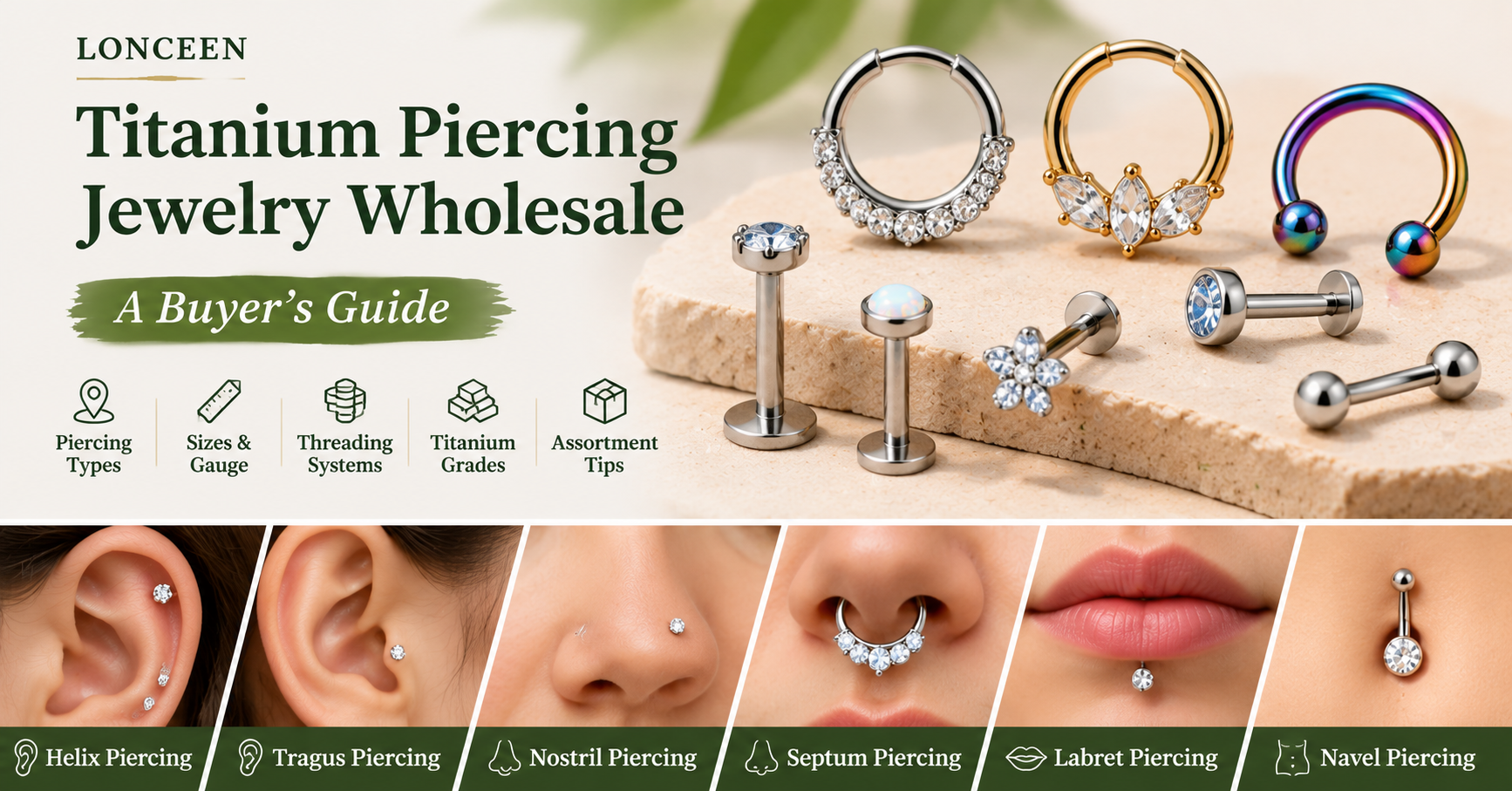
1. Titanium Nostril Jewelry
Nostril jewelry is designed for nose piercings and comes in several different structures.
Common styles include:
Nostril Screws
These feature a curved post designed to remain positioned inside the nostril.
L-Bend Nose Studs
The post has an L-shaped structure that helps keep the jewelry in place.
Flat-Back Nose Studs
These use a straight post and a flat backing, creating a compact structure.
Nose Rings and Hoops
These include continuous rings, hinged segment rings, and decorative hoops.
For retailers, the most important specifications include gauge, post length or inner diameter, decorative end size, and closure structure.
Different nostril placements may require different dimensions, so buyers should not treat every nose ring as interchangeable.
2. Titanium Septum Jewelry
Septum jewelry is designed for the piercing located in the nasal septum.
It is available in several recognizable designs.
Horseshoe Barbells
These feature a curved bar with removable ends, commonly balls or decorative shapes.
Septum Clickers
Clickers use a hinged opening mechanism that allows the ring to open and close.
Segment Rings
These use a removable or hinged segment to create a continuous ring appearance.
Decorative Septum Rings
These may feature crystals, geometric details, floral shapes, or other decorative elements.
When selecting titanium piercing jewelry wholesale, buyers should pay attention to the inner diameter, gauge, decorative width, and closure alignment.
A clicker with a poorly aligned hinge or an uneven closure may affect the overall product experience.
LONCEEN currently lists septum piercing jewelry in its product range.
Explore LONCEEN's Septum Ring Product Listing.
3. Titanium Labret Jewelry
Labret jewelry is commonly used for lip piercings and several ear cartilage placements.
A typical labret consists of:
-
A straight post.
-
A flat disc backing.
-
A decorative front end.
The front end may feature a simple ball, crystal, gemstone, or decorative metal design.
Popular product directions include:
-
Plain ball labrets.
-
Flat-disc labrets.
-
CZ labret studs.
-
Bezel-set gemstone labrets.
-
Decorative threadless labrets.
One important distinction is that labret jewelry is defined by its structure, not by one specific piercing location.
The same general product category can be used for different placements when the post dimensions and design are appropriate.
For wholesale buyers, the post gauge, wearable length, backing diameter, and front-end dimensions should be listed separately.
4. Titanium Helix and Cartilage Jewelry
Cartilage piercing jewelry is designed for different positions around the ear.
Common placement categories include:
-
Helix.
-
Forward Helix.
-
Tragus.
-
Conch.
-
Rook.
-
Daith.
These positions have different anatomical structures, which affects the type of jewelry that may be suitable.
Typical product styles include:
-
Flat-back studs.
-
Small hoops.
-
Hinged segment rings.
-
Curved barbells.
-
Decorative cartilage ends.
Retailers should avoid assuming that one ring diameter or post length will work for every cartilage piercing.
A product assortment with different dimensions gives professional customers more flexibility.
5. Titanium Navel and Body Jewelry
Titanium body jewelry also includes products designed for navel and other body piercings.
A common example is the curved barbell.
Typical designs may include:
-
Plain curved barbells.
-
Gemstone belly rings.
-
Decorative navel jewelry.
-
Floating navel styles.
-
Curved barbells with different end designs.
The upper and lower decorative ends can create different visual effects.
For retailers, this category provides opportunities to offer both basic products and more decorative designs.
The exact product range should be selected according to the target customer group and verified catalog specifications.
3. Understanding Gauge, Post Length and Inner Diameter
One of the most important parts of buying titanium piercing jewelry wholesale is understanding how product dimensions are described.
Unlike ordinary earrings, body jewelry often uses several technical measurements.
These measurements should not be confused with one another.
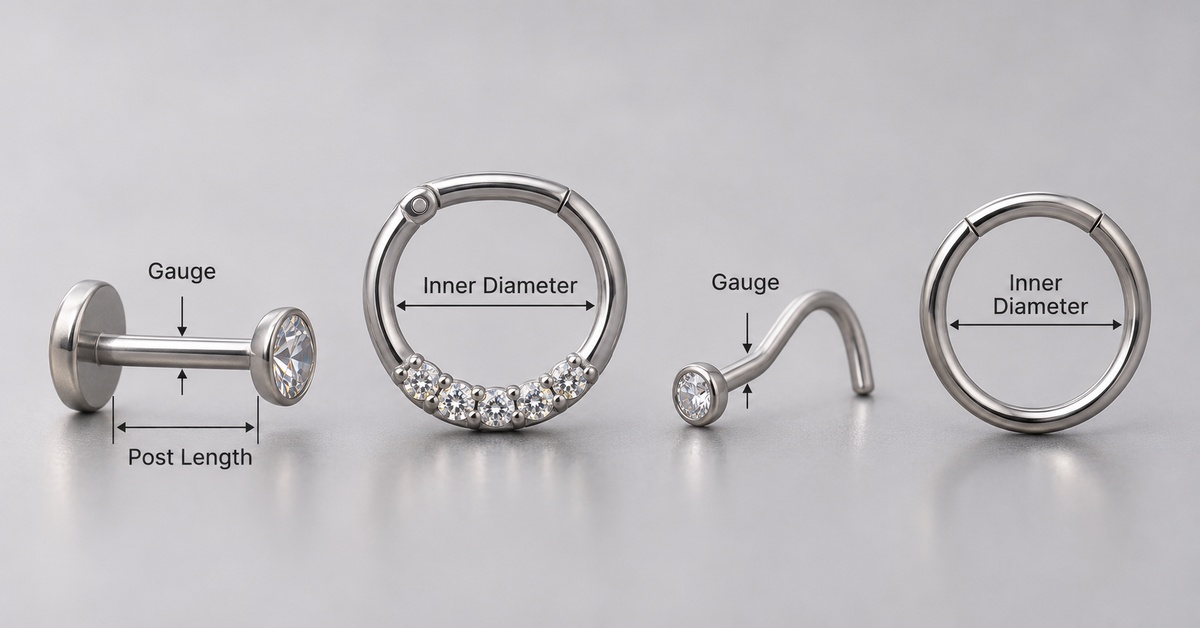
What Is Gauge?
Gauge refers to the thickness of the jewelry post or bar.
In body jewelry, a higher gauge number generally represents a thinner post.
Some common conversions are:
| Gauge | Approximate thickness |
|---|---|
| 20G | 0.8 mm |
| 18G | 1.0 mm |
| 16G | 1.2 mm |
| 14G | 1.6 mm |
These are commonly used gauge conversions.
Retailers should always confirm the exact millimeter specification on the product sheet.
Different piercing positions and individual anatomy may require different gauges. A qualified piercer should determine the appropriate size for each customer.
What Is Wearable Length?
Wearable length refers to the usable length of a straight post between its two ends.
For example, a flat-back labret may be offered in several different post lengths.
A shorter post and a longer post can have different applications depending on the anatomy and placement.
When purchasing, confirm whether the supplier measures the post between the inner surfaces of the ends or includes additional components.
Consistent measurement definitions are important when comparing products from different suppliers.
What Is Inner Diameter?
Inner diameter is mainly used for circular jewelry such as hoops, clickers, and segment rings.
It measures the internal opening of the ring.
For example, two septum rings may have the same gauge but different inner diameters.
Their appearance and fit can therefore be quite different.
Buyers should make sure that product listings clearly distinguish inner diameter from outer diameter.
What Is the Decorative End Size?
The decorative end is the visible component attached to the post.
Common examples include:
-
Small metal balls.
-
Flat discs.
-
Cubic zirconia.
-
Bezel-set gemstones.
-
Prong-set stones.
-
Decorative shapes.
A 2mm decorative top and a 4mm decorative top can create very different appearances even when attached to similar posts.
For retailers, this measurement helps distinguish minimalist piercing jewelry from more noticeable decorative products.
4. Internal Threading vs. Threadless vs. Hinged Designs
The connection system is another important consideration when selecting piercing jewelry.
Different mechanisms affect how the decorative ends connect to the main jewelry body.
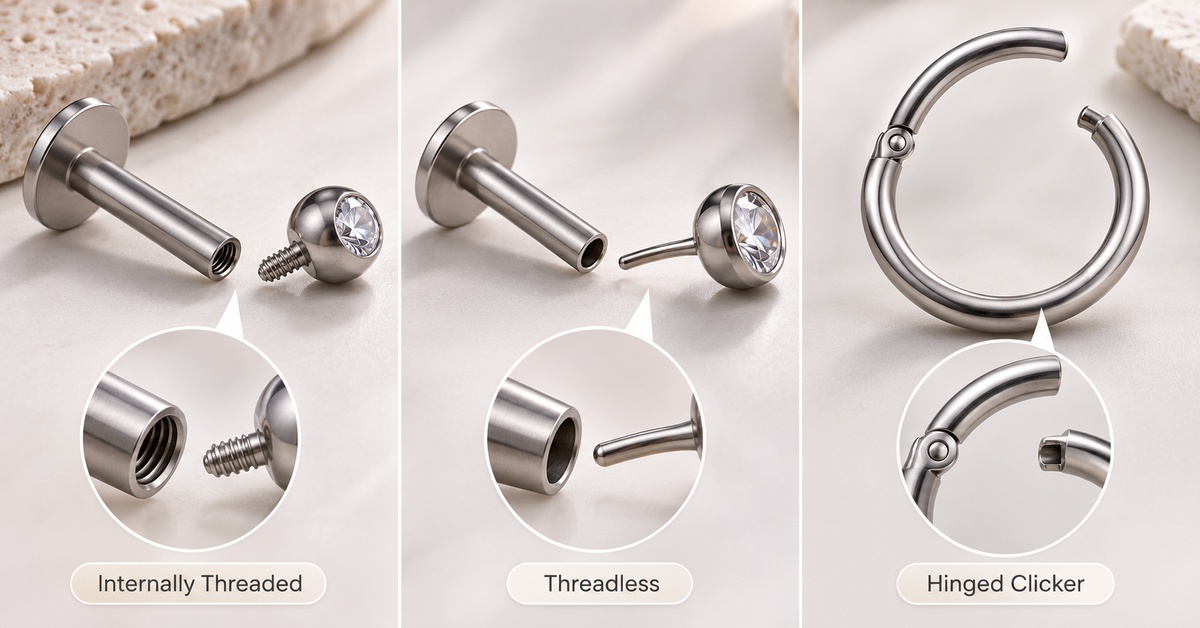
1. Internally Threaded Jewelry
Internally threaded jewelry contains the threaded opening inside the post.
The removable decorative end has a corresponding external screw that fits into the post.
This means the main shaft passing through the piercing channel does not have exposed external threads.
The structure is particularly important when evaluating jewelry intended for initial piercings.
The APP identifies internally threaded construction as an appropriate option for initial piercing jewelry when the complete product also meets its material and quality requirements.
2. Threadless Jewelry
Threadless jewelry, also called press-fit jewelry, does not use conventional screw threads.
Instead, the decorative end contains a small pin that fits into the post.
The pin is held in place through tension.
Common components include:
-
Flat-back posts.
-
Decorative threadless ends.
-
Gemstone tops.
-
Replacement decorative ends.
This system allows different compatible decorative ends to be paired with suitable posts.
For retailers, compatibility between the post and the decorative end should be clearly specified.
3. Hinged Segment and Clicker Designs
Hinged jewelry uses a small opening mechanism that allows the ring to open and close.
It is commonly found in:
-
Septum clickers.
-
Nose rings.
-
Segment rings.
-
Certain cartilage hoops.
The hinge should move smoothly, and the closed ring should align properly.
Buyers should also check the position of the hinge and closure seam.
For jewelry intended for a fresh piercing, the specific design must be assessed carefully to ensure that the hinge or joining section does not pass through the piercing channel.
These closure types should not be treated as interchangeable.
Source: Association of Professional Piercers – Jewelry for Initial Piercings.
5. Decorative Ends, Surface Finishes and Product Variations
Once the main jewelry structure has been selected, decorative details provide another way to differentiate a wholesale collection.
Ball and Disc Ends
Simple ball ends and flat discs are useful for basic piercing jewelry collections.
They have a clean appearance and can be suitable for customers who prefer understated designs.
Crystal and Cubic Zirconia Ends
CZ ends add sparkle without changing the basic post structure.
Common designs include:
-
Round crystals.
-
Marquise shapes.
-
Heart-shaped stones.
-
Star designs.
-
Small multi-stone settings.
These products can help retailers offer more decorative alternatives.
Bezel and Prong Settings
Bezel settings surround the stone with a metal rim.
Prong settings hold the stone using small metal supports.
Both structures create different visual effects.
For buyers, the quality of the setting and the security of the stone are important product details.
Anodized Titanium Colors
Titanium can be anodized to create different surface colors.
This gives manufacturers and retailers opportunities to introduce colorful piercing jewelry without relying exclusively on traditional silver-colored finishes.
However, anodized colors can change or fade under certain conditions, including friction and individual body chemistry.
Retailers should use accurate descriptions and avoid promising that every color will remain unchanged indefinitely.
Surface Finish and Polishing
Surface quality is particularly important for jewelry intended for body piercing.
The APP states that body jewelry surfaces and ends should be free from scratches, nicks, burrs, and polishing compounds.
It also recommends a smooth, mirror-polished finish for metal jewelry used in initial piercings.
These requirements are useful reference points when evaluating finished products.
6. How to Verify Titanium Grades and Product Documentation
Not every product described as titanium has the same material composition.
For professional body jewelry, buyers should understand the difference between general titanium descriptions and specific material standards.
ASTM F136 Titanium
ASTM F136 specifies wrought titanium-6aluminum-4vanadium ELI alloy for surgical implant applications.
It is commonly referenced in professional body jewelry.
When a supplier describes a product as ASTM F136 titanium, buyers should request documentation supporting that material specification.
ASTM F67 Titanium
ASTM F67 covers unalloyed titanium for surgical implant applications.
It is a different material specification from ASTM F136.
Both should be identified accurately rather than grouped under one general description.
ASTM F1295 and ISO 5832-3
These are additional standards referenced for certain implant-grade titanium alloys.
Buyers should confirm the exact standard applicable to the product instead of assuming all titanium alloys are equivalent.
What Should a Material Certificate Include?
A useful material document should identify:
-
The material grade.
-
The applicable ASTM or ISO specification.
-
The material manufacturer.
-
Relevant batch or lot information.
-
The relationship between the documented material and the purchased product.
A certificate for raw material should not automatically be treated as proof that every finished product has been independently tested.
Buyers should also review the finished jewelry's construction, surface finish, and dimensions.
Titanium and Stainless Steel Are Not the Same Material
This distinction is particularly important when sourcing body jewelry.
316L stainless steel and titanium are different materials.
Even when both products have similar silver-colored appearances, their compositions and specifications are not the same.
A generic description such as medical metal is not enough for professional purchasing.
Buyers should request the exact material information for each SKU.
For more information, see the Association of Professional Piercers' material guidance.
7. How to Build a Balanced Titanium Piercing Jewelry Wholesale Collection
A wholesale collection should offer enough variety to serve different customer requirements without creating unnecessary inventory complexity.
Retailers can organize their assortment into several groups.
Group A: Essential Piercing Jewelry
Start with recognizable products that professional piercing customers frequently need.
Potential categories include:
-
Labret posts.
-
Basic septum rings.
-
Nose studs.
-
Simple barbells.
-
Basic cartilage jewelry.
The actual product selection should depend on the target market and the purchasing history of your customers.
Group B: Different Size Specifications
Instead of purchasing many decorative variations in only one size, consider offering multiple dimensions for the core product structures.
For example:
-
Different gauges.
-
Multiple post lengths.
-
Different ring inner diameters.
-
Different decorative top sizes.
This is particularly important for studios that serve customers with different anatomical requirements.
Group C: Decorative Piercing Jewelry
Once the basic structures are covered, retailers can introduce more distinctive designs.
Examples include:
-
CZ decorative ends.
-
Floral designs.
-
Geometric shapes.
-
Colorful anodized finishes.
-
Multi-stone details.
These products help create a more visually diverse collection.
Group D: Different Piercing Locations
A useful wholesale catalog should make it easy for buyers to identify the intended product category.
Organize products into sections such as:
-
Nose and Septum Jewelry.
-
Labret and Lip Jewelry.
-
Ear Cartilage Jewelry.
-
Navel Jewelry.
-
Barbells and Other Body Jewelry.
This structure makes product selection easier and helps customers understand the available assortment.
Use Sales Information to Adjust Inventory
Retailers should monitor which product types, sizes, and decorative styles sell most frequently.
For example, a professional piercing studio may need more basic posts and multiple dimensions, while an online fashion retailer may receive more interest in decorative clickers and gemstone ends.
The best inventory mix depends on the actual customers being served.
8. What Should Wholesale Buyers Check Before Ordering?
Before purchasing titanium piercing jewelry wholesale, buyers should review several product-level specifications.
1. Exact Material Grade
Confirm whether the product uses ASTM F136, ASTM F67, another documented titanium grade, or stainless steel.
2. Gauge and Dimensions
Check the post thickness, wearable length, inner diameter, and decorative end size.
3. Connection Structure
Confirm whether the product is internally threaded, threadless, or hinged.
Make sure compatible components are correctly matched.
4. Surface Finish
Review whether the finished product has a smooth surface and whether the decorative setting has any rough edges.
5. Color and Surface Treatment
Confirm whether the color comes from titanium anodizing, plating, or another surface treatment.
6. Product Documentation
Ask for relevant material certificates and product specifications.
7. Intended Application
Confirm whether the jewelry is intended for healed piercings, fresh piercings, or general fashion use.
These applications should not be treated as automatically equivalent.
Frequently Asked Questions
1. What is titanium piercing jewelry?
Titanium piercing jewelry refers to body jewelry made from titanium or a specified titanium alloy. Common products include labret studs, nose rings, septum clickers, cartilage jewelry, and barbells.
2. What is ASTM F136 titanium?
ASTM F136 is a specification for wrought titanium-6aluminum-4vanadium ELI alloy used in surgical implant applications. It is one of the recognized material specifications referenced in professional piercing jewelry.
3. What is the difference between titanium and 316L stainless steel piercing jewelry?
Titanium and 316L stainless steel have different chemical compositions and material properties. Buyers should request the exact grade and supporting documentation for each product rather than assuming that the two materials are interchangeable.
4. What does 16G mean in piercing jewelry?
16G is a gauge measurement representing approximately 1.2mm in thickness. It describes the thickness of the post or bar, not the length or diameter of the jewelry.
5. What is the difference between internally threaded and threadless jewelry?
Internally threaded jewelry uses a screw connection inside the post, while threadless jewelry uses a pin held in place by tension. Both can provide smooth post surfaces when correctly designed and manufactured.
6. What is the difference between a labret and a septum ring?
A labret generally features a straight post and a flat backing, while septum rings are commonly circular or horseshoe-shaped designs intended for septum piercings. Their structures and dimensions are different.
7. Can titanium piercing jewelry be anodized?
Yes. Titanium can be anodized to produce different surface colors. However, color appearance can change over time depending on wear, friction, and other conditions.
8. What should retailers look for when buying titanium piercing jewelry wholesale?
Retailers should check material grades, documentation, gauge, post length, inner diameter, threading systems, surface finish, and intended product applications. Accurate specifications are essential when building a professional piercing jewelry assortment.
Conclusion: Build a More Professional Piercing Jewelry Collection
Titanium piercing jewelry offers opportunities for jewelry wholesalers, piercing studios, and specialized body jewelry brands to develop more focused product collections.
From nostril and septum jewelry to labret studs, cartilage accessories, and decorative barbells, different product structures serve different piercing positions.
For wholesale buyers, understanding these differences is essential.
A well-organized collection should combine suitable product structures, clearly defined dimensions, compatible connection systems, and accurate material documentation.
At LONCEEN, we are developing our piercing jewelry product range for international wholesale customers, with a focus on different designs and product applications.
Explore our LONCEEN Septum Ring Product Listing and Wholesale Jewelry Collection to discover available product options.
For professional buyers, we recommend confirming the exact material grade, dimensions, and construction of each SKU before selecting products for your assortment.
Choose the right structure, understand the specifications, and build a piercing jewelry collection that meets the needs of your customers.