

How to Choose a Jewelry Supplier for Your Business: A Practical B2B Guide
If you are searching for a jewelry supplier, the real question is not simply who can offer the lowest price. The better question is: which supplier can support your business model, communicate clearly, deliver consistently, and reduce sourcing risk over time?
For retailers, e-commerce sellers, boutique owners, and growing jewelry brands, choosing a supplier is not just a purchasing decision. It affects inventory planning, product quality, reorder stability, delivery timing, and customer experience. A supplier that looks good on paper may still create problems if their MOQ is too rigid, their communication is slow, or their replenishment capability is weak.
This guide explains how to evaluate a jewelry supplier from a buyer’s perspective, with a focus on long-term wholesale and brand sourcing decisions.
Why Choosing the Right Jewelry Supplier Matters
A jewelry supplier is not only a source of products. In practice, they become part of your supply chain. That means their strengths and weaknesses directly affect your operations.
A strong supplier can help you:
- maintain consistent product availability
- plan launches and seasonal collections more confidently
- reduce mistakes caused by unclear specifications
- reorder proven styles more smoothly
- avoid avoidable delays and disputes
A weak supplier can create the opposite outcome:
- inconsistent product quality between orders
- incomplete or inaccurate product information
- long response times during urgent decisions
- unreliable lead times
- difficulty restocking best sellers
- higher operational risk even if initial prices look attractive
This is why supplier selection should be based on fit and reliability, not only on unit cost.
What a Jewelry Supplier Actually Does
In B2B sourcing, the term jewelry supplier can cover several business models. Some suppliers focus on wholesale distribution, some work closely with factories, and some also support custom development. That is exactly why buyers often get confused.
When evaluating a jewelry supplier, do not assume every supplier offers the same level of service. Instead, ask what role they actually play in your sourcing process.
A supplier may be responsible for:
- offering ready-to-order product collections
- coordinating product sourcing across multiple categories
- handling quotation and order communication
- supporting mixed-style wholesale orders
- arranging repeat orders and replenishment
- sharing product specifications, materials, and packaging details
- managing timeline updates and delivery coordination
For many buyers, especially small and mid-sized businesses, the supplier relationship matters more than the technical production background. If your goal is stable wholesale purchasing, the key issue is whether the supplier can support your business consistently.
Who Needs a Jewelry Supplier Most
Not every buyer needs the same type of sourcing partner. A jewelry supplier is often especially useful for the following customer groups.
Boutique Retailers
Boutique stores usually need curated product assortments, flexible style selection, and manageable order structures. They may not need deep factory-level customization, but they do need a supplier who can support selection, replenishment, and clear product details.
E-commerce Sellers
Online sellers depend heavily on accurate specifications, clean communication, and repeatable inventory. Product size, weight, material descriptions, and reorder stability matter because return rates and customer complaints often come from missing or inconsistent information.
Small Businesses and Startup Brands
New businesses often need a practical balance between variety, manageable MOQ, and responsive communication. They may still be testing categories, pricing, or target customers, so a supplier must be commercially flexible enough to support that stage.
Growing Jewelry Brands
As brands become more established, supplier evaluation becomes less about “Can they sell me products?” and more about “Can they support my next stage of growth?” At that point, reorder consistency, delivery control, and product line continuity become much more important.
1. Check Whether the Supplier Matches Your Business Model
One of the most common sourcing mistakes is choosing a supplier that is fine in general, but wrong for your actual business.
Before comparing quotations, clarify what kind of buyer you are.
Ask yourself:
- Are you building a boutique assortment with smaller quantities across multiple styles?
- Are you running an online store that depends on repeatability and clean product data?
- Are you testing products before scaling?
- Are you looking for long-term replenishment, not just a first order?
- Do you need ready-made wholesale products, or supplier support for future customization?
The right jewelry supplier for a fashion boutique may not be the right one for a structured e-commerce store. Likewise, a supplier that works well for seasonal mixed orders may not be the best fit for a brand that relies on repeated restocking of core items.
A good sourcing decision starts with matching supplier capability to your operating model.
2. Evaluate Communication Before You Evaluate Price
Price is easy to compare. Communication quality is harder to measure, but far more important over time.
Many sourcing problems start long before production or delivery. They begin when product details are vague, replies are delayed, or questions are answered incompletely.
A reliable jewelry supplier should communicate in a way that helps you make decisions, not just place orders.
Look for signs such as:
- clear answers to specific product questions
- realistic explanations instead of vague promises
- consistent response speed
- willingness to confirm details in writing
- ability to organize information by SKU, material, quantity, or lead time
Poor communication usually appears in predictable ways:
- answers that ignore part of your question
- repeated use of generic claims without specifics
- changing information from one message to another
- reluctance to confirm details such as material, finishing, packaging, or delivery timing
- slow follow-up when issues become more specific
If communication is already difficult during the inquiry stage, it rarely becomes easier after payment.
3. Make Sure the MOQ Fits Your Current Stage
MOQ is not just a number. It affects cash flow, testing strategy, inventory pressure, and product assortment.
A supplier may look attractive until you realize their order structure does not fit how you buy. For example:
- a startup may need smaller test orders across more styles
- a boutique may prefer mixed orders to build visual variety
- a fast-moving seller may accept higher MOQ if reorder support is strong
- a brand validating a new category may need lower commitment before scaling
When discussing MOQ with a jewelry supplier, do not ask only for the minimum quantity. Ask how the order policy actually works.
Important questions include:
- Is the MOQ per style, per color, per material, or per total order?
- Are mixed-style orders allowed?
- Is reorder MOQ different from first-order MOQ?
- Are there different rules for stock products and custom products?
- Does packaging customization change the MOQ?
The goal is not simply to find the lowest MOQ. The goal is to find a structure you can operate profitably.
4. Assess Lead Time in Relation to Your Selling Cycle
Lead time matters only when understood in context.
A quoted delivery estimate may sound acceptable until you compare it with your launch schedule, selling season, or replenishment needs. That is why buyers should evaluate lead time based on business rhythm, not isolated numbers.
A jewelry supplier is more useful when they can explain:
- sample lead time versus bulk order lead time
- whether delivery timing changes by material or style complexity
- how reorder timing compares with first-order timing
- what stage the lead time starts from
- what factors usually cause delay
For example, a supplier may be acceptable for planned seasonal buying, but risky for frequent small-batch replenishment. Another supplier may be slower on first orders but stronger in repeat-order consistency.
The right question is not “What is your lead time?”
The better question is “Can your lead time support how I sell and restock?”
5. Review Reorder and Supply Continuity, Not Just the First Order
A surprising number of buyers select a jewelry supplier based mainly on first-order convenience. But long-term sourcing success often depends more on what happens after the first successful order.
If a style sells well, can the supplier replenish it with consistent quality and timing?
If demand shifts, can they support new quantities without causing confusion?
If one variation is discontinued, do they notify you early enough to adjust?
This is especially important for:
- stores with repeat best sellers
- e-commerce businesses with stable SKU pages
- brands building signature collections
- wholesalers serving recurring customer demand
Ask practical questions such as:
- How do repeat orders work?
- Do you keep records of previous styles and specifications?
- Can previously ordered items be reproduced consistently?
- How do you handle discontinued components or changes in availability?
- What information is needed to reorder accurately?
A supplier that is easy to buy from once is not always a supplier that is easy to grow with.
6. Check Product Information Quality
A good jewelry supplier should provide more than photos and prices. For business buyers, product information quality is part of supplier quality.
Incomplete product data creates downstream problems in merchandising, customer service, returns, and reorder management.
Useful product information may include:
- material details
- plating or finish information
- dimensions
- weight range
- stone or decorative material description
- closure type
- variation options
- packaging format
- care or usage notes where relevant
This matters even more for online sellers, because unclear product information often becomes a conversion or return issue later.
If a supplier cannot provide clear information during the inquiry stage, buyers should assume additional clarification costs will appear later.
7. Watch for Risk Signals Early
Good supplier selection is not only about finding positive signs. It is also about identifying risk before placing an order.
Common warning signs include:
- prices that are unusually low without clear explanation
- inconsistent answers from different contacts
- unclear product naming or SKU tracking
- difficulty confirming material details
- refusal to clarify MOQ structure
- vague lead time promises without conditions
- sample quality that does not match quoted expectations
- frequent changes in information after initial discussions
None of these automatically disqualifies a supplier, but they should trigger deeper review.
Buyers should avoid being influenced by presentation alone. A professional-looking catalog is useful, but it does not replace operational reliability.
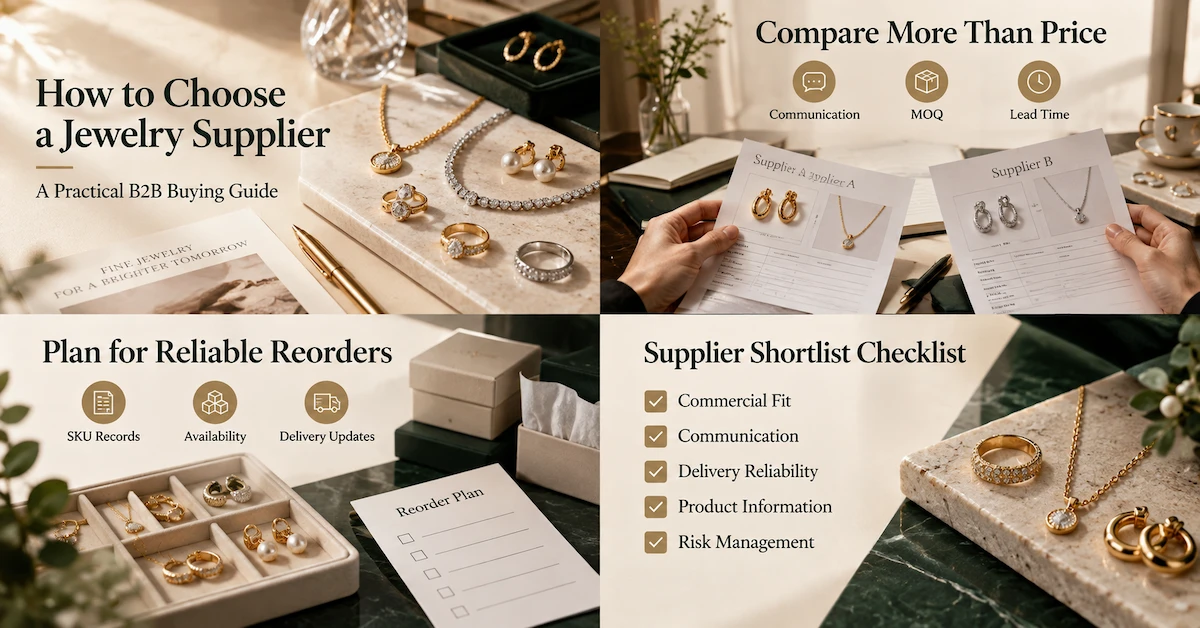
A Practical Shortlist Checklist for Choosing a Jewelry Supplier
Before you decide, compare suppliers using the same framework. A practical shortlist should include questions across five areas:
Commercial Fit
- Does the supplier match your order size and assortment structure?
- Is the MOQ workable for your stage?
- Can they support your type of replenishment?
Communication
- Are replies clear, complete, and timely?
- Do they confirm details in writing?
- Can they handle questions efficiently?
Delivery Reliability
- Are timelines explained clearly?
- Do they distinguish first orders from repeat orders?
- Do they communicate possible delay factors honestly?
Product Information
- Are specifications complete enough for buying decisions?
- Is information consistent across styles and documents?
- Can they support your sales channel with usable data?
Risk Management
- Are there warning signs in pricing, responsiveness, or consistency?
- Do they appear organized enough for ongoing cooperation?
- Can they support stable long-term sourcing, not just one transaction?
A supplier that scores well across these areas is usually a better partner than one that wins only on headline price.
Final Thoughts
Choosing a jewelry supplier is not about finding the supplier who says yes to everything. It is about finding the one whose operating model fits your business, whose communication reduces friction, and whose supply structure supports sustainable purchasing.
For most B2B buyers, the best supplier is not the cheapest, the largest, or the most aggressive in sales messaging. It is the supplier that helps you source with more clarity, fewer surprises, and better continuity.
If you are comparing jewelry suppliers, focus on the fundamentals first: fit, communication, MOQ structure, lead time realism, reorder support, and operational reliability. Those factors usually matter more than marketing language.