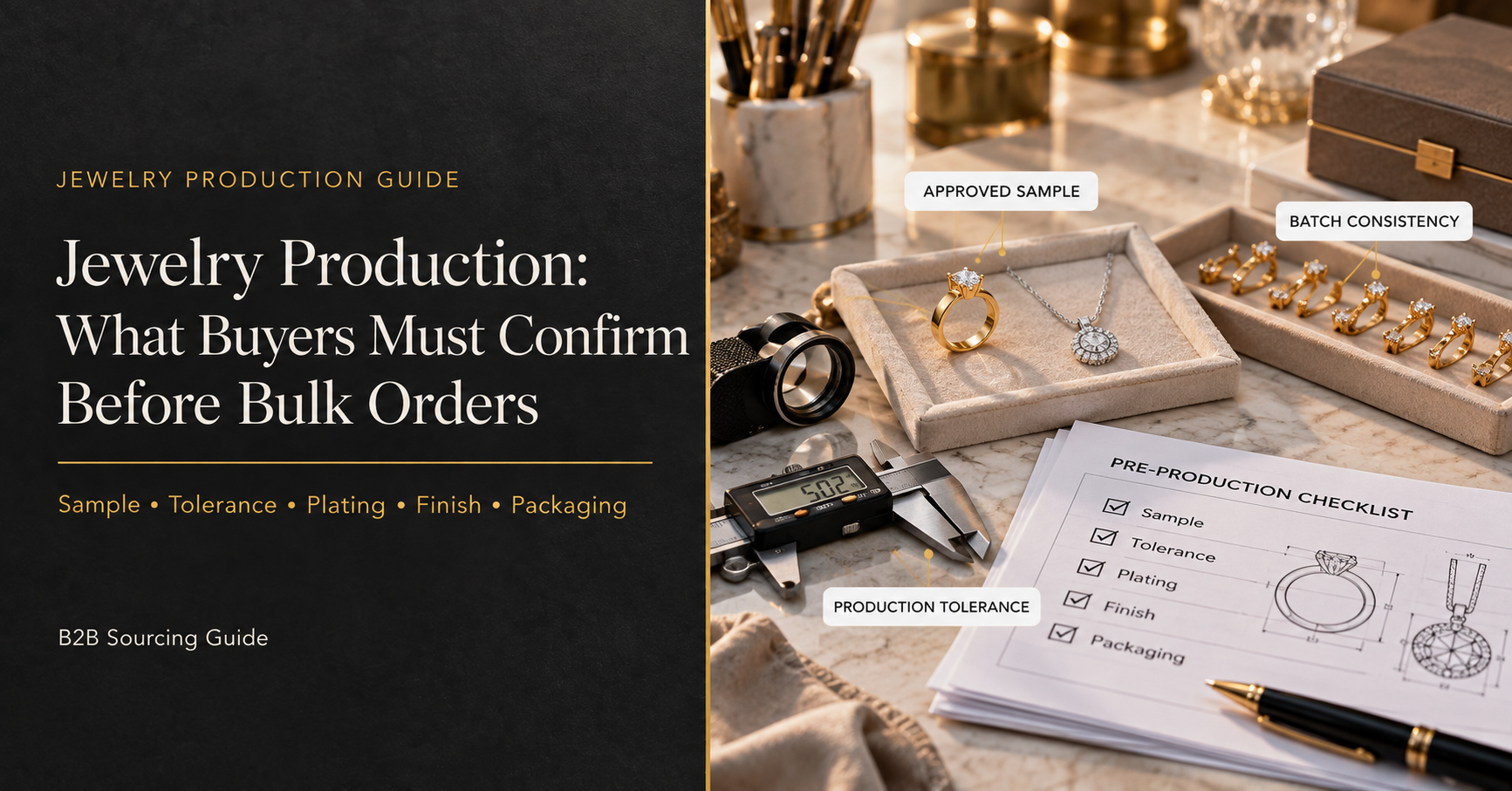


Placing a bulk order is not the end of a sourcing decision. It is the point where the approved design, the sample, and the production run have to stay aligned. Many quality disputes in jewelry production do not come from a poor initial design. They come from details that were never locked before the production line started.
This article focuses on the execution stage: which production points most often cause a gap between sample and bulk delivery, what buyers should confirm in writing, and how to reduce the risk of rework, delay, or disagreement after the order is placed. It does not cover how to select a supplier or assess a factory; those belong to earlier decisions.
Why the Pre-Production Stage Deserves More Attention
Buyers often treat sample approval as the final checkpoint. In practice, approval is only the starting reference. Once a bulk order moves into production, any detail that was not defined at that moment becomes a source of interpretation.
A sample may look correct while still leaving open questions such as:
- what tolerance is acceptable on a dimension
- which shade of the surface finish is the approved reference
- how a stone position is judged
- whether weight variation is permitted
- which closure type is the final specification
When these details are not resolved before production, both sides may believe they agreed, while actually holding different expectations. The result appears later as a consistency problem, even when each party acted in good faith.
The practical principle is simple: anything that can vary between pieces should be confirmed before the run begins, not after.
The Production Stages Where Consistency Is Most Fragile
Most sample-to-bulk gaps in jewelry production fall into a limited set of stages. Knowing these stages helps buyers focus their confirmation effort where it matters.
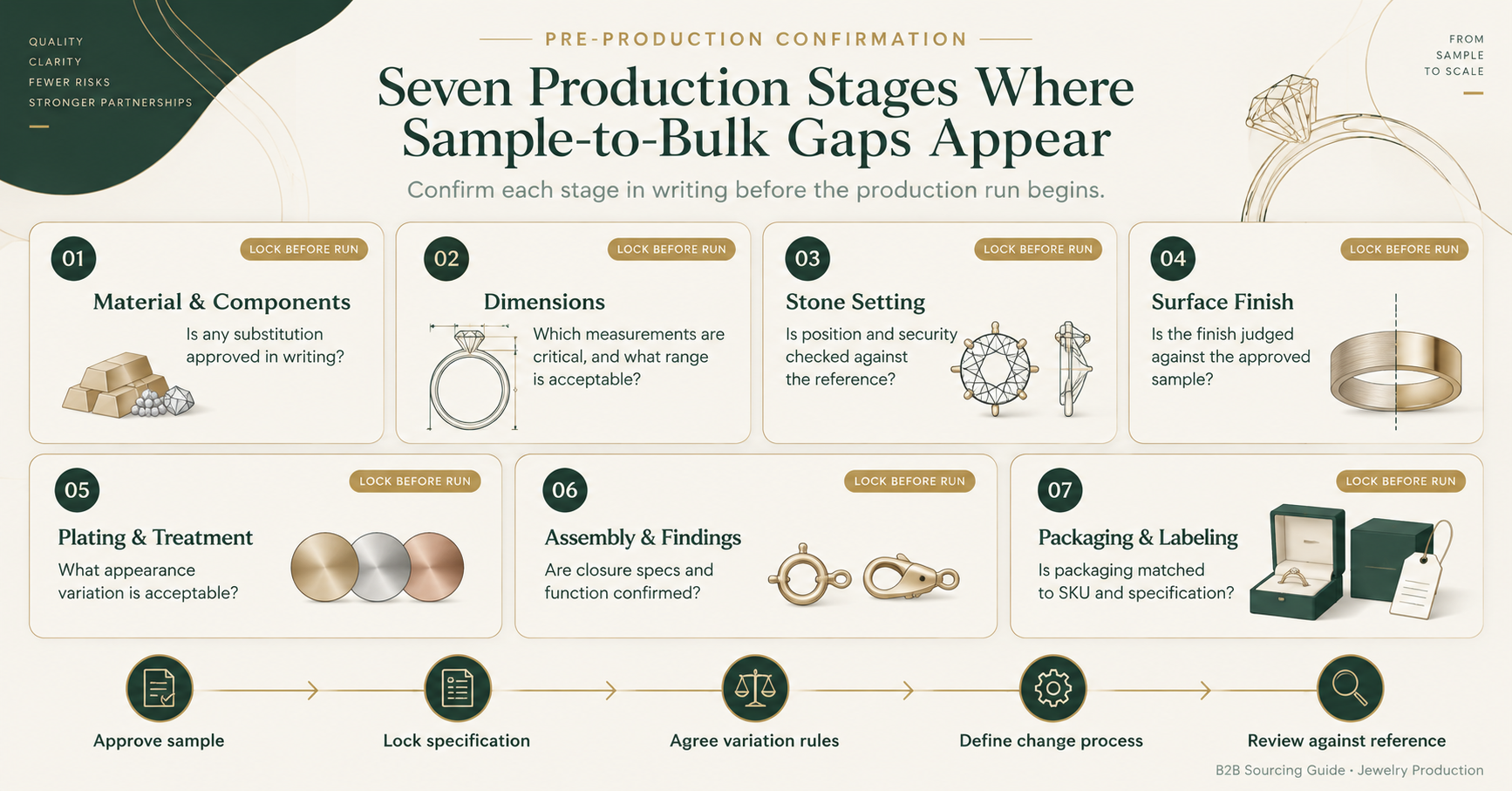
1. Material and Component Preparation
The starting point of consistency is the input material. A change in base material batch, component source, or decorative stone supply can affect the finished result.
Buyers should know:
- which base material specification is approved
- whether components such as findings, clasps, or stones come from a consistent source
- how substitution is handled if an item becomes unavailable
- who must approve any change in material or component before production
An unannounced substitution is one of the most common causes of later disputes, because the finished item may look close to the reference while differing in ways that matter for durability or product claims.
2. Forming and Dimensional Control
In forming or casting stages, dimensions move within a range. Without an agreed tolerance, both sides may be right and still disagree.
Confirm in advance:
- which dimensions are critical to function or fit
- the acceptable variation range for each critical dimension
- how measurements are taken, and with what method
- which measurements are recorded and shared
For products where fit matters, dimensional tolerance is not a technical detail—it is the core of whether the item works for the end customer.
3. Stone Setting
Setting involves both placement and security. Two pieces can look similar and still differ in how firmly and accurately the setting is executed.
Clarify before production:
- the approved stone position and orientation
- how setting quality is judged visually
- whether any functional check is applied to setting security
- how a mis-set or displaced stone is treated
This stage is also where changes become expensive. A setting specification corrected after production has started can mean reworking finished pieces rather than adjusting a plan.
4. Surface Finish
Finishing is highly sensitive to interpretation. “Polished,” “brushed,” or “matte” can describe a range of appearances, and the same term may be understood differently by different teams.
To reduce risk:
- confirm the finish against the approved sample, not only a description
- specify which reference piece governs the judgment
- clarify whether the reference is preserved for comparison
- agree how acceptable variation in finish is evaluated
Surface finish is often the first visible difference customers notice, which makes a clear reference especially important.
5. Plating or Surface Treatment
Where plating or surface treatment is part of the product, consistency depends on both process control and agreed references.
Buyers should confirm:
- the specified plating or treatment type
- how the approved color or appearance is referenced
- what appearance variation is considered acceptable
- how the batch is checked against the reference
Plating is a frequent source of mild mismatch—close enough to pass casual inspection but visibly different when pieces are compared side by side.
6. Assembly and Findings
Assembly consumes small parts that are easy to under-specify. Clasp type, jump ring size, chain attachment, and post or closure choice all affect function and product description.
Clarify:
- the exact findings and closure specification
- how attachments are checked for security
- which functional checks are performed on assembled pieces
- how the buyer will be informed if a finding is unavailable
A seemingly minor components change can alter how a product is used, which then affects customer satisfaction.
7. Packaging and Labeling
Packaging is often confirmed last and treated as a finishing detail. Yet packaging errors can hold up delivery or create mismatch with product claims.
Confirm before production:
- packaging format and dimensions
- labeling content and placement
- how packaging is matched to SKU
- who checks packaging against the specification
Building a Pre-Production Confirmation List
A single written confirmation before production begins reduces most avoidable disputes. The purpose is not to create bureaucracy but to make sure both sides share the same reference.
A confirmation list is most useful when it is specific to the product. A generic form filled with vague entries provides little protection.
How to Distinguish Acceptable Variation from a Defect
One reason sample-to-bulk disputes escalate is that “difference” and “defect” get used interchangeably.
Not every variation is a fault. Production involves natural range in dimensions, appearance, and finish. The question is whether the variation falls within an agreed range for a characteristic that affects function, safety, or the product’s stated attributes.
A useful approach is to classify issues:
- Within range: acceptable variation covered by the agreed specification
- Outside range but correctable: deviation requiring decision, such as rework or selection
- Functionally significant: an issue that affects use, safety, or a stated product claim
Agreeing on these categories before production gives both sides a shared vocabulary when issues arise.
What Changes Are Most Expensive After Production Starts
Timing changes the cost of a correction. Some adjustments are simple early and costly later.
This is why the pre-production stage is not a formality. Decisions made there determine how much freedom remains once output begins.
A Practical Sequence for Buyers
A structured sequence helps buyers manage production without trying to control every internal step.
- Approve the sample against written criteria, not only visual impression.
- Confirm the specification list covering the areas above.
- Agree how variation will be judged and who decides.
- Define the change process before production starts.
- Request progress checkpoints tied to the critical stages.
- Review output against the approved reference before packing and shipment.
The goal is not to participate in manufacturing. It is to ensure that the reference used for judgment is shared, written, and available at the moment decisions are made.
Questions to Ask Before Bulk Production Begins
These questions surface whether the production plan is clear enough to protect consistency:
- Which sample is the official reference, and how is it stored?
- Which dimensions or features are treated as critical?
- How is surface finish judged, and against what reference?
- What happens if a component or material is unavailable?
- Who approves a change, and how is it recorded?
- At which stages will I receive a progress check?
- How will acceptable variation be distinguished from a defect?
Clear answers indicate a production process that can be managed. Vague answers usually mean the buyer will discover the gaps later, when correction costs more.
Conclusion
Jewelry production is where intention meets execution, and where small undefined details become visible differences in finished goods. Most sample-to-bulk problems are preventable, not because production is unpredictable, but because the reference for judgment was never fully agreed.
Focus on the stages where consistency is fragile: material inputs, dimensions, stone setting, surface finish, plating, assembly, and packaging. Confirm each in writing before the run begins, agree how variation will be judged, and define the change process while correction is still affordable.
If you are preparing a bulk order, build a product-specific confirmation list and secure agreement on the reference sample before production starts. That single step protects quality, schedule, and the relationship that makes repeat orders possible.