

A tungsten rings manufacturer works with a material that behaves unlike precious metals in almost every way. Tungsten carbide is extremely hard, heavy, scratch-resistant, and visually distinctive. Those same properties come with constraints: a tungsten ring generally cannot be resized, is more brittle under severe impact than gold or silver, and depends heavily on the inner profile and finish for comfort. Sourcing tungsten is therefore as much about managing expectations and design limits as it is about ordering a product.
This guide focuses on the ring category itself: what to confirm about the material, how to interpret hardness claims, why sizing and fit need special treatment, and how inlays, plating, and engraving behave. It does not cover general supplier screening, fulfillment, or brand packaging; those belong to other sourcing discussions.
Why Tungsten Is Different
Tungsten carbide is a composite material, not a precious metal. That changes how it must be specified, sized, and sold.
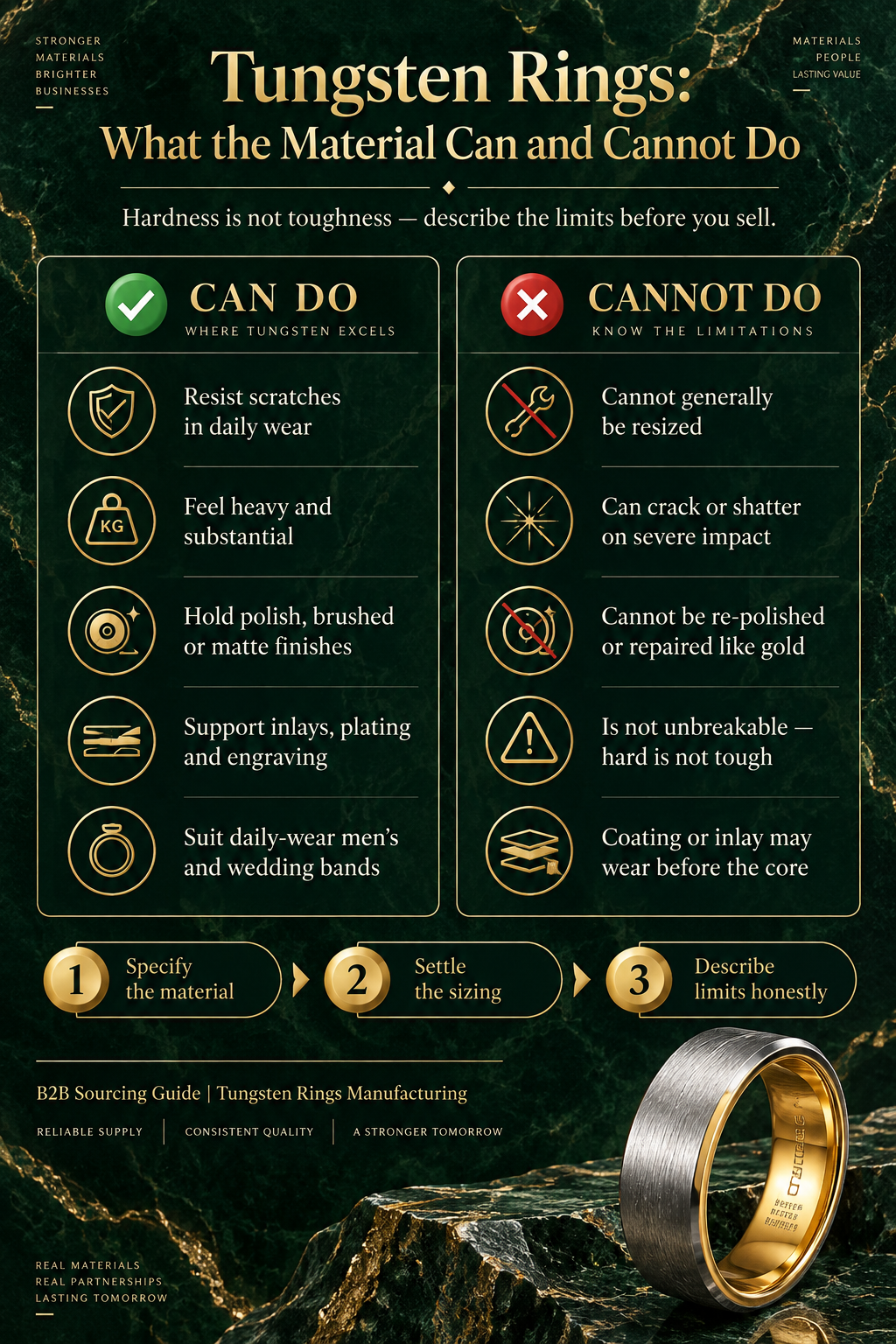
- it is exceptionally hard and highly scratch-resistant
- it is heavy, which gives a distinct feel on the hand
- it generally cannot be resized after production
- it is more prone to cracking or shattering under severe impact than gold or silver
- its appearance is largely determined by finish, inlay, and inner profile
- it cannot be repaired or re-polished the way softer metals can
These traits mean a tungsten order is a design and expectation decision. A beautiful sample proves little if the ring cannot be sized correctly or if the customer expects it to behave like gold.
1. Confirm Material Specification and Grade
Tungsten carbide varies in composition, and the specification should be clear before ordering.
Establish:
- whether the ring is tungsten carbide or another tungsten-based material
- the binder used and its proportion, if the manufacturer can state it
- how the manufacturer describes hardness and density
- what documentation the manufacturer can provide
- whether the specification is consistent across the range
A manufacturer who can state the material clearly is easier to hold to a standard. Vague descriptions such as “pure tungsten” or “high-grade tungsten” should be clarified rather than accepted.
2. Interpret Hardness and Scratch Resistance Accurately
Tungsten is usually sold on hardness, and hardness claims are often stretched. Understand what they do and do not mean.
Clarify:
- what hardness scale is being referenced, if any
- whether “scratch-resistant” refers to daily wear or to all contact
- how the manufacturer tests or demonstrates scratch resistance
- whether hardness is claimed for the whole ring or only the surface
- what the limits of the claim are
The practical point is that hardness and toughness are different properties. A very hard ring resists scratching but is not unbreakable. Marketing that implies indestructibility sets up a customer-expectation problem that surfaces later as a complaint.
3. Address Sizing Limits Before Ordering
This is the single most important operational difference in tungsten. Tungsten rings generally cannot be resized, so sizing must be right the first time.
Confirm:
- whether the manufacturer produces to specific sizes and tolerances
- how sizing is measured and verified before production
- what the manufacturer's policy is if a size is wrong
- whether half sizes and wide-band sizing adjustments are supported
- how you will advise customers about sizing before purchase
Because resizing is not an option, the sizing conversation moves from production to the customer. Sizing guidance, an exchange policy, and a sizing method all need to be settled before a tungsten range goes live. This is a merchandising and customer-service issue as much as a manufacturing one.
4. Specify Comfort Fit and Inner Profile
For a heavy, hard ring, the inside of the band determines how it feels. Comfort fit and inner profile are not cosmetic details.
Ask:
- whether the ring is comfort fit or standard fit
- how the inner profile is shaped and finished
- how the manufacturer controls consistency of the inner surface
- whether wide bands are adjusted for fit
- how the finish of the inner surface affects wearability
A tungsten ring is dense, so a poorly shaped inner profile is felt more than it would be in a lighter metal. Comfort fit is a genuine quality differentiator in this category and should be specified explicitly.
5. Verify Inlays and Plating Durability
Many tungsten rings use inlays, plating, or mixed finishes, and these are often the least durable part of the product.
Confirm:
- which inlay materials are used and how they are set
- how plated finishes are applied and how they wear
- whether the finish is expected to survive daily wear
- how the manufacturer tests adhesion and wear
- whether the same process is used consistently across a range
As with any coated product, the base material may hold up while the decorative layer does not. Positioning should reflect the durability of the finish, not just the hardness of the core.
6. Review Engraving and Finishing Options
Engraving and finishing are common selling points for tungsten rings, especially for wedding and men's bands. Confirm what is actually achievable.
Ask:
- which engraving methods are available and how durable they are
- how deep and how fine the engraving can be
- whether the finish affects engraving legibility
- how domed, stepped, or grooved profiles are finished
- how the manufacturer checks finish quality before dispatch
Some finishes and profiles limit what engraving can achieve. Knowing these limits before a customer orders a personalized ring avoids disappointment that cannot easily be fixed later.
7. Handle Impact and Breakage Risk Honestly
Tungsten's hardness is real, but so is its brittleness under severe impact. Honest positioning protects both the customer and your reputation.
Clarify:
- how the manufacturer describes impact resistance
- what kinds of impact are known to cause cracking or breakage
- whether any warranty covers breakage, and under what conditions
- how you will describe durability to customers without overpromising
- what the returns policy says about impact damage
Any statement about breakage, durability, or warranty is a factual claim and should be checked against the consumer-protection rules of your destination market before publication. It is better to describe the ring as highly scratch-resistant and durable in normal wear than to imply it cannot break.
8. Watch for Tungsten-Specific Risk Signals
Some concerns are particular to this material.
Watch for:
- hardness claims that imply the ring is unbreakable
- no clear statement about resizing limits
- sizing tolerances that are not defined
- comfort fit described vaguely or inconsistently
- inlays or plating with no durability information
- engraving capabilities overstated
- breakage risk not disclosed in care or warranty language
Each of these signals deserves direct clarification before a tungsten range is ordered.
A Tungsten Rings Manufacturer Evaluation Checklist
Use this to compare manufacturers on material accuracy, fit, and honest limits.
A manufacturer that addresses all seven gives you a far more dependable basis for a tungsten range than one that only quotes a hardness figure.
Questions Worth Asking a Tungsten Rings Manufacturer
- Is this tungsten carbide, and can you document the specification?
- What exactly does your hardness claim mean, and what are its limits?
- How do you handle sizing, given that tungsten rings cannot be resized?
- Is the ring comfort fit, and how is the inner profile finished?
- How durable are the inlays and plated finishes under daily wear?
- What engraving methods do you offer, and how durable are they?
- How do you describe impact and breakage risk to customers?
Specific, limit-aware answers indicate a manufacturer who understands the material rather than one who only sells its hardness.
Conclusion
Choosing a tungsten rings manufacturer is a decision about managing a material's strengths and limits. Tungsten's hardness and scratch resistance are real advantages, but so are its constraints: no resizing, brittleness under severe impact, and a fit that depends on inner profile and finish.
Focus on material specification, honest hardness claims, sizing policy, comfort fit, inlay and plating durability, engraving limits, and the accurate handling of breakage risk. Confirming these before ordering protects both the customer experience and the claims you make.
If you are building a tungsten range, settle sizing and fit first, then write product copy that describes durability honestly. In this category, clear expectations are worth more than a bold hardness claim.