

If your design is already finalized, you are not looking for development help. You are looking for an OEM jewelry manufacturer that can execute your specifications accurately and reproduce them consistently across a production run. In this situation, the risk is not whether the design can be built—it is whether it will be built the way you intended.
This guide focuses on OEM execution: how to evaluate whether a manufacturer can follow your technical intent, how to protect version control, and where copy-accuracy most often breaks down. It does not cover design feasibility or development support; those belong to a custom-development discussion.
What OEM Really Requires from a Buyer
OEM means the manufacturer produces according to your design and specification, under your brand. The relationship is defined by fidelity to your reference, not by the manufacturer contributing creative direction.
That shifts responsibility in a specific way. For OEM to work, the buyer must supply a clear, complete, and stable reference. The manufacturer’s job is to interpret and execute it precisely.
This means the buyer should have, at minimum:
- a finalized and approved design
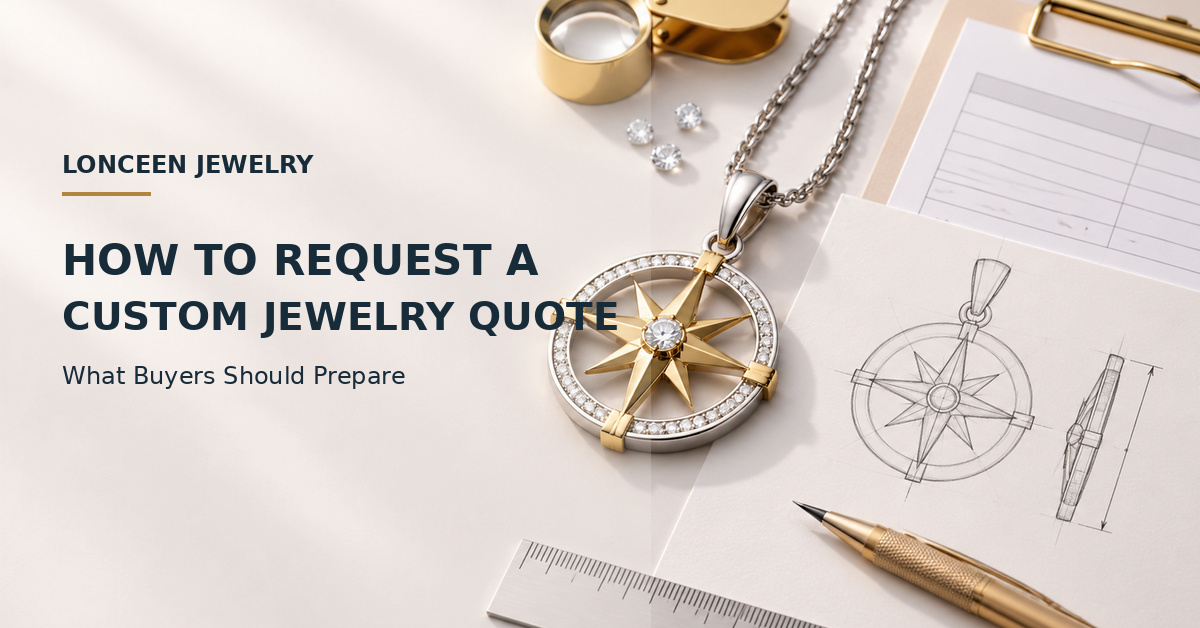
- technical files or drawings that define key dimensions
- material and finish specifications
- component and findings specifications
- packaging or labeling requirements, where relevant
- a clear record of which version is current
The stronger your reference package, the more realistically you can judge whether a manufacturer is executing it correctly.
1. Test Whether the Manufacturer Reads Specifications Correctly
The first thing to evaluate is not equipment. It is whether the manufacturer understands your document.
A practical test is to send a technical drawing or specification set and ask for a short written response covering:
- how they interpret the key dimensions
- which features they consider critical
- any points that appear unclear or contradictory
- how they would approach the specified production method
- which questions they would need answered before starting
This reveals a great deal. A manufacturer that simply replies “we can make this” has not demonstrated understanding. One that returns specific questions about tolerances, thickness, or assembly is showing that they read the document carefully.
2. Confirm How Execution Accuracy Is Verified
Fidelity is not a promise; it is a process. Ask the manufacturer how they will confirm that output matches your reference.
Useful questions include:
- what they compare the first output against
- which dimensions they measure and how
- how they check finish and surface appearance
- how deviations from the reference are documented
- what happens when output falls outside the agreed specification
An OEM manufacturer should be able to describe a concrete check process tied to your document, not a general statement about “strict quality control.” This article is not a full quality-systems audit; the point here is whether verification is connected to your specific reference.
3. Manage Design Versions and Ownership
The single most avoidable OEM failure is working from the wrong version. Design files change, and if version control is weak, effort is spent on obsolete specifications.
Establish clearly:
- which file or drawing is the authoritative reference
- how a new version is introduced and confirmed
- who approves a change and how approval is recorded
- how the manufacturer confirms they are working from the latest version
- how superseded versions are retired
Ownership of design files and tooling is a separate but related matter. It is a commercial term that must be agreed explicitly, and requirements can differ by market. Seek appropriate professional advice rather than assuming a default.
4. Address Confidentiality Before Sharing Files
OEM buyers often share valuable design assets. Confidentiality should be settled before the documents are sent, not after a problem appears.
Confirm:
- what confidentiality terms apply to your files
- who within the manufacturer’s organization has access
- whether your design may be produced for anyone else
- how design materials are stored and returned if the relationship ends
A professional manufacturer should be comfortable discussing confidentiality directly. Reluctance to address it plainly is itself a signal worth noting.
5. Verify That the Reference Can Be Reproduced at Volume
OEM success is judged across a full run, not a single piece. Before committing to volume, confirm that the manufacturer can hold your specification consistently.
Ask:
- which features they expect to vary more in volume
- how they will keep appearance consistent across the run
- whether any specification detail should be adjusted to support repeatability
- how they would handle an early batch that shows deviation
This is not the same as re-discussing design. The design is fixed; the question is whether the manufacturer can hold it across quantity.
6. Align on Change Control After Production Starts
Even with a complete reference, changes sometimes become necessary. What matters is that changes are controlled rather than absorbed silently.
Agree in advance:
- who can authorize a change
- how a change affects sample requirements or schedule
- how a change is recorded against the current version
- what happens to work already completed under the previous specification
A manufacturer that treats a change casually is a risk for OEM work, because silent adjustments undermine fidelity to your reference.
7. Compare OEM Manufacturers on Execution, Not Only Price
Price comparison is only meaningful when the execution scope is the same. Two OEM quotes can differ because of material assumptions, finish specifications, quantity basis, or included checks.
Keep the basis aligned:
A lower quote may exclude steps that protect your specification. The relevant question is whether the difference reflects real execution value for your design.
A Pre-Order OEM Execution Checklist
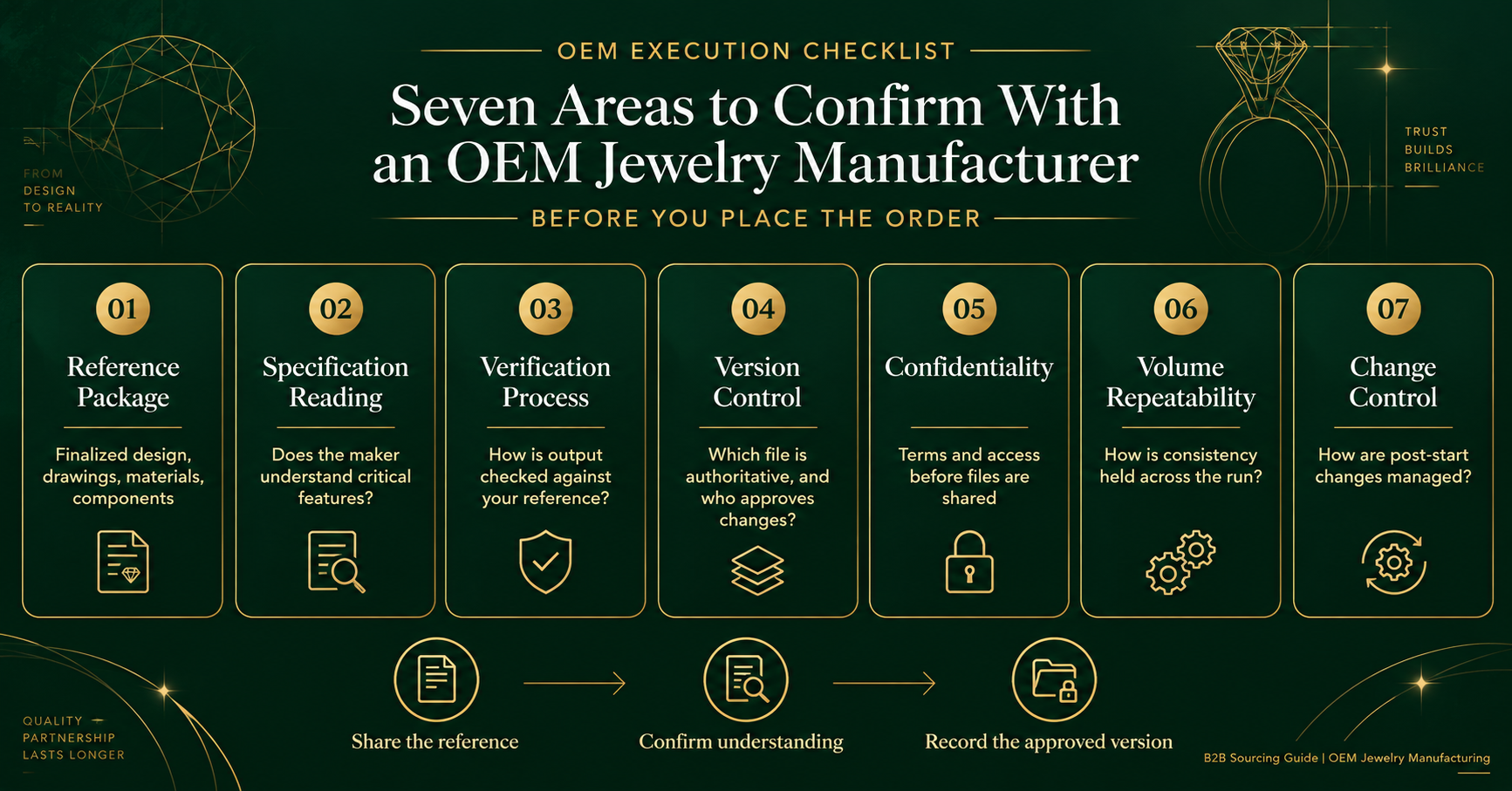
Use this to confirm the questions that matter before placing an OEM order.
A manufacturer that addresses all seven areas is far better positioned to execute your design accurately than one that only confirms it can produce the item.
Questions Worth Asking an OEM Jewelry Manufacturer
- How do you interpret the critical dimensions in this drawing?
- What do you compare the first pieces against?
- How do you confirm you are working from the latest version?
- What confidentiality terms apply to my design files?
- Which features do you expect to vary more in a full run?
- How do you manage a change after production starts?
- How are design files and specifications recorded and approved?
Specific, document-focused answers indicate a manufacturer oriented toward accuracy rather than order-taking.
Conclusion
Choosing an OEM jewelry manufacturer is an accuracy decision. When you already have the design, the priority is a manufacturer that reads your specification carefully, verifies output against your reference, controls versions, protects confidentiality, and holds consistency across the full run.
Focus on specification understanding, verification tied to your document, version and confidentiality management, volume repeatability, and change control. Confirming these before ordering protects both your design and your budget.
If you are preparing an OEM order, assemble a complete and stable reference package and test how the manufacturer interprets it. That first exchange tells you more about execution capability than any general claim.