

For jewelry brands, retailers, and online sellers, a fashion bracelet supplier is not simply a source of individual bracelet styles. The more important question is whether the supplier can help build a commercially useful bracelet collection that stays aligned with changing fashion preferences.
A strong fashion bracelet supplier should be able to provide more than attractive products. Buyers may need multiple bracelet structures, coordinated materials, different price levels, fresh designs, sampling support, and enough production flexibility to refresh collections without creating unnecessary inventory risk.
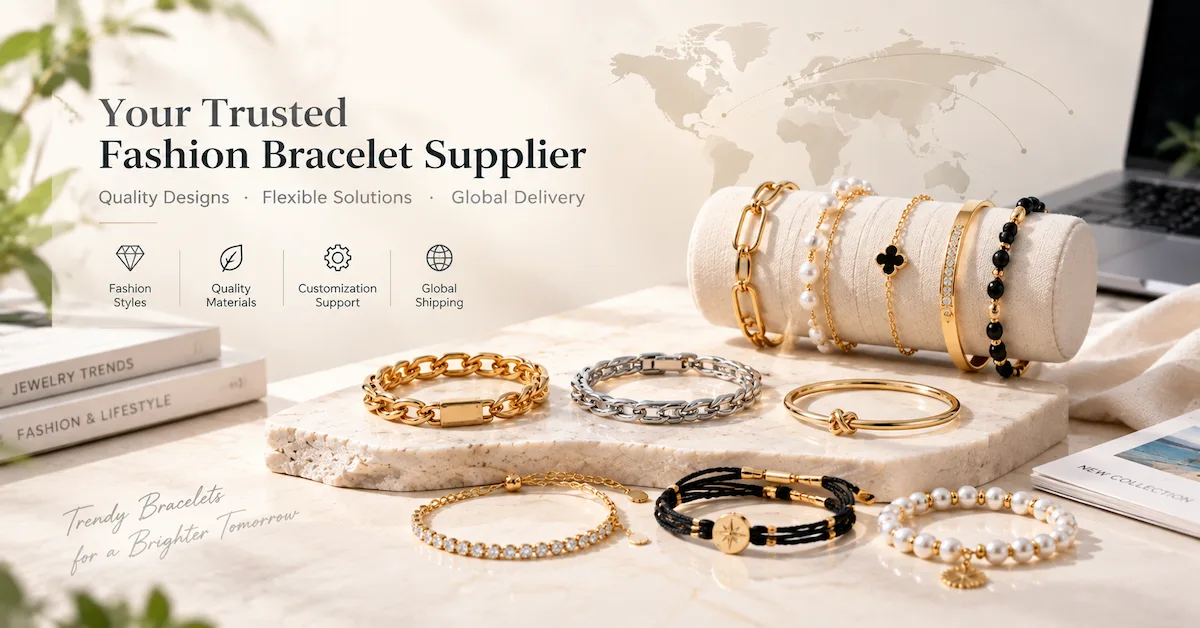
This makes supplier selection less about finding the lowest unit price and more about finding a partner that can continuously support the style, variety, and commercial rhythm of a fashion jewelry collection.
What Makes a Fashion Bracelet Supplier Different?
A general bracelet supplier may offer a selection of bracelets for wholesale purchasing. A fashion bracelet supplier, however, needs to respond to changing aesthetics and collection trends.
For buyers, this difference can be seen in several areas:
- Variety of bracelet structures
- Regular introduction of new designs
- Combination of classic and trend-driven styles
- Multiple material and finishing options
- Customization and private-label support
- Flexible sampling and product development
- Ability to build coordinated collections
- Production support for seasonal launches
The goal is not simply to purchase “bracelets.” It is to create a product assortment that gives customers enough variety while maintaining a recognizable brand direction.
Build a Bracelet Collection, Not Just a Product List
One of the biggest mistakes when sourcing fashion bracelets is evaluating products one by one.
A bracelet may look attractive individually but contribute little to a complete collection. A more useful approach is to divide the assortment into different design roles.
1. Everyday Minimalist Bracelets
These can include:
- Fine chain bracelets
- Simple metal bands
- Slim bangles
- Minimal geometric designs
- Delicate bead bracelets
They are useful as everyday products and can form the foundation of a broader collection.
2. Layering and Stackable Styles
Layering has a different commercial function. Instead of being designed as a single focal product, these bracelets can be combined with other pieces.
Examples include:
- Multi-chain bracelets
- Thin bangles
- Mixed-metal designs
- Adjustable cord bracelets
- Small charm bracelets
A supplier that understands this relationship can help buyers create several products that work together rather than compete with one another.
3. Statement Fashion Bracelets
These products can introduce stronger visual impact through:
- Chunky chains
- Oversized links
- Sculptural cuffs
- Bold geometric shapes
- Textured surfaces
- Decorative stones
They can serve as attention-grabbing pieces within a seasonal collection.
4. Charm and Themed Bracelets
Charm-based designs offer another way to introduce storytelling into a collection.
Possible themes include:
- Initials
- Hearts
- Stars
- Nature
- Travel
- Zodiac-inspired elements
- Seasonal symbols
The advantage is that the same bracelet structure can potentially support different decorative concepts.
Look for a Supplier With Multiple Bracelet Structures
A fashion bracelet supplier should ideally provide enough structural variety to support different collection directions.
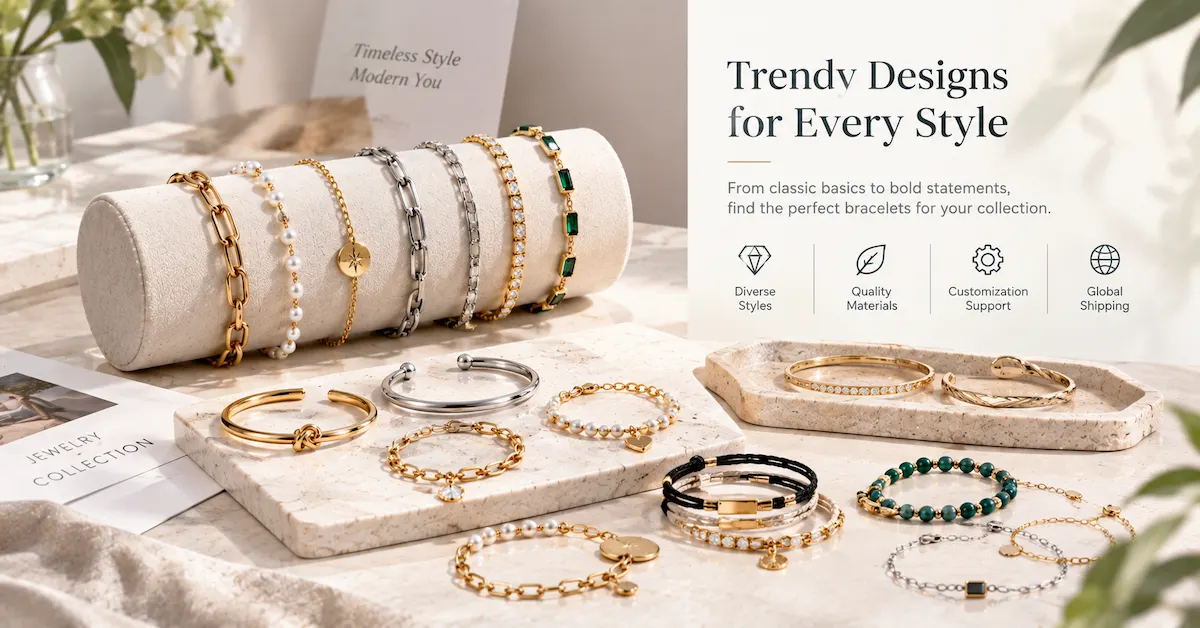
Common bracelet categories include:
| Bracelet Type | Typical Collection Role | Key Considerations |
|---|---|---|
| Chain Bracelet | Everyday / layering | Link size, flexibility, clasp |
| Bangle | Minimal / fashion | Shape, rigidity, finish |
| Cuff Bracelet | Statement | Width, comfort, structure |
| Charm Bracelet | Themed / gifting | Charm selection, attachment |
| Beaded Bracelet | Casual / lifestyle | Bead material, elasticity |
| Tennis Bracelet | Dressy / premium | Stone setting, symmetry |
| Adjustable Bracelet | Flexible sizing | Sliding mechanism, durability |
| Multi-layer Bracelet | Trend-led | Balance, weight, styling |
This variety matters because fashion collections often require several visual levels.
A supplier that only provides one bracelet construction may be suitable for a narrow product line, but a broader fashion brand may need several structures within the same purchasing cycle.
Lonceen's current product classification includes bracelets alongside necklaces, earrings, pendants, rings, and other jewelry categories, while its product catalog includes stainless steel, sterling silver, plated, gemstone, and other fashion-oriented bracelet styles.
Materials Should Match the Fashion Positioning
Fashion bracelet sourcing should not treat material as a purely technical specification.
The material influences the appearance, weight, price structure, target customer, and perceived positioning of the collection.
Stainless Steel
Stainless steel is frequently used for fashion jewelry because it can support clean contemporary designs, chains, cuffs, bangles, and everyday styles.
It can also be finished in different colors or surface treatments depending on the design.
925 Sterling Silver
Sterling silver can support collections positioned toward a more premium jewelry segment.
It works particularly well for:
- Fine chain bracelets
- Stone-set designs
- Charm bracelets
- Personalized pieces
- Delicate women's collections
Brass and Other Fashion Jewelry Materials
Brass and other base-metal options can provide greater flexibility for experimental shapes, decorative finishes, and trend-focused products.
For buyers, the important point is to match material selection with the intended:
design → price → customer → usage scenario
rather than choosing a material simply because it is inexpensive.
Lonceen states that its manufacturing operations cover stainless steel, copper, and silver jewelry, with processes including cutting, grinding, polishing, stone setting, and plating.
For brands developing customized bracelets, its customization service also presents options around materials, styles, plating colors, and other product specifications.
Trend Responsiveness Is a Key Supplier Capability
Fashion jewelry moves faster than many traditional jewelry categories.
A bracelet that fits one season's visual direction may become less relevant as customers move toward another aesthetic.
This means buyers should ask a potential supplier:
- How frequently are new bracelet designs developed?
- Can the supplier respond to reference images?
- Can existing designs be modified?
- Can several related styles be developed as a collection?
- Can seasonal products be sampled quickly?
- Can successful styles be reproduced consistently?
A supplier's product development rhythm can therefore be as important as its existing catalog.
Lonceen states that its design and development operation produces hundreds of new styles and supports custom development from design through sampling and production.
Evaluate the Details That Make Fashion Bracelets Sellable
Two bracelets can have similar shapes but very different commercial value because of finishing details.
When reviewing samples, examine:
Surface Finish
Check whether polished surfaces are smooth and visually consistent.
Edge Treatment
Bracelet edges should be examined for sharp points, uneven transitions, or uncomfortable contact areas.
Chain Movement
For chain bracelets, the links should move naturally without excessive stiffness or visible deformation.
Clasp Construction
The clasp should match the bracelet's weight and structure. A visually attractive bracelet can still create customer complaints if its closure is inconvenient or unreliable.
Plating Consistency
Compare the color and surface appearance across multiple samples rather than evaluating a single piece.
Stone Setting
For stone-set bracelets, check:
- Stone alignment
- Setting consistency
- Missing or loose stones
- Surface symmetry
- Overall visual balance
These details are particularly important for fashion collections because customers often compare products visually across the same product page.
Sampling Should Test the Collection, Not Just One Bracelet
For fashion bracelet sourcing, ordering one sample is useful, but testing a small group of related products can provide much more information.
For example, instead of sampling one chain bracelet, a buyer could test:
- One thin chain
- One chunky chain
- One bangle
- One charm bracelet
- One adjustable style
This reveals whether the supplier can maintain consistency across different constructions.
A useful sample evaluation framework is:
| Evaluation Area | What to Check |
|---|---|
| Design | Does the physical sample match the concept? |
| Proportion | Is the bracelet visually balanced? |
| Comfort | Does it sit naturally on the wrist? |
| Finish | Is the surface consistent? |
| Hardware | Does the clasp work smoothly? |
| Color | Is plating or coating consistent? |
| Stone Setting | Are stones aligned and secure? |
| Packaging | Is the product presentation suitable? |
| Consistency | Can similar styles reach the same standard? |
This turns sampling into a collection validation process, rather than simply checking whether one product looks attractive.
Customization Can Turn Trends Into Brand Products
A fashion bracelet supplier becomes more valuable when it can translate a market trend into a brand-specific product.
For example, a buyer may start with a reference direction such as:
chunky chain + mixed metal + minimalist branding
The supplier may then help develop:
- Initial concept
- Structural adjustment
- Material selection
- Plating or finishing
- Prototype
- Sample revision
- Production version
This is particularly useful for brands that want to avoid selling products that look identical to widely available catalog items.
For custom bracelet projects, a supplier should be able to clearly explain which elements can be changed, such as:
- Bracelet length
- Link dimensions
- Metal color
- Surface finish
- Charm shape
- Stone selection
- Logo position
- Packaging
Lonceen describes an OEM/ODM workflow covering communication, sample design, engineering proofing, sample confirmation, production, delivery, and after-sales service.
For brands with more specific design requirements, its customization service can be used as a starting point for discussing materials, styles, plating, and other customization options.
Private Label Support Matters for Fashion Brands
Fashion bracelets are often sold as part of a larger brand identity.
Therefore, buyers may need more than the jewelry itself.
Ask whether the supplier can support:
- Logo engraving
- Custom tags
- Jewelry cards
- Pouches
- Boxes
- Barcode labels
- Product inserts
- Branded packaging
This can simplify the transition from factory product to retail-ready SKU.
It is also important to determine which branding options require tooling or minimum quantities before placing an order.
Compare Suppliers by Collection Support
Instead of asking only:
“What is your price per bracelet?”
a better supplier evaluation asks:
“What can you help me build over the next collection cycle?”
Consider these areas:
| Supplier Factor | Why It Matters |
|---|---|
| Style Variety | Supports broader collections |
| New Design Development | Helps refresh seasonal products |
| Material Options | Allows different price levels |
| Customization | Creates brand differentiation |
| Sampling | Reduces product development risk |
| Quality Control | Protects product consistency |
| Packaging | Supports retail presentation |
| Production Flexibility | Helps manage changing demand |
| Communication | Reduces development errors |
| Cross-Category Support | Enables future jewelry expansion |
This approach shifts supplier selection from simple price comparison to collection-level business planning.
When a Fashion Bracelet Supplier Is a Good Fit
A supplier may be worth considering when it can support several stages of your product process rather than only selling finished inventory.
Look for evidence of:
- A broad bracelet assortment
- Multiple material choices
- Trend-oriented product development
- Consistent sample quality
- Custom design capability
- Private-label support
- Clear production communication
- Flexible product development
- Reliable quality inspection
- Capacity for repeat orders
For a fashion brand, the ability to move from trend → concept → sample → collection → production can be more useful than having the largest catalog.
How to Prepare Your First Fashion Bracelet Inquiry
A detailed inquiry helps the supplier understand your requirements faster.
Include:
1. Product direction
Describe the aesthetic you want, such as minimalist, vintage, Y2K, streetwear, luxury-inspired, or contemporary.
2. Bracelet types
Specify whether you need chains, bangles, cuffs, charms, beads, tennis styles, or mixed collections.
3. Materials
State your preferred stainless steel, sterling silver, brass, plating, stones, or other materials.
4. Quantity
Give your estimated sample and production quantities.
5. Customization
Clarify whether you need modified designs, completely new designs, logo work, or packaging.
6. Target market
Mention your main customer segment and price positioning.
7. Sample expectations
Provide reference images, sketches, measurements, or existing samples whenever possible.
A supplier can then respond with a much more relevant proposal.
Why Fashion Bracelet Sourcing Should Be Collection-Based
The real value of a fashion bracelet supplier is not the number of products shown in a catalog.
It is the ability to help a buyer create a coherent, commercially useful, and refreshable bracelet collection.
A successful collection may combine everyday basics, layering pieces, trend-led designs, statement styles, and seasonal products. These products should share enough visual logic to feel like part of the same brand while still providing customers with meaningful choices.
This is why fashion bracelet sourcing should be evaluated through three connected questions:
Can the supplier develop the right styles?
Can the supplier maintain consistent quality?
Can the supplier support the collection as it grows?
If the answer is yes, the relationship can extend beyond one purchase order and become part of a brand's ongoing product development system.
Fashion Bracelet Supplier Checklist
Before moving forward, buyers can use this quick checklist:
- Multiple bracelet categories available
- Fashion-oriented new designs
- Suitable material options
- Consistent surface finishing
- Reliable clasp and hardware
- Good sample quality
- Custom design development
- Logo and private-label options
- Custom packaging support
- Clear production process
- Quality inspection procedures
- Ability to handle repeat orders
- Support for additional jewelry categories
For a broader product review, buyers can also explore Lonceen's jewelry product collection, which currently includes bracelets alongside other jewelry categories and customization options.
Frequently Asked Questions
What should I look for in a fashion bracelet supplier?
Focus on style variety, trend responsiveness, material options, sample quality, customization, finishing, production consistency, and the supplier's ability to support future collections.
Can a fashion bracelet supplier provide custom designs?
Yes, suppliers with OEM/ODM capabilities may develop products from sketches, reference images, or existing concepts. Confirm the available customization scope before development.
What bracelet materials are commonly used?
Common choices include stainless steel, sterling silver, brass, plated metals, beads, pearls, and stone-set constructions. The appropriate option depends on product positioning and design requirements.
How important are new bracelet designs?
Very important for trend-driven brands. Regular new development can help brands refresh collections instead of relying entirely on long-running catalog products.
Should I order samples before production?
Yes. Samples allow buyers to evaluate proportions, comfort, finishing, hardware, plating, stones, and overall design consistency before committing to larger quantities.
Can bracelets be private labeled?
Many suppliers can support logo engraving, custom jewelry cards, packaging, tags, and other branding elements. Minimum quantities and tooling requirements should be confirmed in advance.
How can I compare two fashion bracelet suppliers?
Compare their product development capabilities, materials, sample quality, customization, quality control, production flexibility, communication, and total sourcing cost rather than unit price alone.
Can one supplier support other jewelry categories?
Some manufacturers can supply bracelets together with rings, necklaces, earrings, pendants, and other fashion accessories. This can simplify collection development when a brand expands its product range.
How do I start a fashion bracelet project?
Prepare your style references, bracelet categories, materials, quantities, target market, customization requirements, and packaging expectations. Then request samples and a production quotation.
Where can I request a supplier quotation?
You can use Lonceen's contact page to submit product requirements and start a supplier inquiry.
Final Thoughts
Choosing a fashion bracelet supplier should be about more than finding attractive products at a competitive price.
For brands and retailers, the more important capability is the supplier's ability to translate changing fashion directions into practical bracelet collections. Product variety, material flexibility, sampling, customization, finishing, branding, and production support all contribute to that process.
A supplier that can support the complete path from collection concept to finished fashion bracelet gives buyers a stronger foundation for launching new styles, testing trends, and building a consistent jewelry assortment.
For a supplier evaluation or custom project, you can also review Lonceen's current manufacturing information and customization capabilities before preparing your inquiry. Lonceen Jewelry