

For jewelry brands, retailers, and wholesalers, one of the most important questions before starting a new collection is: How long does jewelry production take?
Understanding the jewelry production timeline is essential for planning product launches, managing inventory, preparing marketing campaigns, and meeting customer demand.
However, jewelry manufacturing does not have a fixed production time. The actual timeline depends on multiple factors, including design complexity, material selection, sampling requirements, order volume, finishing methods, and supplier efficiency.
A reliable jewelry manufacturing partner should not only provide products but also help brands create a realistic production schedule from concept to delivery.
As a professional jewelry design and manufacturing partner, Lonceen Jewelry supports global brands with custom jewelry development, production planning, and wholesale solutions. Learn more about our company background and capabilities through our About Us page.
What Is the Average Jewelry Production Time?
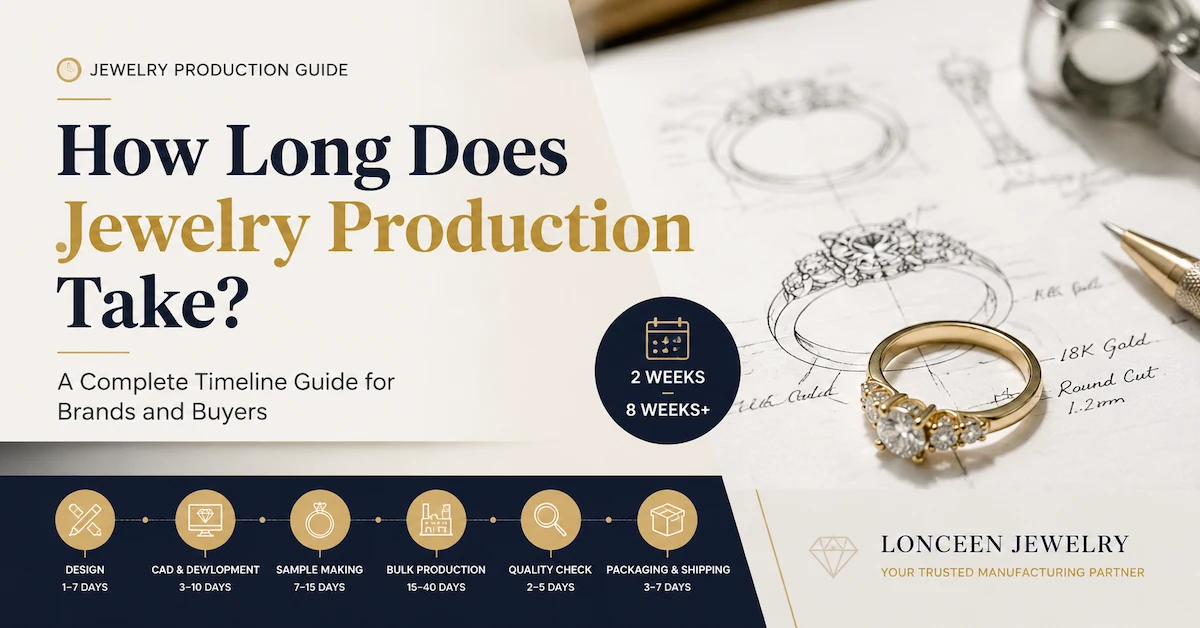
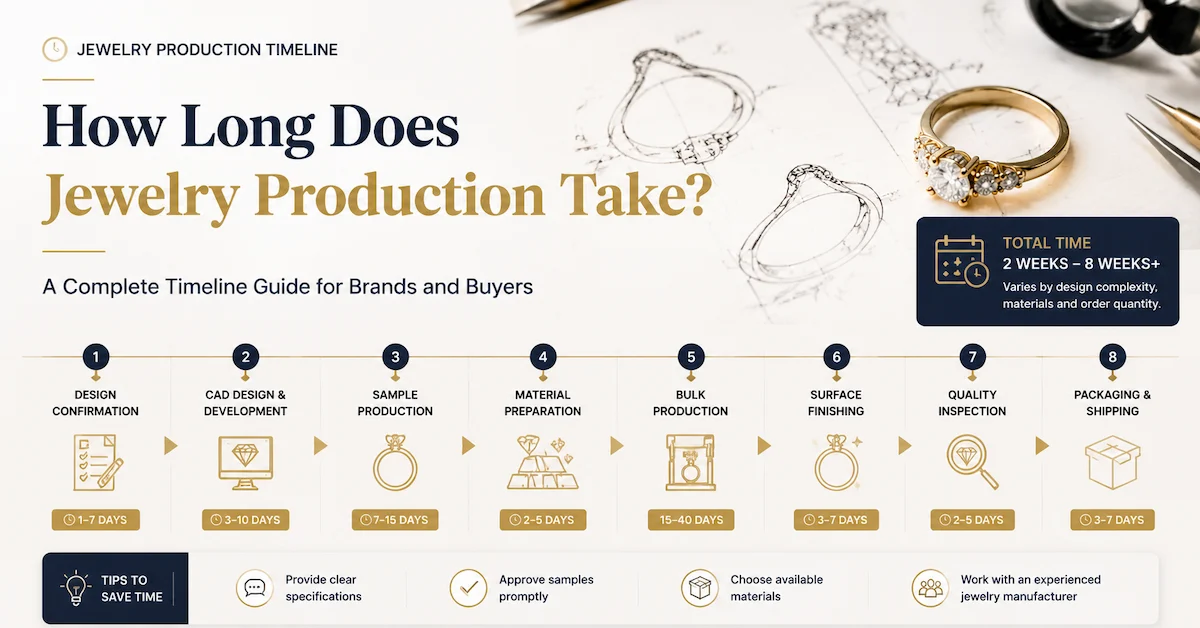
In general, jewelry production can take anywhere from 2 weeks to 8 weeks, depending on the project type.
For standard jewelry designs that already have confirmed specifications, production may be completed faster.
For fully customized jewelry collections requiring new designs, prototypes, special materials, or complex craftsmanship, the timeline will usually be longer.
A typical jewelry production timeline includes:
- Design confirmation
- Product development
- Sample approval
- Material preparation
- Bulk production
- Surface finishing
- Final inspection
- Packaging preparation
Each stage affects the final delivery date.
For B2B buyers, the most important factor is not simply finding the fastest production time, but finding a manufacturer that can provide a predictable and controllable timeline.
Jewelry Production Timeline Breakdown
1. Design Confirmation: 1–7 Days
The first stage begins when the buyer provides product requirements.
This may include:
- Product references
- Sketches
- Technical drawings
- Material preferences
- Size specifications
- Branding requirements
If the design information is complete, manufacturers can move quickly.
However, unclear specifications often create delays because additional communication is needed before production begins.
For brands launching seasonal collections, preparing complete product information early can significantly reduce development time.
2. CAD Design and Product Development: 3–10 Days
For customized jewelry, CAD development is an important step between creative ideas and physical production.
During this stage, manufacturers transform concepts into accurate production drawings.
CAD development helps confirm:
- Product structure
- Dimensions
- Stone placement
- Weight estimation
- Manufacturing feasibility
A well-prepared CAD model reduces mistakes during sampling and helps shorten the overall production cycle.
3. Sample Production: 7–15 Days
Before mass production, most jewelry brands require a sample for approval.
The sample stage allows buyers to check:
- Design accuracy
- Product appearance
- Size and proportion
- Material performance
- Surface finishing
Complex designs involving gemstones, engraving, multiple components, or special finishes may require additional time.
Fast sample approval is one of the biggest factors affecting the final production schedule.
Many delays happen not because of manufacturing speed, but because buyers need multiple revision rounds before confirming the final sample.
4. Bulk Jewelry Production: 15–40 Days
After sample approval, bulk production begins.
The production period depends mainly on:
Product Complexity
Simple jewelry pieces such as basic necklaces, rings, or earrings usually require less time.
More complicated products involving:
- Multiple components
- Hand finishing
- Stone setting
- Special plating
- Custom structures
will require longer production cycles.
Order Quantity
Large-volume orders naturally require more manufacturing time because more units need to pass through each production stage.
Material Availability
Different materials may have different preparation times.
For example:
- Stainless steel jewelry may have shorter preparation cycles
- Sterling silver jewelry may require more craftsmanship steps
- Gold and gemstone jewelry may require additional verification processes
Different Jewelry Projects Have Different Lead Times
Not every jewelry order follows the same timeline.
Existing Jewelry Designs
For products based on existing designs with confirmed specifications:
Estimated timeline: 2–4 weeks
This option is suitable for:
- Online stores
- Wholesale buyers
- Retailers needing fast restocking
Custom Logo Jewelry
For jewelry requiring brand logos or customized details:
Estimated timeline: 3–6 weeks
Additional time may be needed for:
- Logo adjustment
- Sample approval
- Packaging preparation
Fully Custom Jewelry Collections
For new designs developed from concepts:
Estimated timeline: 5–8 weeks or longer
This usually includes:
- Design development
- CAD modeling
- Prototype creation
- Multiple approvals
- Production preparation
Brands planning seasonal collections should reserve enough time before launch dates.
What Factors Can Delay Jewelry Production?
Many buyers focus only on factory production days, but the total timeline is affected by several external factors.
1. Slow Design Approval
Delayed feedback is one of the most common reasons projects exceed the expected timeline.
Each modification may require:
- Updated drawings
- New samples
- Additional testing
Clear communication helps keep production moving.
2. Product Complexity
Jewelry with advanced craftsmanship requires more production steps.
Examples include:
- Detailed engraving
- Multi-layer plating
- Complex stone settings
- Handmade finishing
More craftsmanship usually means more time.
3. Peak Season Production Demand
Jewelry production schedules are often affected by seasonal demand.
Common busy periods include:
- Christmas collections
- Valentine's Day launches
- Mother's Day campaigns
- Black Friday sales
Brands should prepare production schedules earlier during peak seasons.
4. Shipping and Logistics
Production completion does not always mean immediate customer delivery.
International orders also require:
- Packaging preparation
- Export handling
- Transportation time
Therefore, brands should calculate the complete timeline from production start to warehouse arrival.
How Can Brands Shorten Jewelry Production Time?
Brands can improve efficiency by preparing key information before production starts.
Provide Complete Product Information
Prepare:
- Design references
- Material requirements
- Size details
- Color preferences
- Packaging requirements
This reduces unnecessary communication delays.
Approve Samples Quickly
The faster the sample receives approval, the sooner bulk production can begin.
A clear approval process helps manufacturers maintain the planned schedule.
Work With an Experienced Jewelry Manufacturer
A professional jewelry manufacturer can help identify potential production issues before they happen.
Experienced suppliers usually have better control over:
- Production planning
- Material coordination
- Product development
- Delivery scheduling
You can explore Lonceen Jewelry’s jewelry categories and manufacturing capabilities through our Products page.
How Should Brands Plan Jewelry Production for New Collections?
For fashion brands and online retailers, production time should be considered together with marketing and sales planning.
A practical timeline should include:
2–3 Months Before Launch
- Confirm designs
- Select materials
- Develop samples
1–2 Months Before Launch
- Complete production
- Prepare photography
- Create marketing materials
Before Sales Campaign
- Complete shipping
- Prepare inventory
Planning ahead helps brands avoid missing important sales opportunities.
Frequently Asked Questions
How long does jewelry production usually take?
Most jewelry production projects take around 2–8 weeks, depending on customization level, materials, production quantity, and finishing requirements.
Is custom jewelry production slower than standard jewelry?
Usually yes. Custom jewelry requires additional development stages such as CAD design, sampling, and approval before mass production.
Can jewelry manufacturers offer faster production?
Some projects can be accelerated if designs are confirmed, materials are available, and production capacity allows priority scheduling.
When should brands start jewelry production before a product launch?
For new collections, brands should usually begin planning several months before launch to allow enough time for development, production, and shipping.
Conclusion
So, how long does jewelry production take?
The answer depends on the type of jewelry project.
Simple production orders may take only a few weeks, while fully customized jewelry collections may require several months from initial concept to final delivery.
The key to successful jewelry sourcing is not only choosing a manufacturer with fast production speed but also working with a partner who understands timeline planning and brand launch requirements.
With professional design support, efficient production management, and reliable communication, brands can bring new jewelry collections to market faster and with greater confidence.
For more information about jewelry manufacturing processes and sourcing guidance, visit Lonceen Jewelry’s FAQ & Guide page.