

Promotional jewelry can be a simple giveaway, a branded customer gift, or part of a larger marketing campaign. Unlike ordinary wholesale jewelry, the main goal is not simply to sell the jewelry itself. The product needs to help a company increase brand visibility, create a memorable customer experience, or support a specific promotional event.
That makes supplier selection especially important.
A reliable promotional jewelry supplier should be able to balance product appeal, branding options, order quantities, production timing, packaging, and cost. For marketing teams and promotional product companies, the right supplier can make a campaign easier to manage from the first sample to final delivery.
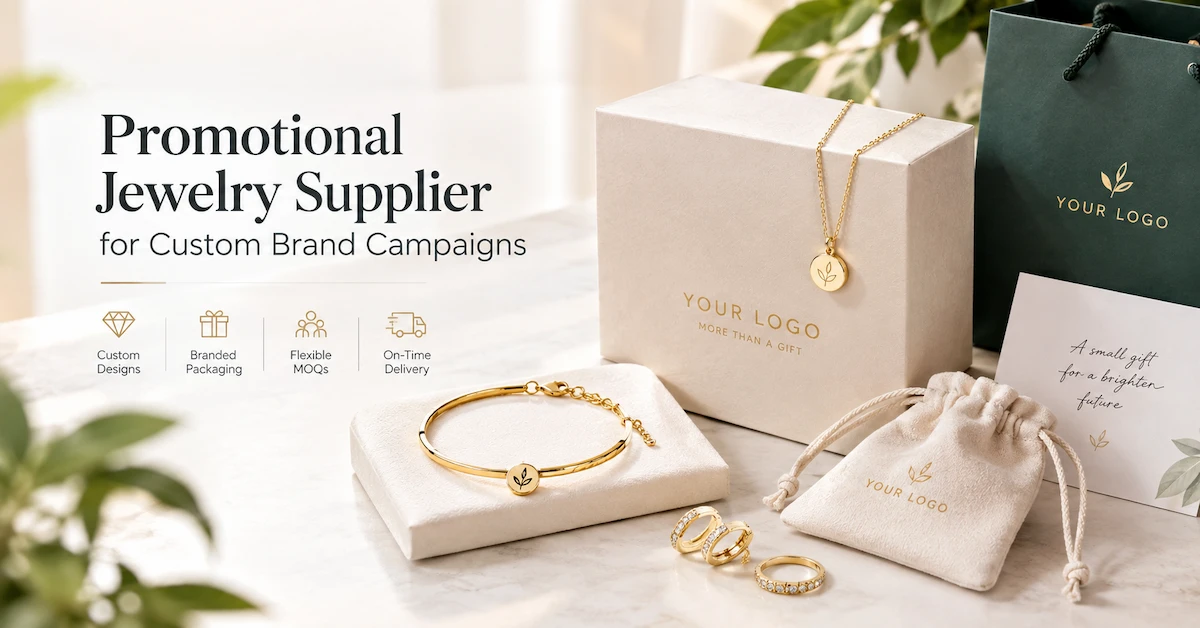
What Is Promotional Jewelry?
Promotional jewelry refers to jewelry products purchased by businesses for marketing, promotional, gifting, or brand-awareness purposes.
Typical applications include:
- Corporate promotional campaigns
- Trade shows and exhibitions
- Product launches
- Customer appreciation gifts
- Influencer campaigns
- Hotel and hospitality promotions
- Seasonal marketing events
- Brand membership programs
- Employee recognition gifts
- Retail promotional bundles
The jewelry itself may be simple or highly customized. What matters is how effectively it supports the marketing objective.
For example, a company may order hundreds of stainless steel bracelets with branded packaging for an event. Another business may choose personalized pendants as VIP customer gifts. The purchasing requirements are very different from those of a retailer looking for regular inventory.
Why Promotional Jewelry Requires a Different Supplier Strategy
When buying jewelry for resale, buyers usually focus on product design, margin, quality, and replenishment.
Promotional projects add several other variables.
| Requirement | Why It Matters |
|---|---|
| Product appeal | The recipient should want to keep and wear it |
| Brand visibility | The item should reinforce the company's identity |
| Customization | Logos, messages, colors, or packaging may be required |
| Quantity | Campaigns can require larger, coordinated orders |
| Delivery schedule | Products must arrive before the event |
| Budget | Cost per unit directly affects campaign economics |
| Packaging | Presentation influences perceived value |
| Consistency | Large quantities need stable quality across the order |
A supplier that performs well for ordinary wholesale orders may not necessarily be the best choice for promotional projects.
The ideal partner understands that the jewelry is part of a marketing campaign, not simply another product SKU.
What Types of Jewelry Work Well for Promotions?
The best promotional jewelry is usually attractive enough to be worn regularly while remaining practical for the campaign budget.
Bracelets
Bracelets are a popular option because they offer a relatively large surface for branding and can work across different customer groups.
They can be used for:
- Company events
- Charity campaigns
- Fitness-related promotions
- Customer loyalty programs
- Festival merchandise
Pendants and Necklaces
Pendants provide more opportunities for symbolic branding.
A company can use a meaningful shape, initial, icon, or simple geometric design rather than placing a large logo directly on the jewelry.
This approach often produces a more wearable result.
Rings
Rings can work well for limited campaigns, membership gifts, or fashion-oriented promotions.
However, sizing needs to be considered before placing a large order. Adjustable designs can simplify inventory planning when recipients have different sizes.
Earrings
Earrings are useful when the target audience is clearly defined.
Lightweight designs are generally easier to package and distribute during events, making them suitable for promotional kits and retail collaborations.
Branding Options for Promotional Jewelry
Customization does not always mean creating a completely new jewelry design.
A promotional jewelry supplier may offer several levels of branding.
1. Logo Customization
A logo can be applied to jewelry components, tags, cards, boxes, or pouches.
For many campaigns, branded packaging is more practical than putting a large logo directly on the jewelry.
2. Engraving
Engraving can be used for:
- Logos
- Initials
- Short messages
- Dates
- Campaign names
- Symbols
It creates a more permanent branding effect and can work particularly well for corporate gifts.
3. Custom Packaging
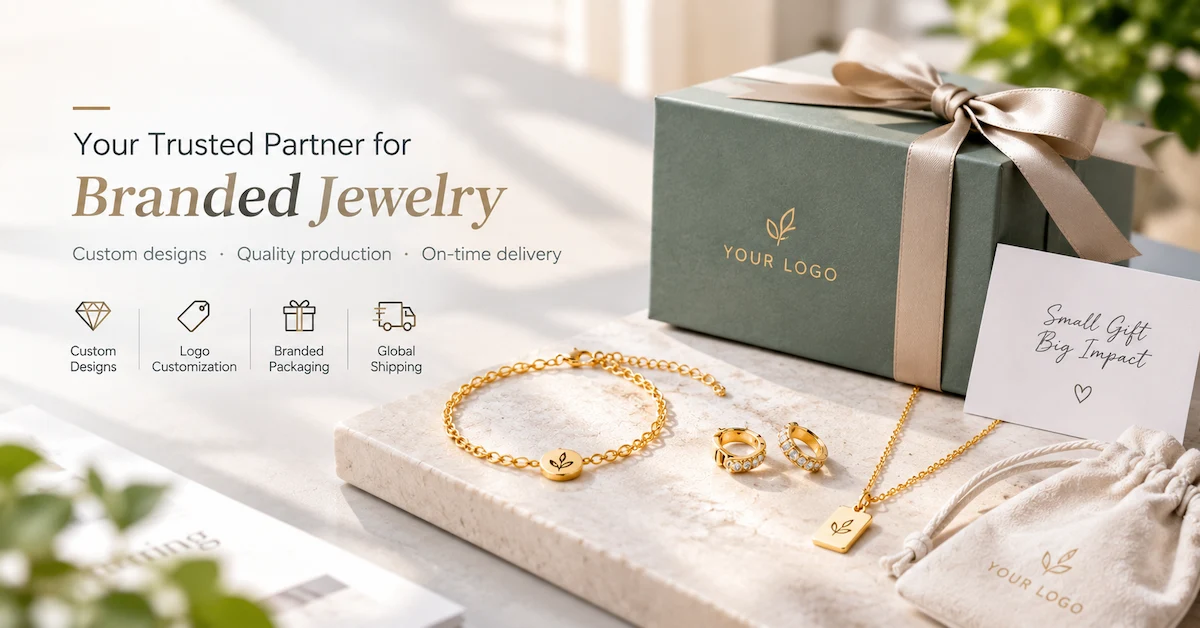
Packaging is one of the most useful tools for promotional jewelry.
A relatively simple bracelet can feel much more premium when presented in a customized box, pouch, or branded card.
For marketing teams, this also creates another place to communicate the campaign message.
4. Custom Colors and Finishes
Certain campaigns may require jewelry colors that match a corporate identity or event theme.
Depending on the product, buyers may explore different plating colors, finishes, materials, or decorative elements.
The key is to confirm which options are realistic for the required quantity and production schedule.
Promotional Jewelry Supplier vs. Regular Jewelry Wholesaler
These two supplier types can overlap, but their strengths are different.
| Factor | Promotional Jewelry Supplier | Regular Jewelry Wholesaler |
|---|---|---|
| Main purpose | Marketing and gifting | Product resale |
| Branding | Usually important | Often limited |
| Packaging | Frequently customized | Usually standard |
| Quantity planning | Campaign-based | Inventory-based |
| Delivery | Often event-driven | Regular replenishment |
| Product selection | Chosen for promotional use | Chosen for retail demand |
| Customization | More important | Depends on supplier |
| Communication | Project-oriented | Order-oriented |
If your jewelry will be distributed as part of a campaign, supplier selection should begin with the campaign requirements rather than simply comparing product prices.
How to Choose a Promotional Jewelry Supplier
1. Start With the Campaign Objective
Before contacting suppliers, define what the jewelry is supposed to achieve.
Ask:
- Is the goal brand awareness?
- Is it a customer appreciation gift?
- Is it for an exhibition?
- Is it part of a product launch?
- Will recipients wear the jewelry afterward?
- Does the campaign have a fixed event date?
The answers will influence the product style, customization level, quantity, and delivery requirements.
2. Match the Product to the Audience
A promotional item should make sense for its recipients.
For a fashion campaign, trend-focused jewelry may be appropriate. For a corporate event, a cleaner and more understated design may perform better.
Think about:
- Age group
- Gender mix
- Lifestyle
- Fashion preferences
- Event type
- Expected product value
The goal is to choose something people are likely to keep rather than immediately discard.
3. Check Customization Capabilities
Ask the supplier exactly what can be customized.
Important details include:
- Jewelry shape
- Material
- Plating color
- Engraving
- Logo placement
- Packaging
- Product cards
- Gift boxes
- Quantity requirements
A clear customization process can prevent unnecessary revisions later.
4. Confirm Quality Before Mass Production
Request samples before approving a large promotional order.
Inspect:
- Surface finish
- Plating consistency
- Engraving quality
- Clasp or fastening strength
- Product dimensions
- Packaging quality
- Logo accuracy
For a campaign involving hundreds or thousands of recipients, small quality problems can quickly become large ones.
5. Build the Delivery Schedule Backward
Promotional orders are often tied to fixed dates.
Instead of asking only, “How long does production take?”, build a complete timeline:
Design → Sample → Approval → Production → Quality Inspection → Packaging → Shipping → Event
Leave enough time for unexpected production or shipping issues.
A supplier with clear project communication is often more valuable than one offering a slightly lower unit price.
How Much Does Promotional Jewelry Cost?
There is no single price for promotional jewelry because the total cost depends on several variables.
The main factors include:
- Jewelry material
- Product complexity
- Quantity
- Customization
- Plating or finishing
- Packaging
- Sampling
- Shipping method
- Delivery destination
A basic stock bracelet with standard packaging will have a very different cost structure from a fully customized pendant with branded packaging.
For this reason, comparing suppliers only by the unit price can be misleading.
A better comparison considers the total campaign cost.
A Simple Cost Framework
You can evaluate the project using:
Total Campaign Cost = Product + Customization + Packaging + Sampling + Shipping
Then calculate:
Cost Per Recipient = Total Campaign Cost ÷ Number of Recipients
This gives the marketing team a more useful number for campaign planning.
Stock Jewelry or Custom Jewelry?
The right choice depends on the campaign.
Choose Stock Jewelry When:
- The campaign timeline is short
- The budget is limited
- You need a proven design
- Branding can be handled through packaging
- The product needs to be reordered easily
Choose Custom Jewelry When:
- The campaign has a strong brand identity
- A unique product is important
- The jewelry represents a specific message
- You want exclusive designs
- The project has enough development time
A hybrid approach can also work. For example, a business may select an existing jewelry design while customizing the engraving and packaging.
This can reduce development time without making the campaign feel generic.
What Should You Ask a Promotional Jewelry Supplier?
Before placing an order, request clear answers to the following:
- What materials are available?
- What customization methods do you offer?
- Can you provide pre-production samples?
- What is the MOQ for customized products?
- How long does sampling take?
- How long does mass production take?
- Can you customize the packaging?
- How do you inspect large orders?
- What happens if the delivered quantity has quality issues?
- Can you support repeat orders?
These questions help separate a supplier that simply sells jewelry from one that can manage a promotional project.
Why Manufacturing Capability Matters
Promotional campaigns can involve large quantities and strict deadlines.
A supplier with direct manufacturing capabilities may provide better control over product development, production coordination, quality inspection, and customization.
LONCEEN, for example, combines jewelry design, manufacturing, sourcing, and wholesale capabilities. Its official website states that it operates its own factory and works with professional jewelry factories, while offering products in materials such as 304 stainless steel, 316L stainless steel, and 925 silver.
For businesses looking for a broader jewelry supply solution, you can explore the Lonceen Jewelry wholesale collection.
For projects requiring custom development, the supplier's manufacturing site also describes an OEM/ODM process covering communication, sample design, proofing, sample confirmation, production, assembly, delivery, and after-sales service.
This type of structured process can be useful when promotional jewelry needs to move from an idea to a finished campaign product.
A Practical Promotional Jewelry Buying Checklist
Before approving the order, review these points:
Product
- Is the design suitable for the target audience?
- Is the material appropriate for the expected use?
- Has a physical sample been approved?
Branding
- Is the logo placement correct?
- Are colors and finishes consistent?
- Has the packaging artwork been checked?
Production
- Is the quantity confirmed?
- Is the production schedule documented?
- Is there a quality inspection before shipment?
Logistics
- Is the shipping method suitable for the event date?
- Is there enough buffer time?
- Are packaging and labeling requirements clear?
Budget
- Is customization included in the quotation?
- Is packaging included?
- Are shipping costs calculated separately?
A detailed checklist can prevent small misunderstandings from becoming expensive campaign problems.
Final Thoughts
The right promotional jewelry supplier should do more than provide attractive products at a competitive price.
The supplier needs to understand the relationship between jewelry, branding, audience, campaign timing, and budget.
For marketing agencies, corporate buyers, event organizers, and promotional product companies, the strongest supplier is one that can support the entire project—from product selection and samples to customization, quality control, packaging, and delivery.
If you are planning a promotional jewelry campaign, start by defining the audience, quantity, budget, branding requirements, and deadline. Then choose a supplier that can meet those requirements consistently.
Contact Lonceen to discuss promotional jewelry sourcing, customization, and wholesale requirements.
FAQ
1. What is a promotional jewelry supplier?
A promotional jewelry supplier provides jewelry products for marketing campaigns, corporate gifts, events, customer promotions, and other brand-building activities.
2. Can promotional jewelry be customized with a logo?
Yes. Depending on the supplier and product, customization may include engraving, logo placement, branded packaging, cards, pouches, or gift boxes.
3. Is promotional jewelry suitable for corporate events?
Yes. Bracelets, pendants, necklaces, and other compact jewelry products can work well as event gifts, customer appreciation items, or branded promotional merchandise.
4. Should I choose stock or custom promotional jewelry?
Stock jewelry is generally better for shorter timelines and simpler campaigns. Custom jewelry is more suitable when unique branding or a specific campaign concept is important.
5. What materials are commonly used?
Common options include stainless steel, 925 sterling silver, copper, and other jewelry materials. The best choice depends on budget, design, target audience, and intended use.
6. Does promotional jewelry have a minimum order quantity?
MOQ depends on the supplier and the level of customization. Standard products may have more flexible quantities, while customized production can require a higher order volume.
7. How early should I order promotional jewelry?
Start as early as possible when the campaign has a fixed event date. Custom designs require additional time for sampling, approval, production, packaging, and shipping.
8. Can packaging be customized?
Yes. Branded boxes, pouches, cards, labels, and other packaging can be used to strengthen the promotional value of the jewelry.
9. How can I control quality for a large promotional order?
Approve a sample before mass production, confirm specifications in writing, and require quality inspection before shipment.
10. How do I choose the right promotional jewelry supplier?
Compare suppliers based on product quality, customization capability, communication, production capacity, quality control, delivery reliability, and total campaign cost rather than unit price alone.