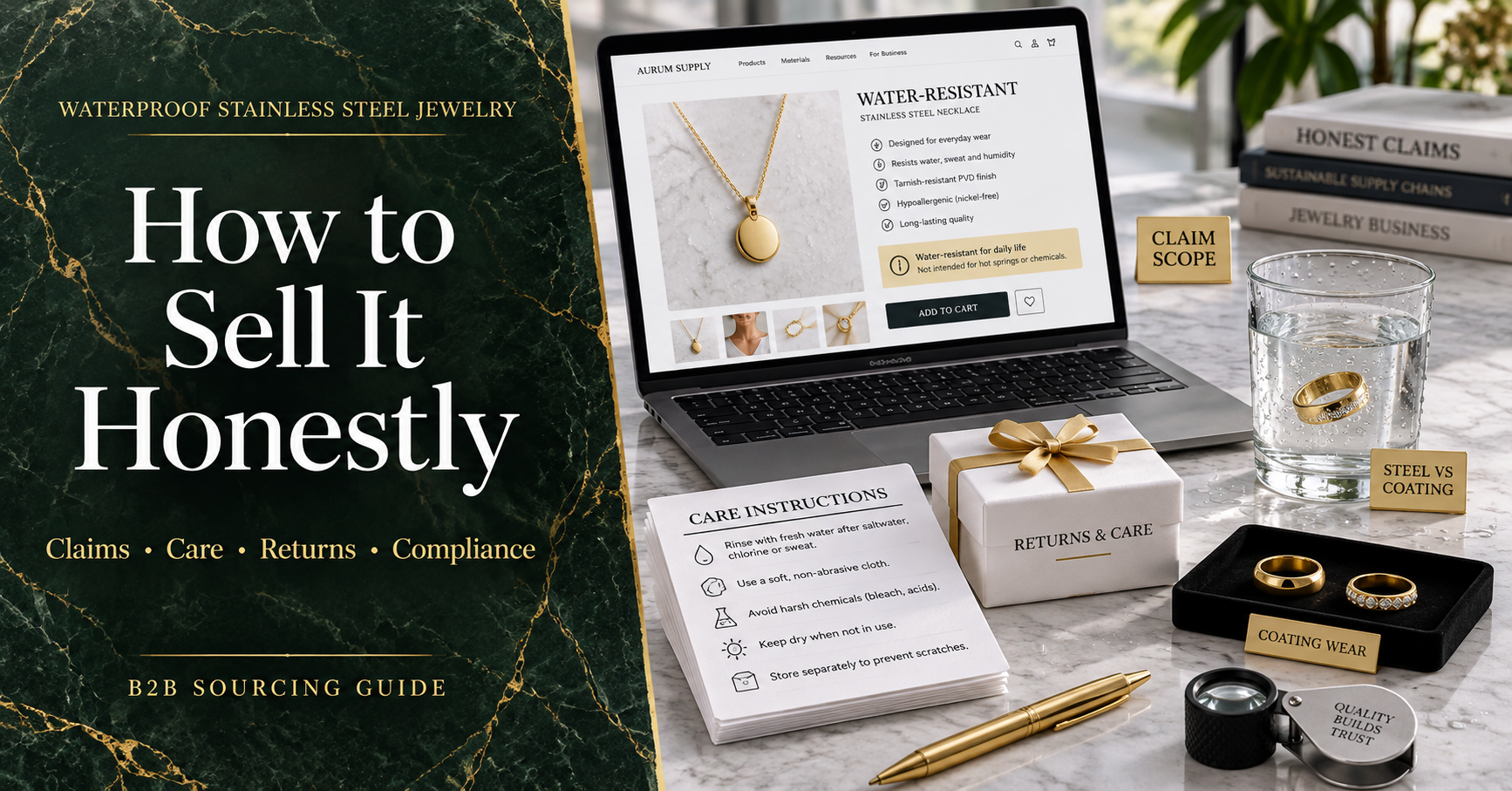


A stainless steel jewelry manufacturer is judged differently from a supplier working in precious metals. Stainless steel is chosen for durability, price positioning, and low maintenance, and much of its appeal rests on claims about water resistance, tarnish resistance, and finish longevity. Those claims are exactly where sourcing decisions most often go wrong.
This guide focuses on the material side of sourcing: what to confirm about grade, coating, and finish, how “waterproof” should be understood, and how stainless steel compares with silver and tungsten when you are building a range. It does not cover supplier screening, order fulfillment, or brand packaging; those belong to other sourcing discussions.
What Makes Stainless Steel Different
Stainless steel is an alloy, and its properties depend on grade and finishing, not on a single standard. That has practical consequences for sourcing:
- the grade determines corrosion resistance and how the metal behaves over time
- many gold-colored stainless items are coated, so the coating—not the steel—is often the weak point
- finish quality varies widely between manufacturers
- the same grade can be produced to very different surface standards
- appearance in a photo says little about how the item will look after months of wear
This is why stainless sourcing is a specification exercise. The questions that matter are about what the metal is and how its surface will hold up, not about how attractive the sample looks on day one.
1. Confirm the Material Grade
Grade is the foundation of every other claim about a stainless product.
Establish:
- which grade the manufacturer uses—commonly 304 or 316L in jewelry
- whether the grade is consistent across the range or varies by product
- what documentation the manufacturer can provide for the grade
- how the grade affects corrosion resistance and cost
- whether the grade stated in a quotation matches what is actually produced
A manufacturer that can state its grade clearly and consistently is easier to hold to a standard. A vague answer such as “good stainless steel” gives you nothing to verify.
2. Understand What “Waterproof” Actually Means
“Waterproof” is used loosely in jewelry marketing, and buyers should be precise about what it refers to.
Clarify:
- whether the claim refers to the steel itself or to the coating
- how the item performs in fresh water, salt water, and chlorinated water
- whether plating on the item is expected to survive repeated water contact
- what the manufacturer’s own wear testing or warranty language covers
- how the claim should be described to customers
The practical point is that the metal and the finish behave differently. An uncoated stainless item may handle water well, while a gold-plated stainless item may lose its color from the coating rather than the steel. Any water-resistance claim should be described in terms you can actually support, and its wording should be checked against the consumer-protection rules of your destination market before publishing.
3. Verify Coating and Finish Durability
For stainless jewelry with a gold, rose-gold, or black finish, the coating is usually the defining quality factor.
Ask:
- which coating process is used—PVD, electroplating, or another method
- how thick the coating is expected to be
- how the manufacturer tests coating adhesion and wear
- how the finish behaves under friction, sweat, and water
- whether the same coating process is used consistently across a range
Coating quality is the difference between a product that still looks new after months and one that shows wear quickly. It is worth confirming the process, not only the color.
4. Address Skin Contact and Allergy Claims Carefully
Stainless steel is often marketed as skin-friendly, and nickel content is a real consideration for some buyers. Claims in this area should be handled with care rather than assumed.
Confirm:
- what the manufacturer can state about nickel release or content
- whether any skin-contact claims can be documented
- how the item performs for sensitive-skin customers
- whether the coating affects skin contact
- how you would describe the product to customers
Statements about nickel, allergy, or skin safety are factual claims and, in many markets, regulated. They should be verified against the applicable rules and supported by the manufacturer’s documentation before they appear in a listing.
5. Confirm Color and Finish Consistency Across a Run
Stainless ranges often rely on consistent color—especially gold-tone and black finishes—so variation across a run becomes a visible problem.
Establish:
- how color and tone are controlled between batches
- whether finish is checked against a retained reference
- how the manufacturer handles slight color variation
- whether the same process is repeated for restock orders
- how you are informed when a process changes
A stainless range that shifts in tone between orders creates listing and customer-service problems, particularly for online sellers.
6. Match the Material to Product Category and Customer
Stainless steel fits some product categories far better than others, and the material should be chosen to suit the item’s use.
Consider:
- which categories suit stainless—rings, chains, bracelets, pendants, everyday wear
- whether the item will be worn daily or occasionally
- whether the customer expects a precious-metal look or a durable modern one
- whether weight and feel matter for the product
- whether price positioning is consistent with the material
Material choice is a merchandising decision as much as a technical one. Stainless works best where durability and low maintenance are part of the value proposition.
7. Position Stainless Steel Honestly Against Silver and Tungsten
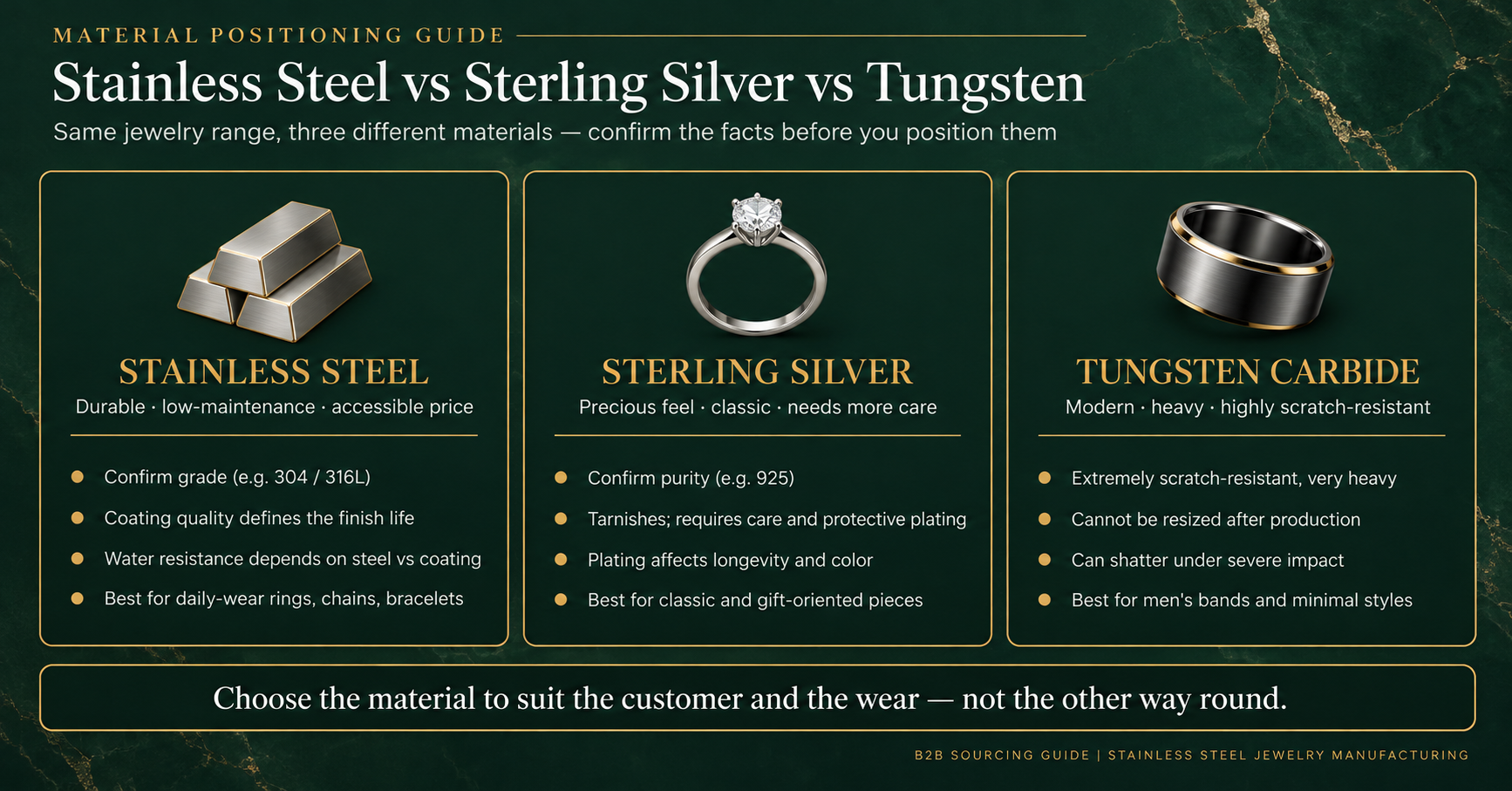
If your range includes several materials, buyers need a clear view of how they differ. The comparison is not about which is “best,” but about which suits which customer.
Each material carries different production implications. Silver tarnishes and needs care and protective plating; tungsten is extremely scratch-resistant and heavy but cannot be resized and can shatter under severe impact; stainless balances durability against cost and depends heavily on coating quality. Confirm these characteristics with the manufacturer rather than assuming consistency across materials.
8. Watch for Material-Specific Risk Signals
Some concerns are particular to stainless sourcing.
Watch for:
- grade claims that cannot be documented
- “waterproof” statements that do not distinguish steel from coating
- vague answers about coating process or thickness
- finish that differs noticeably between batches or orders
- allergy or skin-safety claims offered without evidence
- the same item quoted at very different prices without a material explanation
- inconsistent color in gold-tone or black finishes
Each of these signals deserves direct clarification before an order is placed.
A Stainless Steel Manufacturer Evaluation Checklist
Use this to compare manufacturers on material facts and finish consistency, not only on price.
A manufacturer that addresses all seven areas gives you a far more dependable basis for a stainless range than one that only quotes a price per piece.
Questions Worth Asking a Stainless Steel Jewelry Manufacturer
- Which grade do you use, and can you document it?
- Does your “waterproof” claim refer to the steel, the coating, or both?
- Which coating process do you use, and how is wear tested?
- What can you state about nickel content or skin contact?
- How do you keep gold-tone and black finishes consistent between batches?
- Which product categories do you consider best suited to stainless?
- How does your stainless compare with your silver and tungsten lines?
Specific, documented answers indicate a manufacturer that understands material properties, not just catalog presentation.
Conclusion
Choosing a stainless steel jewelry manufacturer is a material decision. The appeal of stainless rests on durability, low maintenance, and finish longevity—and those qualities depend on grade, coating process, and consistency, not on appearance alone.
Focus on grade, the true meaning of water resistance, coating and finish durability, skin-contact claims, color consistency, category fit, and honest positioning against silver and tungsten. Confirming these before ordering protects both the product and the claims you make about it.
If you are preparing a stainless range, ask for the grade and coating process in writing and test how the finish holds up before scaling. That evidence tells you far more than a sample that only looks good on arrival.