

Retail jewelry businesses need more than attractive products. They need a manufacturing partner that can support product selection, consistent quality, packaging, replenishment, and ongoing collection development.
Choosing a jewelry manufacturer for retailers is therefore different from simply finding a wholesale jewelry supplier. The key question is whether the manufacturer can fit into your retail operation and support the product lifecycle from initial selection to repeat orders.
For retailers, a strong manufacturing relationship can help create a more organized product assortment, reduce supply friction, and make it easier to expand successful collections.
What Does a Jewelry Manufacturer for Retailers Provide?
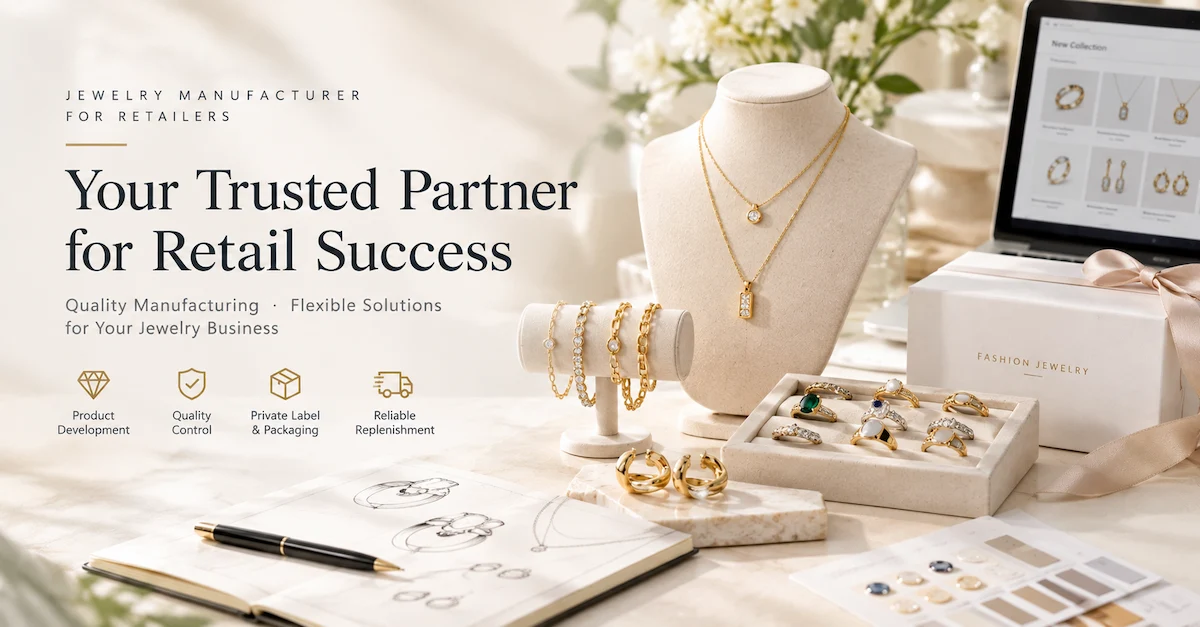
A jewelry manufacturer for retailers produces jewelry specifically for businesses that sell directly to consumers through physical stores, boutiques, online shops, or multiple retail channels.
Depending on the manufacturer, retail-focused services may include:
- Ready-to-sell jewelry collections
- Product development
- OEM and ODM manufacturing
- Private-label production
- Custom packaging
- Branding and labeling
- Sampling and prototyping
- Quality control
- Repeat production
- Wholesale order support
The important difference is the retail orientation.
A manufacturer serving retailers should understand that a product is not finished when it leaves the factory. It also needs to arrive in a condition suitable for display, inventory management, customer presentation, and future replenishment.
Why Retailers Need a Different Manufacturing Partner
Retailers operate around sell-through rather than production alone.
A product may look excellent in a factory catalog, but retailers also need to consider:
- How it fits the existing collection
- Whether customers can understand the product quickly
- How it will be displayed
- Whether different styles work together
- How easily successful products can be reordered
- Whether quality remains consistent between batches
- Whether packaging matches the store experience
This means the manufacturer should be evaluated as part of the retailer's supply system.
Instead of asking only, “Can they manufacture jewelry?”, retailers should ask:
“Can this manufacturer support the way my retail business buys, sells, and replenishes jewelry?”
Build a Retail-Ready Product Assortment
One of the first areas to evaluate is product assortment.
Retailers rarely need a collection made up of dozens of unrelated products. They usually need a balanced assortment that gives customers different price points, styles, and purchase reasons.
A practical assortment may include:
| Assortment Area | Retail Purpose |
|---|---|
| Core styles | Maintain dependable everyday products |
| Trend styles | Respond to changing consumer preferences |
| Entry-level products | Encourage lower-price purchases |
| Premium styles | Create higher-value options |
| Giftable jewelry | Support seasonal and occasion-based sales |
| Statement pieces | Add visual impact to displays |
| Matching products | Encourage cross-selling |
A manufacturer with a broad product development capability can help retailers build collections rather than purchasing isolated SKUs.
This is particularly useful when a retailer wants to expand from one jewelry category into several complementary categories.
SKU Planning Matters More Than Product Count
A large catalog does not automatically make a manufacturer useful to retailers.
Retailers need relevant SKU depth.
For example, a jewelry store may need several variations of a similar product concept:
- Different colors
- Different finishes
- Different sizes
- Different stones
- Different shapes
- Different price levels
This allows the retailer to create a cohesive collection without making the assortment look repetitive.
A useful manufacturer should therefore be able to discuss products at both the individual SKU level and the collection level.
The goal is not simply to offer more products. It is to help retailers build a selection that makes commercial sense.
Consistent Quality Across Repeat Orders
Retailers have a different quality concern from one-time buyers.
When a product sells well, the retailer may reorder it several times. If the appearance of the product changes significantly between batches, the customer experience can become inconsistent.
Retailers should therefore review how a manufacturer manages:
- Material specifications
- Product dimensions
- Surface finishing
- Plating color
- Stone placement
- Logo application
- Packaging
- Inspection procedures
- Production specifications
A repeat-order system should ideally be based on confirmed product specifications rather than relying on visual memory.
This creates a clearer reference for future production and helps maintain consistency as order quantities increase.
Retail Packaging Should Be Part of the Product
For retail businesses, packaging is not simply a shipping accessory.
The jewelry may be sold through a store display, gift counter, online product page, or branded packaging experience. Packaging can therefore influence how the customer perceives the product.
Retailers may require:
- Jewelry cards
- Product labels
- Pouches
- Boxes
- Care cards
- Barcodes
- Brand inserts
- Custom packaging
A manufacturer that can coordinate product and packaging requirements can simplify the retailer's purchasing process.
Instead of sourcing jewelry from one supplier and packaging from another, retailers may be able to consolidate more of the product preparation through one manufacturing relationship.
Sampling Before Retail Production
Before committing to a larger production order, retailers should evaluate physical samples.
Product photographs are useful for initial selection, but physical samples allow buyers to examine details that are difficult to judge online.
A retail sample review can include:
| Area | What Retailers Should Check |
|---|---|
| Appearance | Does the actual product match the presentation? |
| Finish | Is the surface clean and consistent? |
| Comfort | Is the product comfortable to handle and wear? |
| Construction | Are components properly assembled? |
| Color | Is the finish consistent with the approved sample? |
| Packaging | Is the product presentation suitable for retail? |
| Product information | Are specifications clear and accurate? |
Sampling is especially important when the product will become part of a long-term retail collection.
Once a sample is approved, the retailer should keep clear records of the specifications for future orders.
Replenishment Is Part of Retail Supply
For retailers, the first order is only one stage of the relationship.
A successful product creates another operational question:
Can the manufacturer reproduce and replenish it when inventory needs to be restored?
This makes repeat-order capability an important factor when selecting a jewelry manufacturer for retailers.
A practical replenishment process should cover:
- Product identification
- Confirmed specifications
- Required quantity
- Production schedule
- Quality inspection
- Packaging
- Shipping arrangement
Clear communication at each stage helps retailers reduce unnecessary delays when popular products need to be restocked.
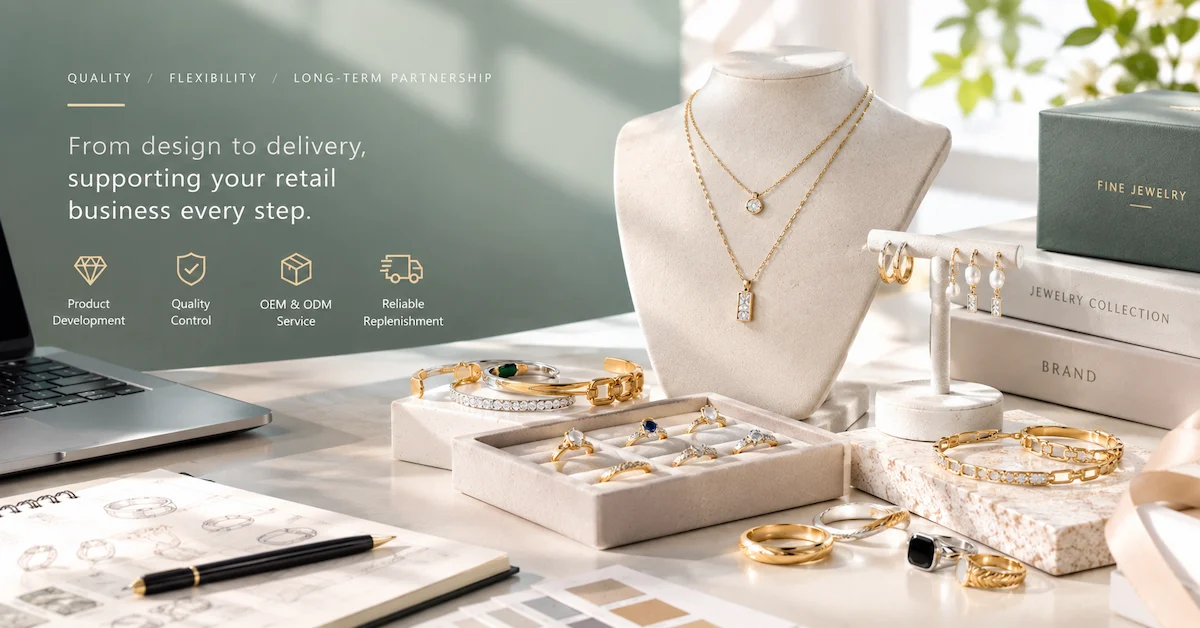
Private Label Support for Retail Stores
Some retailers sell products under their own brand rather than the manufacturer's name.
In this situation, the manufacturing partner may need to support:
- Brand logos
- Jewelry cards
- Packaging
- Product labels
- Customized finishes
- Product specifications
- Private-label presentation
Private labeling can help retailers create a more consistent customer experience across their product range.
The important consideration is whether the manufacturer can reproduce the approved brand elements consistently across different products.
OEM and ODM for Retail Collection Development
Retailers may begin with ready-made products but later require more differentiated collections.
This is where OEM and ODM services can become useful.
OEM is suitable when the retailer already has defined product requirements and needs a manufacturer to produce them.
ODM can be useful when the retailer needs greater development support, including product concepts, design directions, or collection development.
For retailers, the practical workflow may look like:
Market Idea → Product Direction → Sample → Approval → Production → Retail Launch → Reorder
This approach allows a retailer to begin with a specific product requirement and gradually develop a broader collection.
Compare Manufacturers by Retail Capability
Price is only one part of a manufacturing decision.
A more useful comparison focuses on how each manufacturer fits your retail operation.
| Evaluation Area | Questions to Ask |
|---|---|
| Product range | Can the manufacturer support your target categories? |
| SKU flexibility | Can products be developed in multiple variations? |
| Sampling | Can you approve physical samples before production? |
| Quality control | How are specifications checked during production? |
| Packaging | Can retail-ready packaging be supplied? |
| Branding | Is private-label support available? |
| Replenishment | Can successful products be reproduced consistently? |
| Customization | Can existing designs be modified when needed? |
| Communication | Can specifications be clearly confirmed? |
| Scalability | Can the relationship support larger future orders? |
This approach creates a more practical evaluation than comparing unit prices alone.
When a Retailer Should Consider a Direct Manufacturer
Working directly with a manufacturer can become particularly relevant when a retailer:
- Needs regular replenishment
- Wants private-label products
- Plans to develop exclusive collections
- Requires consistent product specifications
- Needs multiple jewelry categories
- Wants packaging customization
- Expects order volumes to grow
- Wants a long-term product development partner
For retailers with ongoing product requirements, the relationship can become more valuable as the number of SKUs and repeat orders increases.
How to Start a Retail Manufacturing Project
Before contacting a jewelry manufacturer, prepare a simple retail product brief.
Include:
1. Retail Positioning
Explain your store type, target customer, and general product positioning.
2. Product Categories
Specify whether you need rings, necklaces, earrings, bracelets, pendants, or a broader jewelry collection.
3. Style Direction
Describe the visual direction, such as minimalist, fashion, classic, contemporary, or statement jewelry.
4. Order Requirements
Provide estimated quantities and whether you are testing new products or placing recurring orders.
5. Branding Requirements
Include logo, labeling, jewelry cards, packaging, and other private-label requirements.
6. Sample Requirements
Identify which products need physical samples before production.
7. Replenishment Expectations
If some products are expected to become core SKUs, tell the manufacturer that repeat availability is important.
The more clearly these requirements are defined, the easier it is for the manufacturer to provide a relevant solution.
Why Retailers Should Think Beyond the First Order
The first purchase is often treated as the main supplier decision.
For a retail business, however, the longer-term relationship may be more important.
A manufacturer that supports retailers should be able to help with a process such as:
Selection → Sampling → Retail Launch → Sales Feedback → Replenishment → Collection Expansion
This creates a more continuous supply model.
Instead of repeatedly searching for new suppliers whenever a product performs well, retailers can develop a stable manufacturing relationship around proven product requirements.
Jewelry Manufacturer for Retailers: Key Takeaways
A jewelry manufacturer for retailers should be evaluated according to the complete retail product lifecycle.
The most important areas include:
- Retail-ready product selection
- Useful SKU variety
- Consistent manufacturing quality
- Physical sample approval
- Packaging and private-label support
- Flexible product development
- Reliable replenishment
- Clear production communication
- Long-term collection development
The objective is not simply to find a company that can produce jewelry. It is to find a manufacturing partner whose capabilities match the way your retail business selects, launches, sells, and replenishes products.
For retailers planning ongoing jewelry purchases, this broader approach can create a more organized supply process and provide a foundation for expanding the product range over time.
FAQ
What is a jewelry manufacturer for retailers?
A jewelry manufacturer for retailers produces jewelry and related services specifically for businesses selling jewelry to consumers. Services may include manufacturing, sampling, private labeling, packaging, and repeat production.
What should retailers look for in a jewelry manufacturer?
Retailers should evaluate product range, SKU flexibility, sample quality, manufacturing consistency, packaging, branding support, replenishment capability, and communication.
Can a jewelry manufacturer provide private-label products?
Yes. Many manufacturers offer private-label services such as logos, jewelry cards, packaging, labels, and customized product specifications. Requirements vary by manufacturer and project.
Do retailers need samples before placing an order?
Physical samples are useful for evaluating appearance, finishing, comfort, construction, packaging, and other details before larger production.
Can retailers order multiple jewelry categories from one manufacturer?
Depending on the manufacturer's capabilities, retailers may source rings, necklaces, earrings, bracelets, pendants, and other categories through one manufacturing relationship.
What is the difference between a supplier and a manufacturer?
A supplier may distribute products from different sources, while a manufacturer directly participates in product production. Some businesses combine manufacturing and sourcing capabilities.
Can retailers develop their own jewelry collections?
Yes. Retailers can work with manufacturers through OEM, ODM, private-label, or custom development programs, depending on their product requirements.
How important is replenishment for retail jewelry?
It is important for products that become regular sellers. A repeat-order process helps retailers maintain availability and keep successful SKUs in their collections.
Should retailers choose a manufacturer based only on price?
No single factor describes manufacturing suitability. Retailers should also consider product quality, sampling, packaging, branding, production consistency, replenishment, and communication.
Can a manufacturer support long-term retail growth?
A suitable manufacturing partner can support growth by helping retailers expand product categories, develop new SKUs, manage repeat production, and introduce customized collections.