

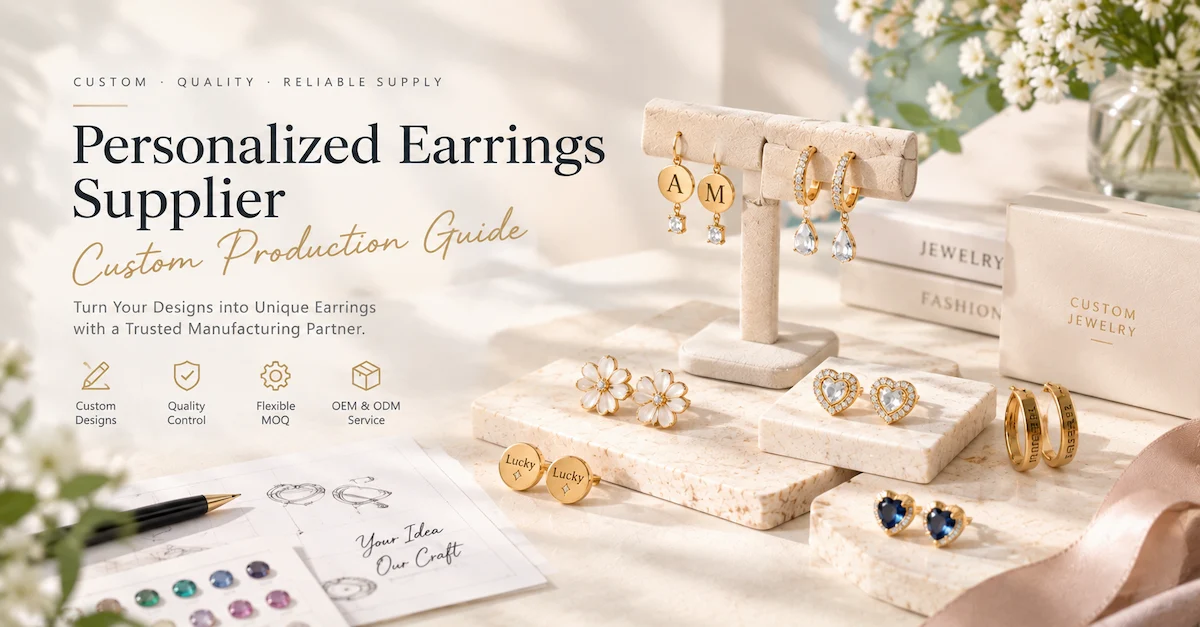
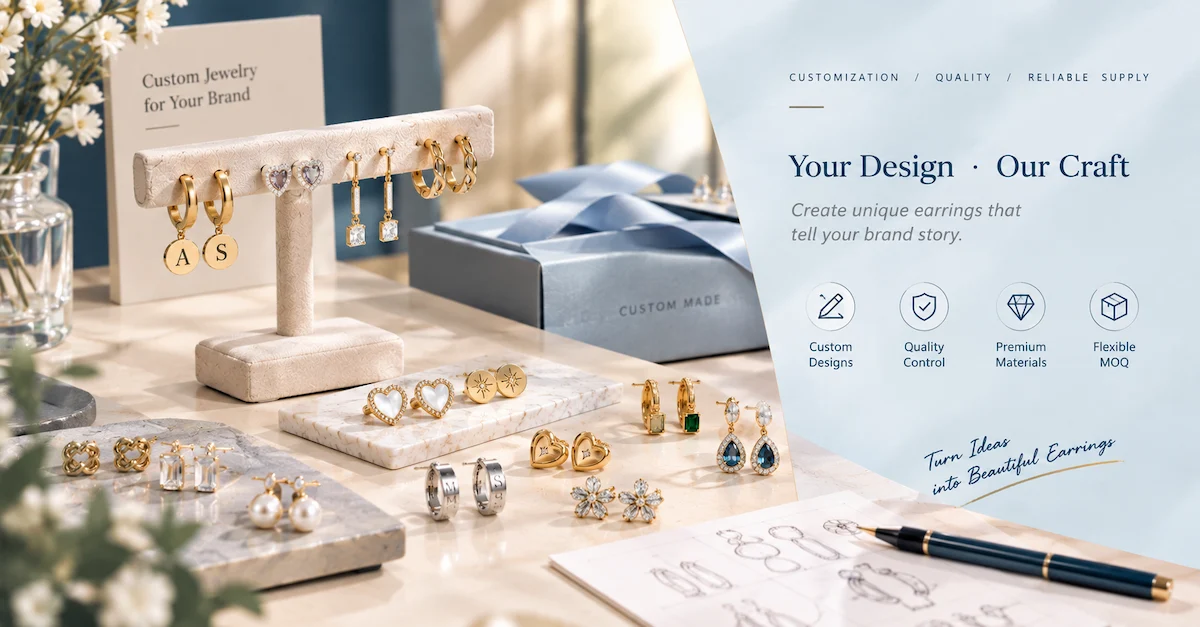
Personalized earrings give jewelry brands a way to offer products that feel more distinctive without creating an entirely new jewelry category. Names, initials, symbols, dates, birthstones, engraving, and custom shapes can all be incorporated into an earring collection.
However, personalized earrings are more demanding to manufacture than standard earrings. A supplier must control not only the jewelry itself but also personalization accuracy, left-and-right matching, attachment structure, finishing, packaging, and production consistency.
For brands developing custom earring collections, the right personalized earrings supplier should therefore be evaluated by its ability to turn a personalization concept into a repeatable production process.
What Does a Personalized Earrings Supplier Provide?
A personalized earrings supplier typically supports the development and production of earrings with customer-specific or brand-specific details.
Depending on the project, personalization may include:
- Initials or letters
- Names or short words
- Dates or numbers
- Engraved symbols
- Birthstones or colored stones
- Custom motifs
- Special shapes
- Logo elements
- Custom finishes
- Branded packaging
The important distinction is that personalization is not simply adding text to an existing earring.
The supplier needs to determine whether the design can be produced consistently at the required size, thickness, detail level, and quantity.
For example, an initial engraved on a small stud earring requires different production considerations from a large custom hoop or drop earring.
A suitable manufacturing partner should evaluate the complete product before production begins.
Why Personalized Earrings Need a Specialized Production Process
Earrings have several characteristics that make personalization more sensitive.
Unlike a large pendant or bracelet surface, an earring may have limited space for customization. Small changes in typography, engraving depth, stone placement, or component size can affect the final appearance.
There is also another issue: earrings are normally produced and sold as pairs.
This means manufacturers need to control:
- Left-and-right design consistency
- Matching dimensions
- Matching color and finish
- Matching stone placement
- Matching engraving position
- Earring-post alignment
- Backing compatibility
- Overall weight balance
A supplier that can manufacture ordinary jewelry is not automatically experienced in managing these details at scale.
The goal should be repeatable personalization, not simply one successful sample.
Popular Personalization Options for Earrings
Different customization methods create different production requirements.
1. Initial and Letter Earrings
Initial earrings are one of the simplest ways to create personalized products.
A brand may offer:
- A–Z letter selections
- Single initials
- Double initials
- Monograms
- Letter combinations
- Custom symbols
For production, the supplier should establish consistent rules for font, dimensions, thickness, and attachment structure.
This is particularly important when a collection contains the entire alphabet. Each letter should maintain a consistent visual language rather than appearing as unrelated products.
2. Name and Word Earrings
Name earrings require more customization because the number of characters can vary.
Before production, brands should define:
- Maximum character count
- Font style
- Character spacing
- Minimum line thickness
- Maximum pendant size
- Position of the name
- Engraving or cut-out method
These specifications reduce the risk of producing names that look visually unbalanced.
3. Engraved Earrings
Engraving is useful when a brand wants personalization without significantly changing the basic earring structure.
Possible details include:
- Initials
- Dates
- Short messages
- Coordinates
- Symbols
- Small logos
The supplier should confirm the available engraving area before finalizing the design.
4. Birthstone and Color Personalization
Personalization does not always require text.
Brands can create customizable earrings through:
- Birthstone selections
- Different gemstone colors
- Pearl options
- Enamel colors
- Mixed-metal finishes
This model can be easier to scale because customers select from predefined options rather than submitting completely different artwork for every order.
5. Custom-Shaped Earrings
For stronger product differentiation, brands may develop earrings around a unique shape or motif.
Examples include:
- Initial-shaped earrings
- Heart designs
- Star motifs
- Geometric forms
- Floral elements
- Brand-specific symbols
These projects usually require more development work and may benefit from 2D drawings, 3D files, or physical prototypes before mass production.
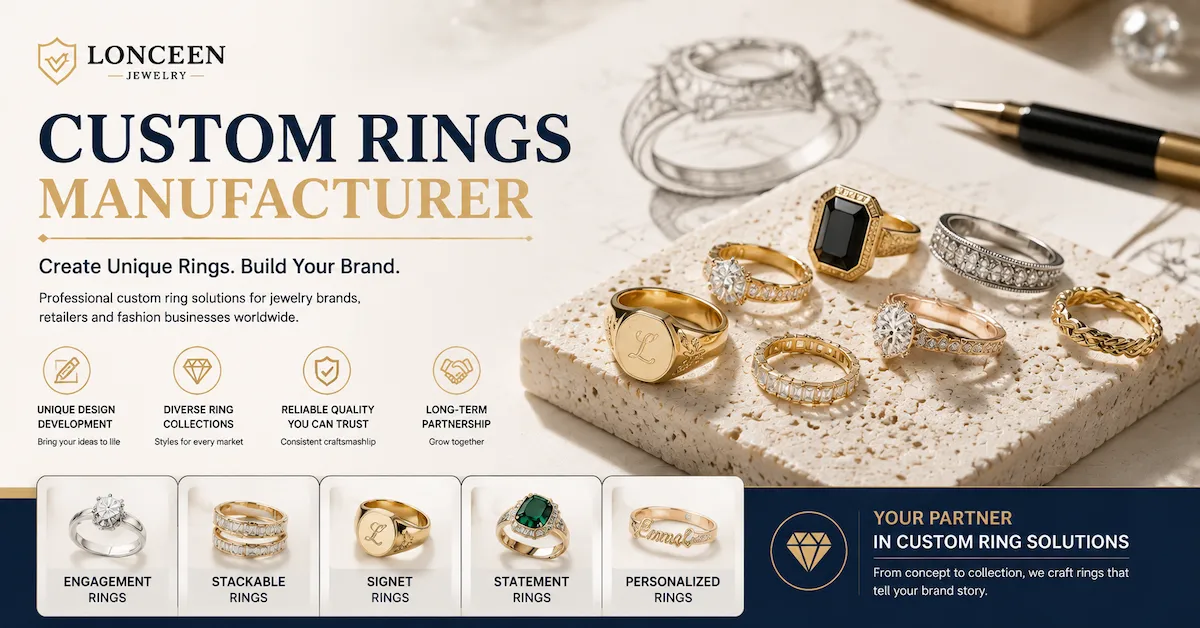
For brands developing a completely new concept, a manufacturer offering broader custom jewelry development can be useful. Custom Jewelry Supplier
Key Specifications to Confirm Before Production
A personalized earrings supplier should not quote a project based only on a product image.
The production specification should cover the details that influence both appearance and manufacturing.
| Specification | What to Confirm |
|---|---|
| Earring type | Stud, hoop, drop, dangle, huggie |
| Material | Stainless steel, 925 silver, alloy, etc. |
| Personalization | Initial, name, engraving, stone, symbol |
| Size | Overall dimensions and thickness |
| Finish | Polished, plated, PVD, matte or textured |
| Attachment | Post, hook, hoop mechanism or other structure |
| Stone setting | Type, size and placement |
| Pair matching | Left/right consistency |
| Packaging | Standard or branded packaging |
| Quantity | Sample quantity and production quantity |
This specification sheet becomes especially important when the product has many personalization variants.
Personalization Accuracy Is a Core Quality-Control Issue
For standard jewelry, quality control often focuses on appearance, dimensions, plating, stone setting, and structural integrity.
Personalized earrings add another layer: the personalized information itself must be correct.
A practical workflow can look like this:
Customer Information → Artwork Confirmation → Sample/Proof → Approval → Production → Personalization Check → Final QC → Packing
The supplier and buyer should agree on how personalized information is submitted and approved.
For example, an order may contain hundreds of different initials or names. The manufacturing team needs a clear production file rather than relying on informal messages.
Before bulk production, brands should confirm:
- Spelling
- Font
- Character order
- Artwork
- Engraving location
- Color
- Stone selection
- Quantity by variation
This is one of the most important differences between personalized production and standard wholesale sourcing.
Sampling Should Come Before Bulk Production
A personalized earrings supplier should ideally provide a sample or production proof before a large order is released.
The sample should be checked for more than appearance.
Design Check
Does the finished earring match the approved design?
Personalization Check
Are the letters, names, symbols, or dates correct?
Structural Check
Are the earring posts, hooks, clasps, and attachments secure?
Pair Check
Do both earrings match in size, shape, color, and personalization position?
Finish Check
Is the plating or surface finish consistent with the approved sample?
Only after these points are confirmed should the project move into larger-scale production.
Materials and Finishing for Personalized Earrings
Material selection affects the appearance, positioning, durability, and production cost of personalized earrings.
Common options include:
Stainless Steel
Stainless steel can be suitable for fashion jewelry collections where durability and accessible pricing are important.
316L Stainless Steel
316L stainless steel is often selected for jewelry projects requiring a more specific material positioning.
925 Sterling Silver
Sterling silver is suitable for brands positioning personalized earrings toward a more premium segment.
Alloy
Alloy can provide greater flexibility for certain shapes and fashion-oriented designs, depending on the project requirements.
Finishing options may include:
- Gold plating
- Silver-tone finishing
- Rose-gold finishing
- PVD coating
- Polished surfaces
- Matte surfaces
- Textured finishes
The best material should be selected according to the design, target market, positioning, and production requirements rather than simply choosing the cheapest option.
MOQ and Production Quantity
MOQ for personalized earrings depends heavily on the production model.
There is a major difference between:
Pre-designed personalization
Customers choose from predefined letters, symbols, stones, or colors.
and
Fully customized production
Each order may require different names, shapes, artwork, or specifications.
The second model normally creates more production complexity because the manufacturer must process more unique variations.
Before placing an order, ask the supplier:
- What is the MOQ for standard designs?
- What is the MOQ for customized designs?
- Can different personalization options be combined in one order?
- Is there a minimum quantity per variation?
- Does the MOQ change for different materials?
- Is the sample included in the production MOQ?
This information helps brands design a personalization model that is commercially practical.
How a Personalized Earrings Supplier Can Support OEM and ODM
OEM and ODM become particularly useful when a brand wants to move beyond simple personalization.
OEM
The brand provides the design or specifications, while the manufacturer handles production.
For example:
Brand Concept → Design File → Sample → Approval → Production
ODM
The manufacturer contributes design and development expertise to transform a concept into a production-ready product.
This can be useful when a brand has:
- A rough sketch
- A reference image
- A concept
- A preferred material
- A target price
- A desired style
but does not have a complete manufacturing specification.
Lonceen's published OEM/ODM information describes a workflow in which customers can provide concepts or files and the design team develops production-ready CAD information after the details are confirmed.
For a personalized earring collection, this can shorten the distance between a creative idea and a manufacturable product.
Compare Personalized Earrings Suppliers by Production Capability
Price is only one part of the supplier decision.
| Factor | Basic Supplier | Custom-Focused Supplier |
|---|---|---|
| Standard earrings | Yes | Yes |
| Initial personalization | Sometimes | Yes |
| Name customization | Limited | Yes |
| Custom artwork | Limited | Supported |
| Sampling | Basic | Structured |
| Pair consistency | Standard QC | Dedicated checking |
| OEM | Limited | Supported |
| ODM | Limited | Supported |
| Packaging | Standard | Custom options |
| Repeat production | Depends | Process-based |
For personalized products, the key question is not simply:
“Can this supplier make earrings?”
A better question is:
“Can this supplier reproduce customized earrings accurately across many variations and future orders?”
Packaging for Personalized Earrings
Packaging becomes particularly important when personalized earrings are sold directly to consumers.
The packaging can communicate:
- Brand identity
- Product information
- Personalization details
- Care instructions
- Gift positioning
- SKU information
For larger personalized collections, packaging should also support internal order management.
For example, a package label may need to identify:
- Product code
- Personalization code
- Customer order number
- Quantity
- Variation
- Packaging type
This reduces the risk of mixing personalized products during fulfillment.
How to Start a Personalized Earrings Project
Before contacting a supplier, prepare a basic project brief.
Step 1: Define the Earring Type
Choose whether the project uses studs, hoops, drops, huggies, or another structure.
Step 2: Define the Personalization
Decide whether customers can customize initials, names, dates, stones, symbols, or complete designs.
Step 3: Set Product Specifications
Prepare the preferred material, dimensions, finish, attachment method, and packaging requirements.
Step 4: Request a Sample
Ask the supplier to produce a physical sample or proof based on the final personalization specifications.
Step 5: Approve the Production Standard
Confirm the approved sample as the reference for future production.
Step 6: Establish the Order File
Create a structured system for submitting names, letters, artwork, quantities, and variations.
Step 7: Start Bulk Production
Once specifications and personalization data are confirmed, move into production and final inspection.
Why Repeatability Matters More Than One Successful Sample
A personalized earrings supplier may produce an excellent first sample.
That alone does not guarantee a successful long-term partnership.
The more important test is whether the supplier can reproduce the same product when:
- The order quantity increases
- Personalization variations increase
- Materials change
- A new production batch begins
- The collection expands
- Customers reorder older designs
For this reason, brands should document the approved sample, technical specifications, personalization rules, packaging requirements, and QC standards.
A clear production standard gives future orders a reference point.
Lonceen Jewelry for Personalized Jewelry Development
For brands looking for personalized jewelry manufacturing support, Lonceen Jewelry provides wholesale, OEM, ODM, and custom jewelry services. Its published product and manufacturing information covers materials, design development, customization, sampling, and production support.
Lonceen also lists earrings within its jewelry product range, including customizable earring projects where MOQ and production timing depend on the selected design, material, stock status, and customization requirements.
FAQ About Personalized Earrings Suppliers
1. What is a personalized earrings supplier?
A personalized earrings supplier produces earrings with customizable elements such as initials, names, engraving, stones, symbols, shapes, or other brand-specific details.
2. Can I customize the name on each pair of earrings?
Yes, depending on the supplier's production system. The order should include clearly structured personalization information for approval and production.
3. Can a supplier make custom earring shapes?
Yes. Custom earring shapes can be developed through drawings, reference images, CAD files, or OEM/ODM development.
4. What materials can be used for personalized earrings?
Common choices include stainless steel, 316L stainless steel, 925 sterling silver, and alloy. The appropriate option depends on design, positioning, and production requirements.
5. Do personalized earrings require samples?
A sample is strongly recommended, especially when the project includes new shapes, engraving, unusual dimensions, or multiple personalization options.
6. What should I check on a personalized earring sample?
Check the design, personalization accuracy, size, pair matching, attachment structure, finish, stone placement, and overall workmanship.
7. Is MOQ higher for personalized earrings?
It can be. MOQ depends on the design, material, customization method, production complexity, and number of variations.
8. Can personalized earrings be private labeled?
Yes. Depending on the supplier, brands may be able to customize product details, logos, packaging, and other brand elements.
9. How can I reduce mistakes in personalized orders?
Use a standardized order file and require artwork or personalization approval before production. Keep the approved sample as the production reference.
10. What should I ask a personalized earrings supplier before ordering?
Ask about customization methods, materials, MOQ, sample process, personalization accuracy, QC procedures, packaging, lead time, OEM/ODM capability, and repeat-order support.
Conclusion
The value of a personalized earrings supplier is not simply the ability to add a name or initial to an earring.
For brands, the real manufacturing challenge is creating a system that can manage customization accurately while maintaining consistent product quality, pair matching, finishing, packaging, and repeat production.
When evaluating suppliers, focus on five areas:
- Personalization capability
- Earring-specific production accuracy
- Sampling and approval process
- Quality control for multiple variations
- Repeat-order consistency
A supplier that can manage these areas can become more than a production source. It can support the development of a scalable personalized earring collection from the first prototype through ongoing production.