

Finding the right jewelry ring supplier China can make a significant difference to a jewelry brand's product range, margins, consistency, and ability to launch new collections.
Rings may look simple compared with larger jewelry categories, but sourcing them requires attention to details that are easy to overlook. Ring size, inner comfort, metal thickness, stone setting, plating, finishing, and style consistency can all affect the final product.
For brands, wholesalers, retailers, and online jewelry businesses, the goal is therefore not simply to find a supplier offering inexpensive rings. The more important question is whether the supplier can provide the right combination of ring styles, materials, production capabilities, customization options, and commercial support.
This guide explains what to look for when evaluating a China jewelry ring supplier and how to build a ring collection that can support your business over time.
What Can a Jewelry Ring Supplier in China Provide?
A China-based ring supplier may support several different sourcing models.
Depending on your business model, you may need:
- Ready-made wholesale rings
- Private-label ring collections
- Custom ring designs
- OEM or ODM production
- Seasonal ring collections
- Stainless steel rings
- 925 sterling silver rings
- Brass or copper rings
- Stone-set fashion rings
- Adjustable and open rings
- Men's and women's ring collections
The important point is that “ring supplier” does not describe a single type of supplier.
Some companies mainly sell existing designs. Others focus on custom manufacturing. Some combine product development, manufacturing, inventory, and private-label services.
For example, current China supplier listings show ring suppliers working with materials such as stainless steel, brass, and 925 sterling silver, while also offering OEM/ODM capabilities.
This makes supplier capability more important than simply comparing catalog size or unit price.
1. Start With the Type of Ring Collection You Need
Before contacting a supplier, define the type of ring collection you want to build.
A fashion jewelry brand may need a broad assortment of affordable everyday rings. A semi-fine jewelry brand may require 925 sterling silver and higher-quality stone settings. A men's jewelry brand may focus on heavier bands, geometric designs, or stainless steel.
Your requirements can usually be divided into several areas:
| Requirement | Examples |
|---|---|
| Ring style | Band, stacking, open, geometric, statement |
| Target customer | Women, men, unisex |
| Material | Stainless steel, brass, 925 sterling silver |
| Finish | Gold tone, silver tone, rose gold, polished, matte |
| Stones | CZ, zircon, natural stones, other options |
| Sizing | Fixed sizes, multiple sizes, adjustable |
| Branding | Logo, packaging, product cards |
| Order type | Ready-made, private label, OEM/ODM |
Having this information ready makes supplier communication much more efficient.
Instead of asking, “Can you supply rings?”, you can describe exactly what your collection requires.
2. Look for a Supplier With a Real Ring Product Range
One of the first things to evaluate is product depth.
A supplier may have hundreds of jewelry SKUs, but that does not necessarily mean it has strong ring capabilities.
Look specifically at the supplier's ring assortment.
A useful ring catalog may include several design directions such as:
- Minimalist bands
- Stackable rings
- Adjustable rings
- Open rings
- Geometric rings
- Stone-set rings
- Signet-inspired designs
- Fashion rings
- Men's rings
- Seasonal collections
This gives buyers more flexibility when creating a coordinated collection.
A supplier with multiple ring categories can also reduce the need to manage several small vendors for different designs.
Lonceen's current product structure includes Ring alongside necklaces, earrings, bracelets, brooches and other jewelry categories, while its manufacturing information highlights stainless steel, 925 sterling silver, and copper jewelry production.
Explore Lonceen's jewelry product range
3. Evaluate Materials Based on Your Market Position
Material selection should match your selling price, target customer, and product positioning.
Stainless Steel
Stainless steel is commonly used for fashion jewelry because it can support durable everyday designs and relatively straightforward production.
It can be suitable for:
- Everyday fashion rings
- Men's jewelry
- Minimalist collections
- Trend-driven designs
- Larger-volume collections
925 Sterling Silver
925 sterling silver can be appropriate when a brand wants to position its rings above basic fashion jewelry.
It is commonly used for:
- Fine-detail designs
- Stone-set rings
- Gift collections
- Premium fashion jewelry
- More elevated brand positioning
Brass and Copper
Brass and copper can provide flexibility for fashion-focused designs, particularly when plating and surface finishing are important parts of the product concept.
Rather than asking which material is universally “best,” buyers should compare:
material → target price → design requirements → expected usage → finishing → market positioning.
This approach is more useful than selecting a material based only on its raw cost.
Lonceen's current manufacturing information identifies stainless steel, copper, and silver jewelry as key product materials.
For brands developing different price levels, this can make a multi-material ring assortment easier to plan.
4. Pay Attention to Ring Size Management
Ring sourcing has one issue that many other jewelry categories do not have to the same extent: size.
A necklace can often be adjusted through chain length. Earrings generally do not require multiple circumference sizes. Rings are different.
A supplier should be able to clearly communicate:
- Available ring sizes
- Size conversion standards
- Adjustable options
- Open-ring structures
- Size consistency
- Inner diameter or circumference specifications
- Tolerance requirements
This becomes particularly important for international brands because US, UK, EU, and other ring-size systems are not identical.
For a collection sold internationally, your supplier should be able to work from a clearly approved size chart rather than relying on informal descriptions.
Why adjustable rings can be useful
Adjustable and open rings can reduce some inventory complexity for certain fashion collections.
They may be useful for:
- Trend collections
- Gift products
- Multi-market selling
- Fashion accessories
- Collections where exact finger size is difficult to predict
However, adjustable construction is not appropriate for every design. The opening mechanism, metal thickness, comfort, and durability still need to be evaluated through samples.
5. Check Ring Finishing and Surface Quality
For rings, surface quality is highly visible because customers frequently see the product from multiple angles.
When reviewing samples, inspect:
- Polishing
- Edges
- Inner-ring smoothness
- Plating consistency
- Stone placement
- Surface scratches
- Color consistency
- Logo application
- Connection points
- Overall symmetry
A ring may look attractive in a catalog image but feel very different when handled.
For this reason, supplier evaluation should include physical samples rather than relying entirely on digital product photographs.
Lonceen describes its production process as covering communication, sample design, engineering proofing, sample confirmation, production, assembly and delivery, with quality checks throughout manufacturing.
6. Ask How the Supplier Handles Custom Ring Development
If you are creating your own collection, the supplier's development process becomes more important than its existing catalog.
A capable ring supplier may support development from:
concept → drawing → prototype → sample → revision → production
Custom development can involve:
- Ring shape
- Band width
- Surface pattern
- Stone position
- Stone size
- Ring thickness
- Plating color
- Logo
- Packaging
- Size range
For brands, the ability to make controlled revisions is particularly important.
A design may look correct in a digital rendering but require changes after the first physical sample. The supplier needs to be able to communicate those changes clearly and reproduce the approved specifications.
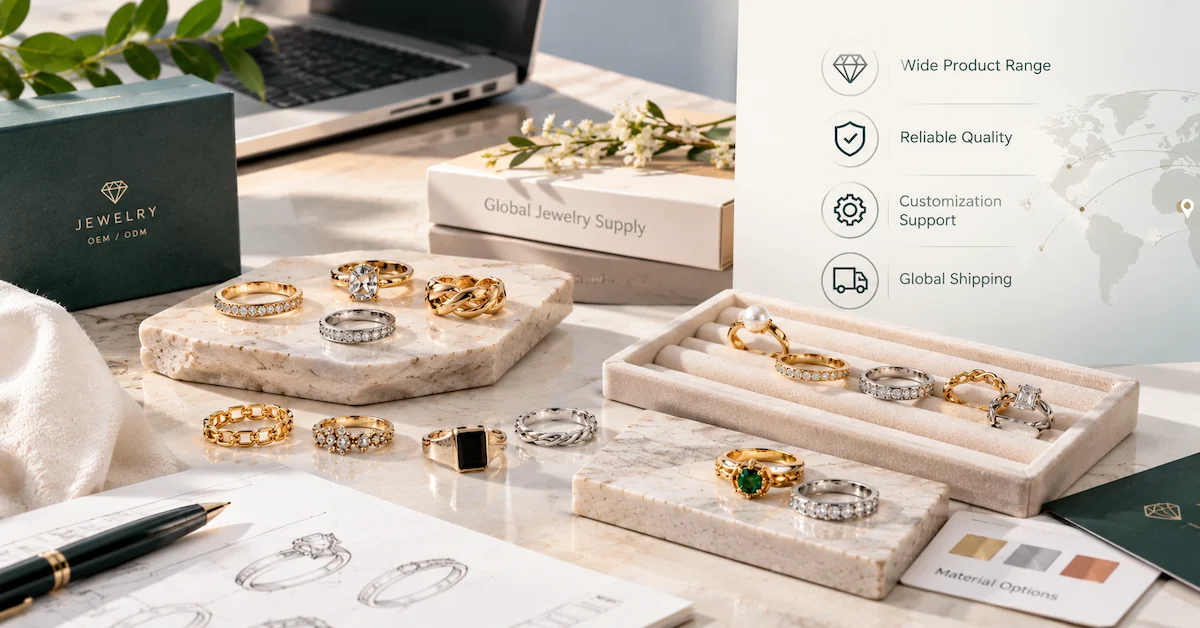
Lonceen's official customization service describes customization across plating colors, styles, materials and other specifications, while its main site presents an OEM/ODM process from sample design through production and delivery.
View Lonceen's customization service
7. Compare Suppliers Through Samples, Not Catalogs Alone
Catalogs are useful for the initial screening stage, but samples provide much more useful information.
When comparing China jewelry ring suppliers, consider requesting samples from several suppliers and comparing the same criteria.
| Sample Evaluation | What to Check |
|---|---|
| Appearance | Does the physical ring match the photos? |
| Size | Is the size accurate? |
| Comfort | Are the inner surfaces smooth? |
| Weight | Does the product feel appropriate for its price level? |
| Finishing | Is the surface even and clean? |
| Stone setting | Are stones secure and aligned? |
| Plating | Is the color consistent? |
| Packaging | Is the product protected during transport? |
| Communication | Can specifications be understood accurately? |
This creates a more practical comparison than simply asking several suppliers for their lowest price.
8. Understand the Difference Between a Ring Supplier and a Ring Factory
The terms supplier, manufacturer, factory, and trading company are sometimes used interchangeably online, but they can represent different operating models.
A supplier may:
- Manufacture products directly
- Source products from multiple factories
- Combine manufacturing and trading
- Offer ready-made products
- Coordinate OEM/ODM production
A factory may provide:
- Direct production
- Product development
- Sampling
- Manufacturing
- Finishing
- Quality inspection
- Packaging
- Export support
Neither model should be judged only by its label.
The more useful question is:
Can this company reliably deliver the ring products and specifications my business requires?
This keeps the evaluation focused on actual capability.
9. Look Beyond Unit Price When Comparing China Ring Suppliers
Price matters, but the lowest quotation does not necessarily produce the lowest total sourcing cost.
Consider the complete commercial picture:
Product price + sampling + packaging + tooling + inspection + shipping + defect risk + inventory cost
For example, a slightly higher unit price may be easier to manage if the supplier provides:
- More consistent quality
- Better packaging
- Clearer specifications
- Fewer defects
- Better communication
- More reliable production coordination
For ring collections, consistency can be particularly important because customers may purchase multiple styles from the same collection.
If plating colors, ring sizes, or surface finishing vary between production batches, the collection may look inconsistent when displayed together.
10. Build a Ring Collection Instead of Buying Isolated Products
One advantage of working with a specialized jewelry ring supplier is the ability to think in terms of collections rather than individual SKUs.
For example, a brand might create:
Core Collection
Simple bands and everyday rings.
Fashion Collection
Geometric, textured, or trend-driven designs.
Stone Collection
CZ, zircon, or natural-stone designs.
Men's Collection
Wider bands, signet-inspired shapes, and stronger visual elements.
Seasonal Collection
Limited colors, motifs, or occasion-based designs.
This structure makes product selection easier for both the supplier and the buyer.
It also allows a brand to maintain a consistent design language across multiple products.
11. Ask About Branding and Private Label Support
If you are building your own jewelry brand, ring products may need more than a customized design.
Ask whether the supplier can support:
- Logo engraving
- Product cards
- Hang tags
- Jewelry boxes
- Pouches
- Barcode labels
- Custom packaging
- Brand-specific specifications
Packaging becomes especially important when rings are sold directly to consumers.
The ring itself represents the product, while packaging contributes to the overall customer experience.
A supplier that can coordinate both can simplify communication between product development and final fulfillment.
12. Consider Whether the Supplier Can Support Future Product Expansion
Your first order may only contain rings, but your long-term product strategy may include additional categories.
This is where a broader jewelry manufacturing partner can become useful.
If a supplier already supports rings, necklaces, earrings, bracelets and pendants, it may be easier to develop coordinated collections later.
Lonceen currently lists rings together with necklaces, earrings, bracelets, pendants and other categories, and its official site states that it supports OEM/ODM production and global delivery.
View Lonceen Jewelry's product categories
This does not mean every brand needs a multi-category supplier. The key is to consider whether your sourcing strategy is likely to expand beyond rings.
China Jewelry Ring Supplier Evaluation Checklist
Before placing an order, use a simple checklist:
| Area | Questions to Ask |
|---|---|
| Product range | Does the supplier offer enough ring styles? |
| Materials | Can they work with your required materials? |
| Sizes | Can they manage your size specifications? |
| Sampling | Can you review physical samples? |
| Customization | Can they modify designs accurately? |
| Finishing | Can they maintain consistent surface quality? |
| Branding | Can they provide private-label support? |
| Production | Can they support your expected order volume? |
| Communication | Are specifications clearly understood? |
| Quality | Is inspection built into the production process? |
| Packaging | Can packaging match your brand requirements? |
| Expansion | Can the supplier support future categories? |
The objective is not to find a supplier that checks every possible box. It is to identify the supplier whose capabilities match your particular ring business model.
A Practical Way to Start Working With a China Ring Supplier
Once you have shortlisted suppliers, prepare a concise inquiry containing:
- Ring photos or design drawings
- Required material
- Ring sizes
- Plating or finish
- Stone requirements
- Estimated quantity
- Branding requirements
- Packaging requirements
- Target market
- Sample requirements
This gives the supplier enough information to respond with a meaningful quotation instead of a generic price.
For custom projects, Lonceen's current process specifically includes communication, sample design, engineering proofing, sample confirmation, production, assembly and delivery.
Contact Lonceen Jewelry for a ring sourcing inquiry
Final Thoughts
Choosing a jewelry ring supplier China is ultimately about matching supplier capabilities with the structure of your ring collection.
The key areas to evaluate are not limited to price. Product variety, materials, sizing, finishing, sampling, customization, branding, quality consistency, and future product support can all influence the success of a jewelry collection.
For brands and retailers, a supplier should be viewed as part of the product-development system rather than simply a source of individual rings.
When your requirements are clearly defined and suppliers are compared through actual samples and production capabilities, it becomes easier to build a ring collection that is consistent, commercially practical, and ready for long-term development.