

A gemstone jewelry supplier carries a responsibility that goes beyond assembling metal and stone. The stones themselves must be specified, described accurately, verified where required, and matched consistently. In colored stones especially, two items that look similar in a photo can differ in quality, treatment, and value. That makes gemstone sourcing a question of documentation and consistency, not just appearance.
This guide focuses on the stone side of sourcing: how to define what you are buying, how to read grading language, how to verify claims, and how to keep a set or a repeat order consistent. It does not cover fulfillment, packaging, or brand development; those belong to other sourcing discussions.
What Makes Gemstone Sourcing Different
Metal and findings can be specified by dimension and finish. Gemstones introduce variables that are harder to standardize:
- color and tone vary between stones
- clarity and inclusions differ even within one grade range
- treatment status affects both value and disclosure obligations
- size and calibration affect how a set looks together
- availability varies by stone, size, and quality
These variables mean a gemstone order is only as clear as its specification. Vague language such as "nice color" or "good quality" leaves room for very different results.
1. Define Stone Specifications Precisely
The most common cause of gemstone disputes is an imprecise specification. Before ordering, define the stone as clearly as possible.
Specify:
- stone type, and whether natural, lab-grown, or synthetic
- size in measurable terms—millimeters, carat, or both
- shape and cut style
- color description using a consistent reference
- clarity expectations, in terms understandable to both sides
- treatment status, if any
- quantity and whether stones must match as a set
The more precise the specification, the less room there is for a different interpretation. A specification that relies on adjectives rather than measurable terms is difficult to enforce.
2. Confirm Grading Language and Disclosure
Grading terms carry different meanings in different contexts. A supplier should be able to explain what their descriptions mean in practical terms.
Clarify:
- what grading scale or language the supplier uses
- whether descriptions are based on a recognized system or internal judgment
- how color and clarity are actually assessed
- whether treatment is disclosed, and how
- how the supplier describes stones that fall between grades
Be cautious with superlative language that is not tied to a defined standard. "Top quality" or "best color" without a measurable basis is difficult to verify and easy to dispute later.
3. Verify Certificates and Reports
Where a certificate or gemological report is offered, treat it as a document to be checked, not a badge to be trusted at face value.
Confirm:
- which laboratory issued the report
- whether the report matches the specific stone being supplied
- how you can verify the report independently
- whether the report covers treatment and origin, where relevant
- what happens if a stone does not match its stated report
A report only has value if it corresponds to the actual stone and can be verified. Two practical habits help: check the report against the stone's measurable details, and confirm the issuing laboratory is one you can independently verify. Claims about grading, treatment, and origin are factual statements that should be verifiable, not assumed.
4. Check Matching Across a Set
For pieces that use multiple stones—eternity bands, tennis bracelets, matched pairs—consistency between stones matters as much as the quality of any single stone.
Ask:
- how stones are matched for color and tone across a set
- how size and calibration are kept consistent
- whether matching is done at the supplier or left to you
- what tolerance is acceptable between stones in one piece
- how a replacement stone would be matched later
A set where stones differ noticeably in color or size undermines the finished piece, regardless of how good each stone is individually. Matching should be discussed explicitly, not assumed.
5. Understand Supply Consistency and Substitution Rules
Colored stones are rarely available in unlimited, identical quantities. Understanding how a supplier handles this prevents surprises on repeat orders.
Clarify:
- whether the same stone quality can be supplied again in the same size
- what happens when a specific stone is unavailable
- whether substitution is allowed, and who approves it
- how you are informed of a change before it is shipped
- whether matching stones can be reserved for future orders
A supplier that substitutes stones without clear approval creates inconsistency that surfaces only when the customer compares two orders. Substitution rules should be agreed in advance.
6. Confirm How Stones Are Handled During Setting
Stone quality can be affected by how stones are handled and set. A well-sourced stone can still be damaged or poorly seated.
Ask:
- how stones are inspected before setting
- how stones are protected during production
- how the supplier checks that each stone is secure after setting
- what happens if a stone is damaged during production
- how the finished piece is checked against the intended stones
This connects sourcing to production, which is why it is worth confirming even when your main concern is the stone itself. A supplier who cannot describe this process may be less reliable with valuable stones.
7. Clarify Origin, Treatment, and Compliance Claims
Statements about origin, treatment, and material are factual and, in many markets, subject to disclosure and consumer-protection rules.
Confirm:
- whether origin is verified, and how
- whether treatment is disclosed and documented
- what the supplier can support with evidence
- how you will describe the stone to your customers
- who is responsible for the accuracy of these statements
Any claim about origin, treatment, or grading must be verified against the applicable regulations for your target market before it is published or printed. This is a shared responsibility: the supplier provides accurate information, and the buyer confirms it meets the rules of the market being sold into.
8. Watch for Gemstone-Specific Risk Signals
Some concerns are particular to gemstone sourcing.
Watch for:
- specifications that rely only on adjectives
- grading claims with no defined basis
- certificates that cannot be independently verified
- reports that do not clearly match the supplied stone
- sets where stones visibly differ in color or size
- substitutions made without approval
- vague or inconsistent answers about treatment and origin
Each of these signals deserves direct clarification before an order is placed.
A Gemstone Supplier Evaluation Checklist
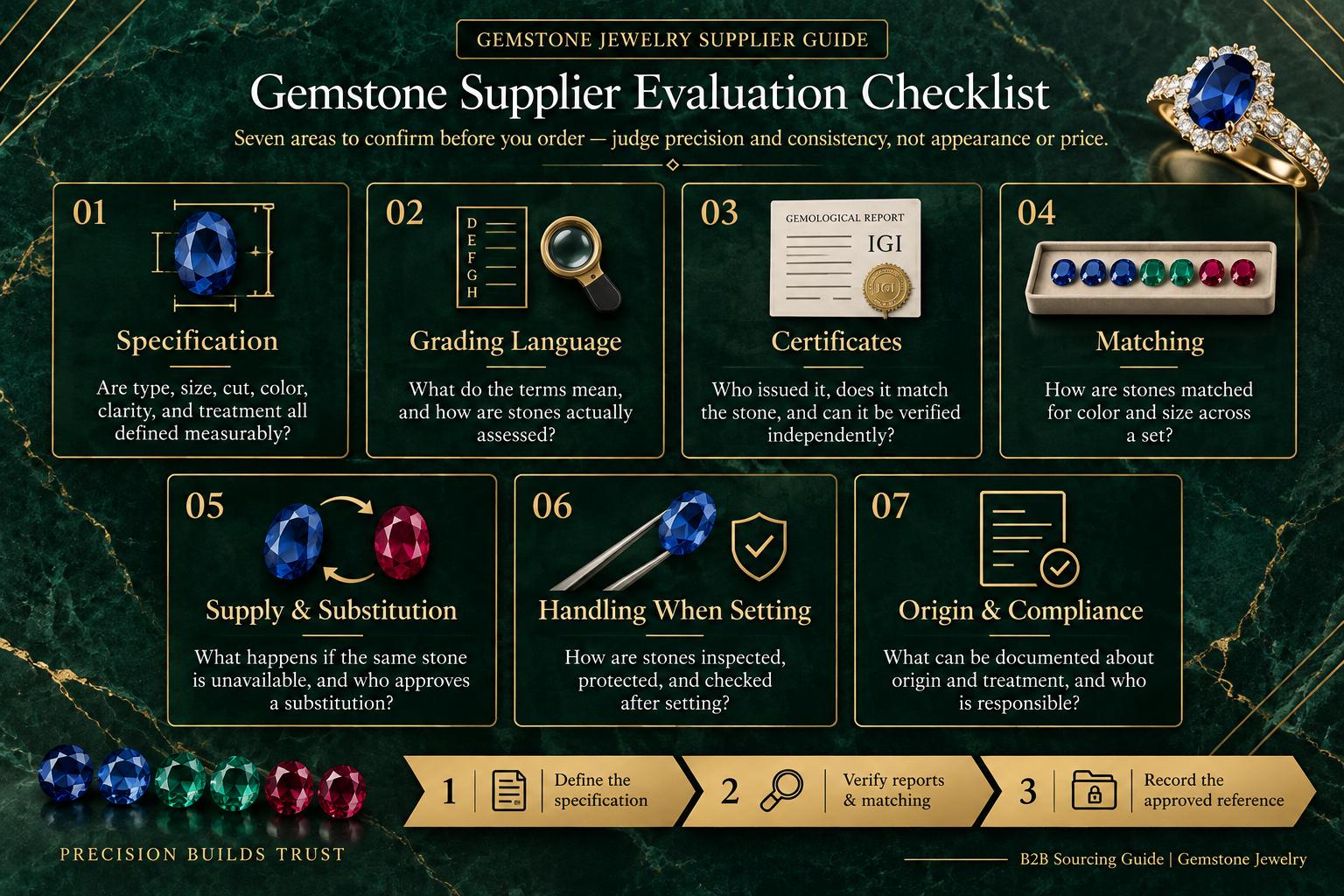
Use this to compare suppliers on specification and consistency, not only on appearance or price.
A supplier that addresses all seven areas gives you a far more reliable basis for gemstone buying than one that only presents attractive stones.
Questions Worth Asking a Gemstone Jewelry Supplier
- How exactly are these stones specified, and can you confirm size in millimeters?
- What grading language do you use, and how do you assess color and clarity?
- Which laboratory issued this report, and how can I verify it?
- How are stones matched for color and size across a set?
- What happens if the same stone is unavailable for a repeat order?
- How are stones protected and checked during setting?
- What can you document about origin and treatment?
Specific, evidence-based answers indicate a supplier that treats gemstone sourcing as a documentation task, not a sales conversation.
Conclusion
Choosing a gemstone jewelry supplier is a question of precision and verification. The appearance of a stone matters, but so does the ability to define it, describe it accurately, verify its claims, match it within a set, and supply it consistently.
Focus on precise specifications, grading language, certificate verification, set matching, substitution rules, handling during setting, and origin and treatment disclosure. Confirming these before ordering protects both the final product and the claims you make about it.
If you are preparing a gemstone order, write a measurable specification and ask the supplier to confirm it in writing, along with any certificates and matching rules. That clarity is what separates a dependable gemstone supplier from one that only looks convincing.