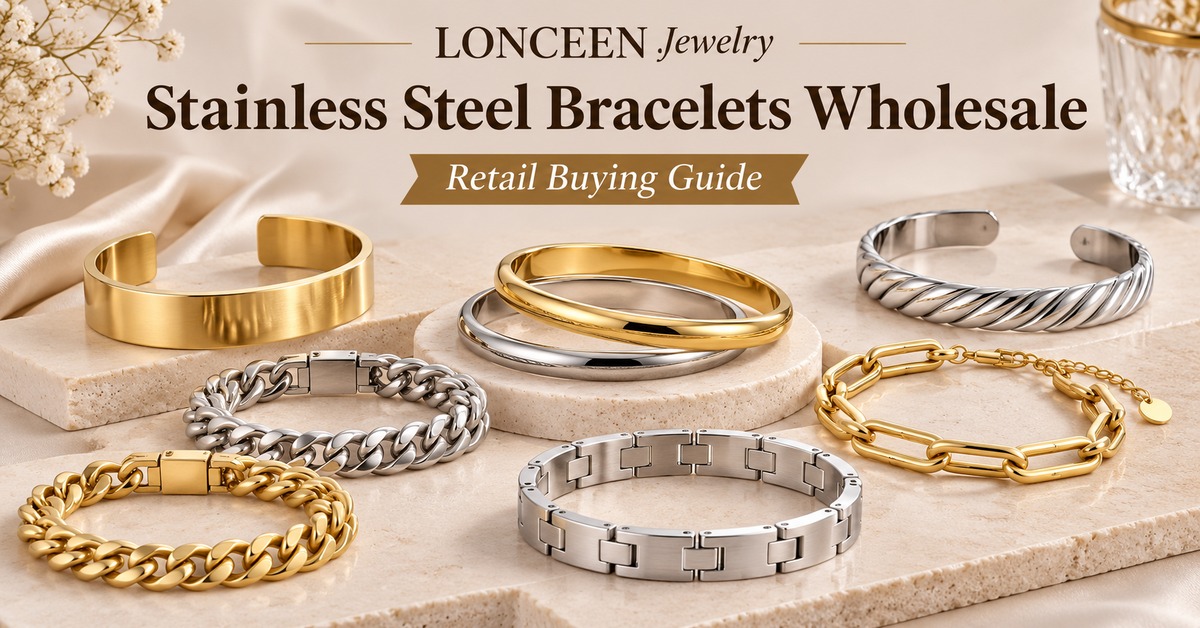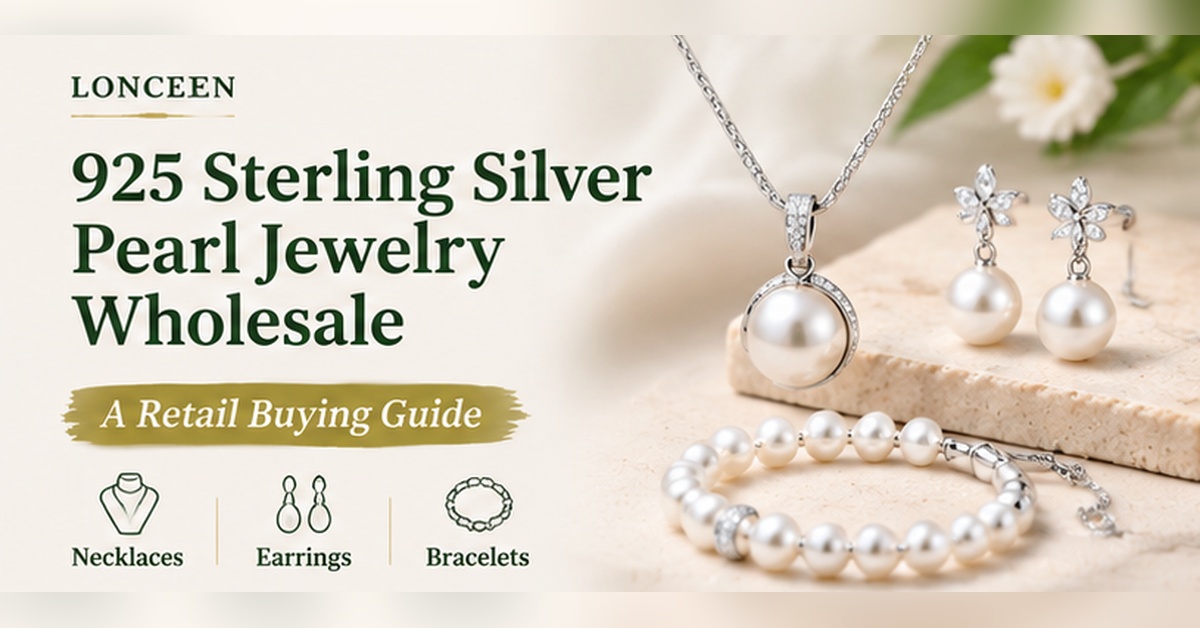


A jewelry wholesaler plays a different role from a manufacturer. The wholesaler is not primarily selling you production capability. The wholesaler is selling you availability—finished, ready-to-order inventory that you can resell. That distinction matters, because buying from a wholesaler is a merchandising decision rather than a manufacturing one.
Most sourcing guides focus on production. This one focuses on resale. It explains what a wholesaler actually provides, how to judge whether a wholesaler’s stock suits your customers, and what to confirm before ordering. It does not cover factory assessment, custom development, or OEM/ODM arrangements; those belong to production-side discussions.
What a Wholesaler Really Offers
The value of a wholesaler is not simply “products at a lower price.” Its value comes from the way it organizes inventory so that buyers can assemble a sellable selection without producing anything.
A wholesaler typically provides:
- access to a broad range of ready products
- stock availability without minimum production runs
- the ability to order in smaller and varied quantities
- faster replenishment than production lead times
- consistency in the products a retailer already sells
This is why buyers turn to a wholesaler: speed, breadth, and flexibility. Judging a wholesaler means judging how well it delivers those three things for your specific selling context.
1. Understand the Wholesaler’s Role and Limits
Before comparing wholesalers, be clear about what the relationship can and cannot do.
Ask:
- whether the wholesaler holds stock or sources on demand
- which product categories it specializes in
- whether it produces any products itself or only distributes
- what happens when stock runs out
- how the wholesaler differs from a manufacturer in your specific case
Some wholesalers are closely connected to production; others are pure distributors. This affects availability, response time, and how flexible they can be. Understanding the role prevents misunderstandings later.
2. Evaluate the Product Range Against Your Market
For a reseller, the range is the product. Whether a wholesaler suits you depends on whether its assortment fits your customers.
Consider:
- whether the styles match your existing or planned assortment
- whether the price bands align with your positioning
- whether the quality level suits your market expectations
- whether the range covers the categories your customers want
- whether there is enough variety to build a coherent selection
A wholesaler with a large range is not automatically a good fit. A smaller, focused range that matches your market can be far more useful.
3. Assess Stock Depth and Availability
A wholesaler’s core promise is availability. If items are frequently out of stock, the advantage over production disappears.
Clarify:
- how stock levels are communicated
- how often popular items go out of stock
- how quickly items are replenished
- whether availability is shown before ordering
- how you are informed when an item cannot be supplied
Practical availability is more important than catalog size. A wholesaler that reliably supplies a smaller stable range often serves resellers better than one with a wide but unstable catalog.
4. Confirm Order Flexibility
Wholesalers are often chosen for the ability to order varied quantities. Confirm what that flexibility actually looks like.
Ask:
- what the minimum order quantity is, and whether it is per order or per style
- whether mixed orders across styles are allowed
- how quantity breaks are structured
- whether single units or small quantities of a style are possible
- how assortment planning is supported
This matters most for boutiques and online sellers who need to test demand without committing to full production runs. The real value is not the lowest price, but the ability to order the mix you actually need.
5. Check Consistency for Repeat Selling
For resellers, especially online sellers, consistency across restocks is essential. A product that looks different on the second order creates listing and customer-service problems.
Confirm:
- whether the same product remains consistent across orders
- whether specifications and appearance stay stable
- how changes to a product are announced
- whether discontinued items are flagged in advance
- how often styles are replaced
Consistency is not only a quality issue; it is a merchandising one. Stable products are easier to market, photograph, and restock.
6. Understand Pricing Structure and Terms
Bulk price is only one part of the cost of buying from a wholesaler.
Clarify:
- whether pricing tiers are based on order value or quantity
- what is included in the quoted price
- how packaging is handled
- what the minimum order value is
- how shipping and fulfillment terms are set
- whether prices change frequently, and how you are notified
A low unit price can be outweighed by unfavorable terms. Comparing wholesalers on price alone often hides differences in what the buyer actually receives.
7. Consider Support for Reselling
A useful wholesaler supports selling, not just supplying. This is an area worth probing.
Ask whether the wholesaler provides:
- product information suitable for listings
- images you can use
- consistent product descriptions
- updates when products change or are discontinued
Not every wholesaler offers this, but it can meaningfully reduce the work of getting products to market, especially for online resellers building catalogs.
8. Watch for Wholesaler-Specific Risk Signals
Some concerns are characteristic of buying from a wholesaler.
Watch for:
- stock availability that is unclear until after ordering
- frequent substitution or unannounced changes
- catalog images that do not match supplied products
- unclear minimum order rules
- inconsistent product quality across an order
- items discontinued without notice
- pricing that changes without clear communication
Each of these deserves direct confirmation before you rely on a wholesaler for ongoing resale.
A Wholesaler Evaluation Checklist
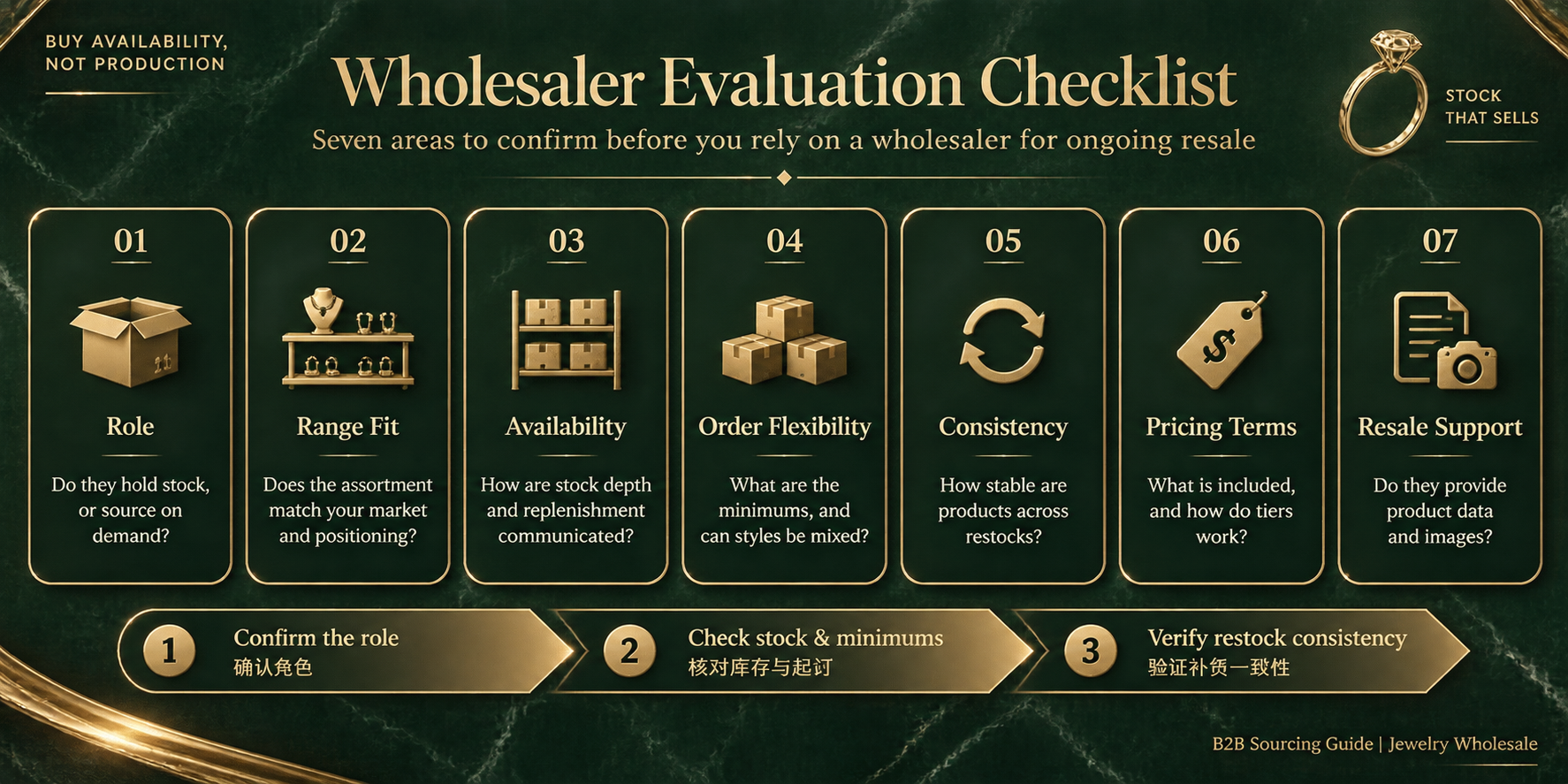
Use this to compare wholesalers on suitability for resale, not only on price.
A wholesaler that addresses all seven areas is far more useful to a reseller than one that simply offers a large catalog.
Questions Worth Asking a Jewelry Wholesaler
- Do you hold stock, or source to order?
- What is your minimum order, and is it per order or per style?
- Can I mix styles and quantities within one order?
- How do you keep products consistent across repeat orders?
- How are discontinuations and changes communicated?
- What product information and images can you provide?
- How are shipping and fulfillment terms set?
Specific, practical answers indicate a wholesaler organized around resale needs rather than one that only quotes prices.
Conclusion
Choosing a jewelry wholesaler is a merchandising decision. You are not buying production capability; you are buying availability, range, flexibility, and consistency—the things that let you resell reliably.
Focus on the wholesaler’s role, range fit, stock availability, order flexibility, restock consistency, pricing terms, and resale support. Confirming these in advance turns a convenient supply option into a dependable part of your business.
If you are preparing to buy from a wholesaler, define your assortment criteria and clarify stock and minimum rules before ordering. That clarity protects both your margins and your ability to keep products available to customers.