

A custom jewelry manufacturer is not simply a producer who accepts a sketch. The real question is whether your design can be translated into a product that is structurally sound, reproducible, and consistent with what you intended. A design may look clear as a drawing and still create production problems if the manufacturer does not interpret it correctly or cannot confirm its feasibility.
This guide focuses on design-to-production feasibility. It explains what to confirm with a custom jewelry manufacturer before development, which design details most often cause problems, and how to reduce the risk of expensive revisions later. It does not re-explain supplier selection, factory assessment, or bulk-order consistency; those are separate topics.
What Makes "Custom" Different
Custom jewelry development is a translation process. You supply intent—an idea, a sketch, a reference, or a technical drawing—and the manufacturer must turn that into something that can be built consistently.
That translation involves several decisions:
- how the design will be constructed
- which production method suits the intended look
- how small details will behave when produced
- whether the design can be repeated reliably across quantities
- what compromises, if any, are technically necessary
A custom manufacturer’s real value is not only in making the item. It is in identifying feasibility issues before development begins, when changes are still cheap.
Start with a Design Brief the Manufacturer Can Evaluate
Many custom problems begin because the input is too open. A manufacturer cannot confirm feasibility from an aesthetic idea alone.
A workable brief should include:
- the product type and intended use
- the main dimensions or scale you expect
- the base material you want
- any stones or decorative components
- the surface appearance you are aiming for
- the quantity you plan to produce
- reference images that show the intended look and any related structural details
The brief does not need to be a full technical drawing. It does need to be specific enough that the manufacturer can identify the relevant construction questions.
If you already have technical files or a CAD model, state clearly which version is the current one. Version confusion is a common and avoidable cause of development errors.
1. Confirm Structural Feasibility
Before styling details are discussed, the manufacturer should be able to explain whether the design can physically exist as intended.
Structural questions include:
- whether the thickness in key areas is realistic
- whether the form is stable and comfortable where relevant
- how components will connect or be assembled
- whether any part is likely to be too delicate for routine use
- whether the design can be produced without an unavoidable visual compromise
A design that appears elegant on paper may become too thin, too heavy, or too fragile in production. A capable custom manufacturer should surface these issues directly rather than simply agreeing and discovering them later.
2. Match the Design to a Suitable Production Method
The same appearance can sometimes be achieved in different ways, and each way affects cost, look, and consistency.
Clarify with the manufacturer:
- which production method they recommend for your design
- why that method suits the intended look and quantity
- what visual or structural differences the method creates
- whether an alternative method would change the result
- how the chosen method affects repeatability
This is not a request to learn manufacturing in depth. It is a way to understand whether the manufacturer is choosing a method that matches your design intent, not just one that is convenient for them.
3. Review CAD or Technical Files Before Sampling
Where a CAD model or technical file is involved, review it as a design document, not a formality to approve quickly.
Look at:
- overall proportions against your intent
- thickness in areas that affect durability
- how detail will be represented at the intended scale
- whether connections and fittings are clearly defined
- whether the model reflects agreements made in discussion
A CAD review is the last low-cost opportunity to catch design problems before physical samples are made. Approving a model without scrutiny pushes risk into a more expensive stage.
4. Identify Details That Do Not Scale Well
Some design elements behave differently at small sizes or in production quantities. A custom manufacturer should be able to point these out.
Common examples include:
- fine patterns that lose definition when reduced
- very small text or markings that become unclear
- delicate settings that are difficult to reproduce consistently
- thin connectors that may not hold up
- details that require unusual patience to produce at volume
If a manufacturer cannot discuss how small details will be affected, that is a sign to verify the design’s feasibility more carefully before proceeding.
5. Confirm the Sample’s Purpose and Approval Criteria
A sample has a specific job: to confirm feasibility and serve as a reference. Agreeing on what the sample must demonstrate prevents later ambiguity.
Before sampling, agree:
- which design features the sample must confirm
- what dimensions or details will be checked
- how differences from the intended design will be discussed
- what changes would trigger a new sample
- which sample becomes the accepted reference
A sample approved without a clear purpose is easy to interpret differently later. The clearer the criteria, the more useful the sample becomes.
6. Check Whether the Design Can Be Reproduced in Quantity
A custom design that works once is not automatically suited to production. Feasibility should include repeatability.
Ask:
- whether the design can be produced consistently in the planned quantity
- which details might vary more when produced in volume
- whether any element should be adjusted to support repeatability
- how the manufacturer would maintain the intended look across production
This distinction matters because a design confirmed at sample stage can still create problems at volume if repeatability was never considered. Addressing it during development is much less costly than during bulk production.
7. Understand How Design Changes Are Managed
Custom development almost always involves some revision. What matters is that changes are controlled.
Confirm:
- who provides design approval at each stage
- how a requested change is recorded
- whether a change requires a new sample or CAD revision
- how design versions are tracked
- who owns the design files and specifications
Clear change management protects the design’s integrity and avoids confusion about which version is authoritative.
This is also where design ownership should be discussed. Ownership of design files and moulds is a commercial term that must be agreed explicitly, and requirements can differ by market. Seek appropriate professional advice rather than assuming a default.
A Pre-Development Feasibility Checklist
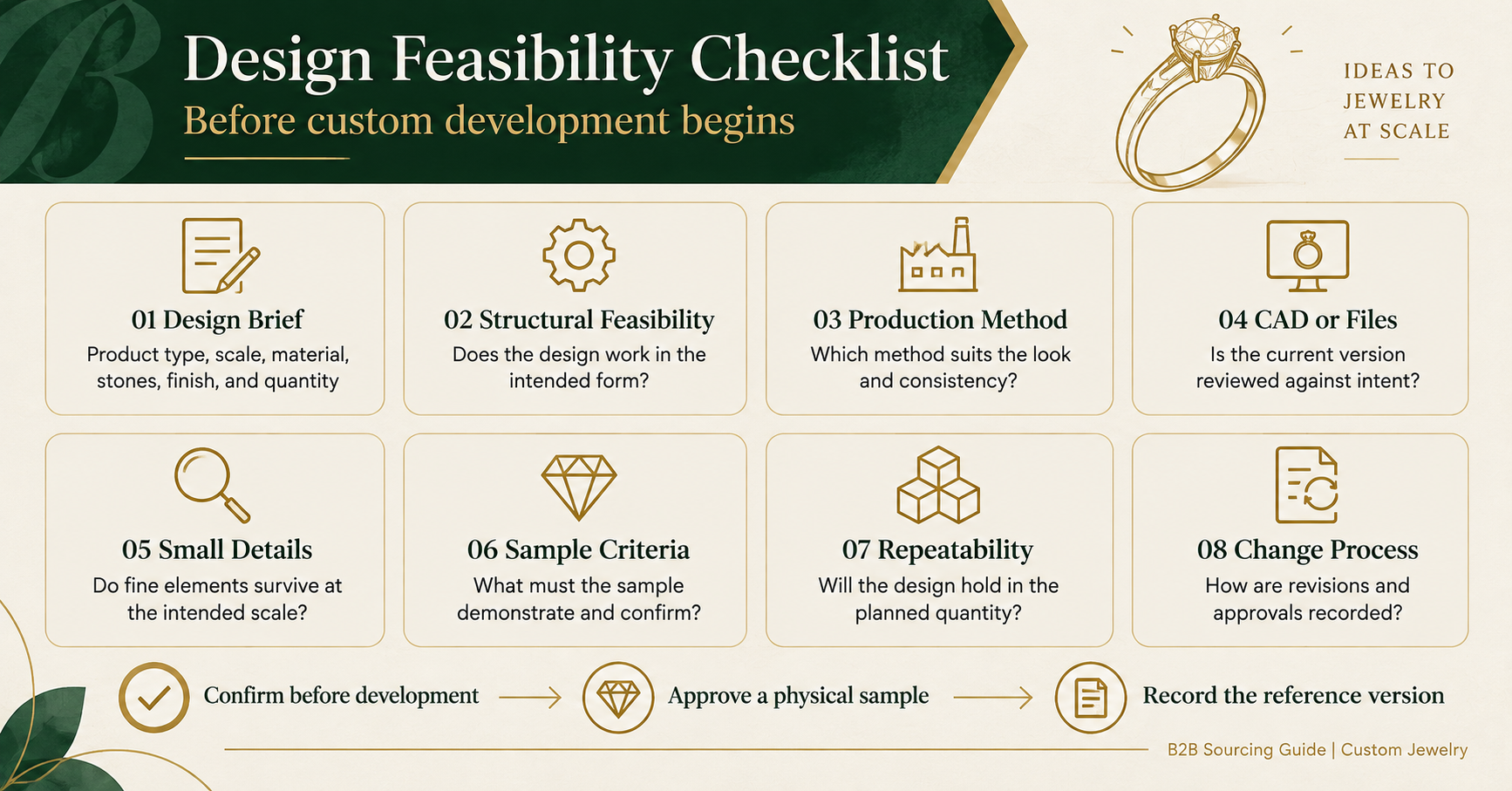
Use this to confirm the questions that matter before development starts.
A manufacturer that can address all eight areas is more likely to deliver a design that matches your intent without repeated, expensive corrections.
Questions Worth Asking a Custom Jewelry Manufacturer
These questions help reveal whether feasibility is being treated seriously:
- Can this design be produced as drawn, or are adjustments needed?
- Which production method do you recommend, and why?
- Are there details that will behave differently at the intended size?
- What will the sample confirm, and how will we judge it?
- How would you keep the design consistent across a full production run?
- How do we manage revisions and approve the final version?
- How are design files and specifications recorded?
Direct, specific answers indicate a manufacturer that thinks about how a design will be built, not only about accepting the order.
Conclusion
A custom jewelry manufacturer is most valuable when it can tell you early whether a design is feasible, what compromises may be needed, and how the design will be reproduced. The aim is not to transfer your creative decisions to the manufacturer, but to confirm that your intent can become a consistent product.
Focus on structural feasibility, production-method fit, CAD and file review, small-detail behavior, clear sample criteria, repeatability, and controlled change management. Confirming these before development begins protects both the design and the budget.
If you are preparing a custom project, write a specific design brief and ask the manufacturer to confirm feasibility and repeatability before sampling. That conversation prevents most avoidable rework later.