

An ODM jewelry manufacturer offers something different from a custom or pure OEM partner: a ready design that you can select, adapt, and sell under your brand. That sounds convenient, and it can significantly shorten the path from idea to product. But it also creates a distinct set of decisions that buyers often overlook.
When the manufacturer owns the design, the buyer’s questions shift. It is no longer only “Can this be made?” or “Will it be made exactly as specified?” The more important questions become: Which designs are actually worth selecting? How much can I adapt them? And who controls the design once it is in my range?
This guide focuses on selecting and adapting ODM designs. It does not cover design feasibility from scratch, technical execution of your own drawings, or branding and packaging; those belong to other sourcing discussions.
What Makes ODM Different
In ODM, the manufacturer develops designs and offers them to multiple buyers, who then select and adapt what fits their market.
This changes the starting point of the conversation:
For the ODM buyer, the work is curatorial and commercial as much as technical. You are choosing from an existing pool, deciding what to adapt, and judging whether the result fits your customers.
1. Understand How the Design Library Is Organized
A manufacturer’s ODM range is not a random catalog. Understanding how it is structured helps you select more intelligently.
Ask:
- how the range is organized—by collection, material, price band, or style
- which designs are current and which are being phased out
- which designs are widely offered versus more distinctive
- whether designs vary by material or finish within the same style
- how often new designs are added
This context matters because selection quality depends on knowing what you are choosing from. A buyer who understands the structure of the range can build a more coherent collection rather than picking isolated items.
2. Assess Whether a Design Suits Your Market
The central ODM risk is choosing a design that works as a product but not for your customers. Suitability is a market question, not only a design question.
Consider:
- whether the style fits your existing assortment
- whether the price band matches your positioning
- whether the material and finish are appropriate for your market
- whether the design addresses a real customer need or trend
- whether the item is likely to sell once, or support repeat demand
A design that looks attractive in isolation may not fit a range. Selection should be guided by your market and merchandising plan, not by the appeal of individual pieces.
3. Confirm How Much Adaptation Is Possible
ODM does not mean you must accept a design exactly as offered. Most manufacturers allow some adaptation. The key is knowing the boundaries and the cost.
Clarify:
- which elements can be changed—material, size, finish, stones, findings
- which elements cannot be changed without becoming a new development
- how far an adaptation can go before it counts as custom work
- whether a modified design is still considered part of the ODM range
- how adaptation affects minimum quantities and timeline
Understanding this boundary prevents two common mistakes: assuming you can change anything, or accepting a design that does not quite fit when a small adaptation would solve it.
4. Clarify Design Ownership and Exclusivity
This is the most important commercial question in ODM, and the one buyers most often leave vague.
Because the manufacturer owns the design, other buyers may be able to select the same or similar items. Clarity here protects your positioning.
Establish:
- who owns the original design
- whether the design can be offered to other buyers
- whether any exclusivity is available, and on what terms
- whether adapted versions create any ownership or protection
- whether your brand marking affects how the design can be shared
These are commercial and legal terms that must be agreed explicitly. Requirements differ by market, so it is worth seeking appropriate professional advice rather than assuming a default. Do not rely on informal reassurance; confirm exclusivity and ownership in writing.
5. Understand the Difference Between a Variant and a New Design
ODM ranges often include variations of a base design. Knowing whether an item is a variant or effectively a new design affects cost, ownership, and expectations.
Ask:
- whether a requested change is treated as a variant or a new development
- how a variant is priced compared with a full development
- whether a variant inherits the ownership terms of the original design
- how many variations are practical within the same base design
Clear answers help you plan a coherent range without drifting unintentionally into custom development costs.
6. Check Sample and Reference Clarity
Even for an existing design, buyers need a clear reference before ordering. A catalog image is not a specification.
Confirm:
- which sample or reference represents the approved version
- how the reference reflects any agreed adaptation
- how differences between a catalog image and the physical item are handled
- how the reference is retained for repeat orders
A clear reference protects both sides and reduces the chance that a later order drifts from what was approved.
7. Plan for Repeatability Across the Range
ODM ranges are often built to be repeated. That is part of the value, especially for e-commerce sellers who need consistent restocking.
Ask:
- whether selected designs remain available for repeat orders
- how availability is communicated when a design changes
- whether adapted versions are recorded for future orders
- how consistency is maintained across repeat runs
A range that cannot be restocked consistently creates problems later, particularly for online sellers whose listings depend on stable products.
8. Watch for ODM-Specific Risk Signals
Some concerns are particular to ODM selection.
Watch for:
- unclear answers about whether a design is offered to others
- exclusive claims that cannot be confirmed in writing
- catalog images that do not match the physical product
- unclear boundaries between adaptation and custom development
- frequent changes to the available range without notice
- vague statements about repeat availability
These signals deserve direct clarification before an order is placed.
An ODM Selection Checklist
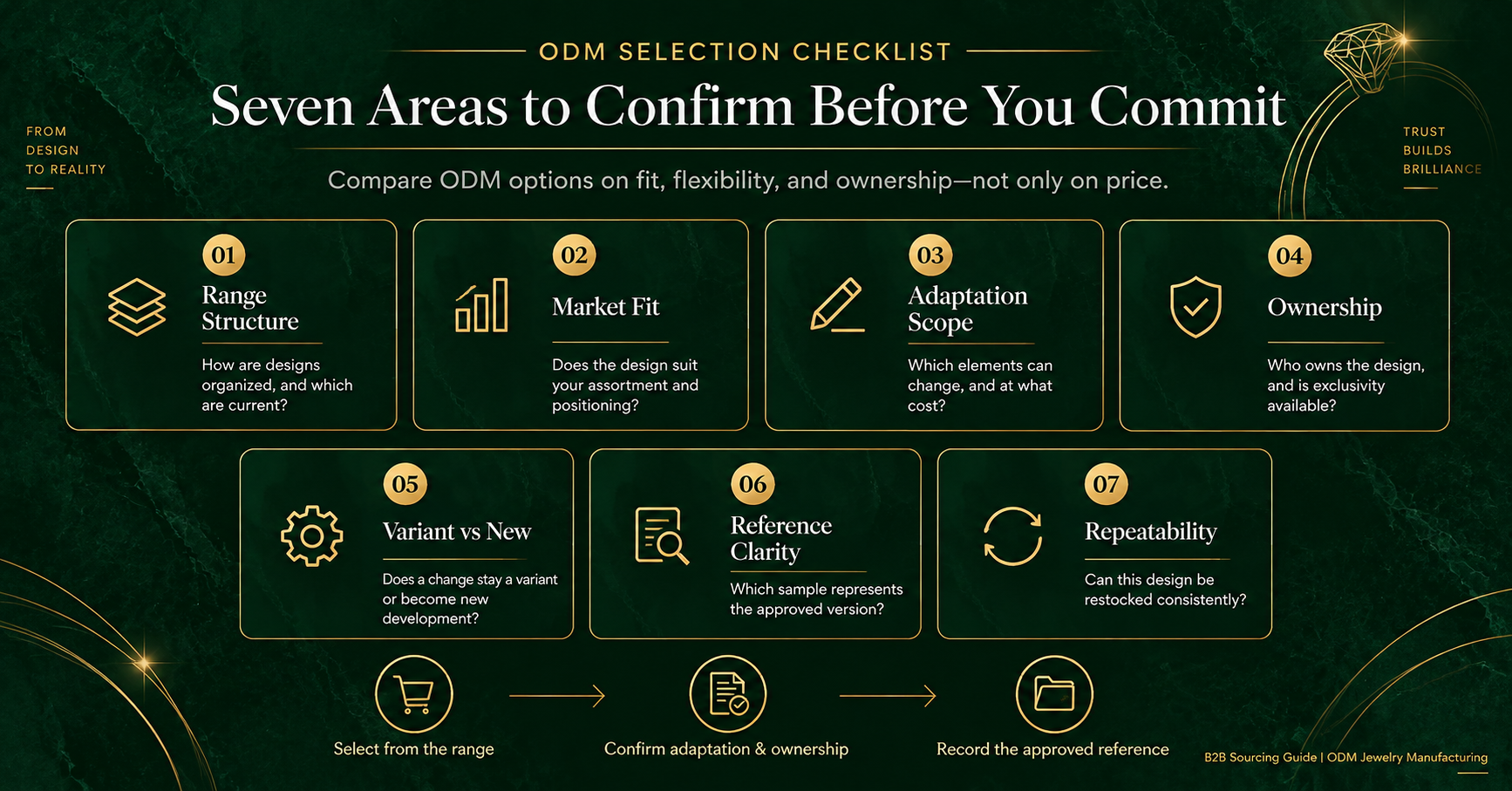
Use this to compare ODM options on fit, flexibility, and ownership, not only on price.
A manufacturer that addresses all seven areas gives you a more dependable basis for building a range than one that only presents attractive designs.
Questions Worth Asking an ODM Jewelry Manufacturer
- How is your design range organized, and how current is it?
- Can this design be adapted, and how far before it becomes custom work?
- Who owns the design, and can it be offered to other buyers?
- Is any exclusivity possible, and on what terms?
- How do you treat a variant versus a new development?
- Which sample represents the version I would be ordering?
- Can this design be reordered consistently in the future?
Specific answers indicate a manufacturer that understands the commercial side of ODM, not just the design side.
Conclusion
Working with an ODM jewelry manufacturer is a selection and positioning decision. Because the design comes from the manufacturer, your priorities are understanding the range, judging market fit, confirming how far you can adapt, and—most importantly—clarifying ownership and exclusivity before committing.
Focus on the design library, market suitability, adaptation limits, ownership terms, the variant-versus-new distinction, reference clarity, and repeatability. Confirming these turns a convenient shortcut into a reliable part of your product strategy.
If you are preparing to build a range from ODM designs, define your selection criteria and confirm ownership and exclusivity in writing. That clarity protects both your positioning and your ability to restock with confidence.